
An ongoing dialogue on HIV/AIDS, infectious diseases,
July 1st, 2018
Why Do Our Patients Think They Have Spider Bites?
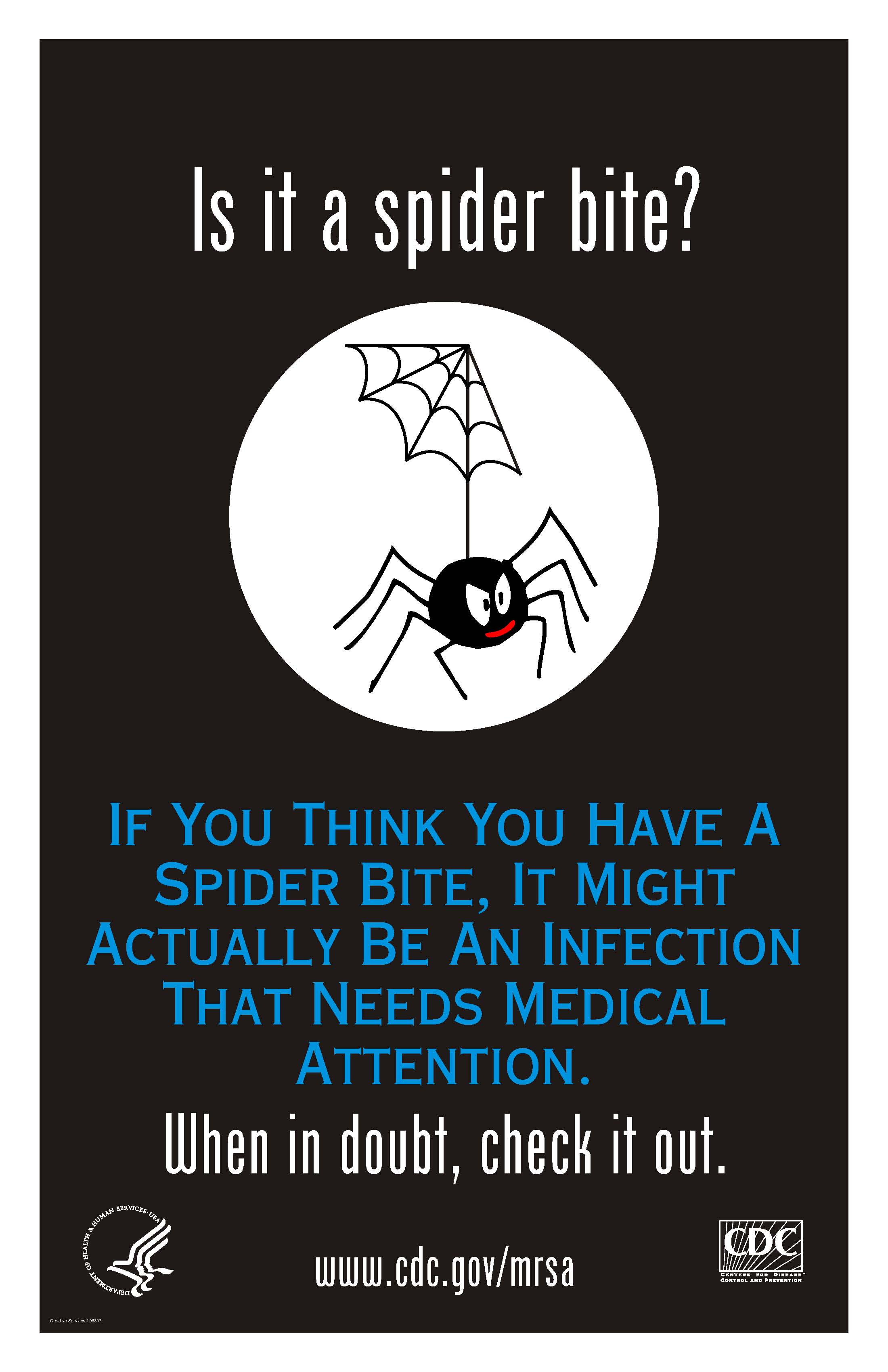
www.cdc.gov/mrsa
We are currently in peak tick season here in the Northeastern United States.
It might be hard for clinicians elsewhere to understand just how profoundly this changes our assessment of fevers and rashes. But consider this — ordering the trio of Lyme antibody, Anaplasma PCR, and Babesia PCR is as much a part of the routine diagnostic evaluation of the febrile adult in the summertime as ordering an influenza swab in the winter.
So it was with some amusement that I received the following email from a patient recently who had just been hiking in New Hampshire (some details changed as always for confidentiality reasons):
Hi Dr. Sax,
Just got back from a 2-night camping trip, and think I might have gotten a spider bite [emphasis mine] behind my left knee. There’s a dark area in the center, and a red rash spreading around it — no bull’s eye.
Anything I should do?
Gerry
He included in this email a photo of the rash, which was pretty classic for erythema migrans, the tell-tale rash of Lyme Disease.
In fact, everything about his story was consistent with Lyme, including the time of year, the recreational activity (remember, hike in the center of the trail, folks!), the location of the rash (popliteal fossa is a favorite site for tick bites), and even it’s appearance — many erythema migrans rashes lack central clearing. It’s a common misconception that all Lyme rashes must be have a “bull’s eye.”
But for today, let me just focus on one piece of Gerry’s clinical history that defies explanation:
I think I might have gotten a spider bite.
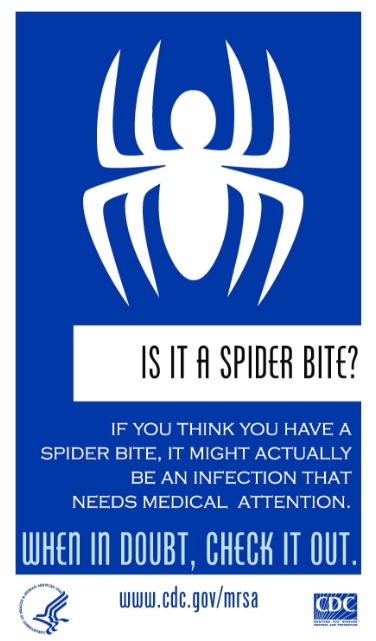 I’ve never understood this mass psychosis. We first noted it when community-acquired MRSA spiked in the early 2000s. A shockingly high proportion of people seeking attention for their boils, furuncles, and skin abscesses mistakenly attributed them to spider bites.
It got so bad that the CDC issued special graphics, suitable for framing, two of which grace this post.
“When in doubt — check it out.” Clever. While these graphics may lack some of the artful touches of wartime posters warning about sexually transmitted infections, they nonetheless have a blunt and direct appeal.
In reality, spider bites are quite rare:
Spiders tend to avoid people, and have no reason to bite humans because they aren’t bloodsuckers and don’t feed on humans … In North America, there are only two groups of spiders that are medically important: the widow group (which includes black widows) and the recluse group (brown recluses).
Entomologists say that spiders as a rule are fearful of humans — makes sense, we’re much bigger than they are! They only bite when surprised, or trapped.
Which leaves us with this mystery — why do our patients so often think they have a spider bite? It’s a mystery to me.
But perhaps you, smart readers of this ID blog, might have an idea?
42 Responses to “Why Do Our Patients Think They Have Spider Bites?”

Paul E. Sax, MD
Associate Editor
NEJM Clinician
Biography | Disclosures & Summaries
Learn more about HIV and ID Observations.
People have fear about things they know or imagine that are danger. Lay people don’t know about diseases related do ticks or other small bugs. The great majority of people have fear or panic about spiders and imagine that an unrecognized bite may be related to a spider attack. I think that’s the reason.
Agree … but why spiders? Why not some other creature? Plenty of bugs and creepy things out there to choose from.
Mosquitoes bring malaria, dengue, etc.
Ticks bring Lyme (and etc and etc).
Mites bring scabies (sometime from Norway).
Flies bring fariasis.
Worms are too cute and are good for fishing.
Lady bugs are pretty.
….
The spider needs to have its day, too!
Quite poetic, Monica!
Understood.
Hi Paul, i beleive it is a matter of psicological phobia. Spyders, snakes, worms all of them have been portraited in horror movies (remember arachnophobia) as dangerous creatures. There is perhaps a collective and unconscious bias to them. It seems to be universal. In Argentina I see the same in my practice. Thank you for your comments. Carlos
Movies:
Cat Women of the Moon (1954) (a.k.a. Rocket to the Moon)
Tarantula (1955)
World Without End (1956)
The Incredible Shrinking Man (1957)
Missile to the Moon (1958)
Earth vs. The Spider (1958 & MST3K)
The Lost World (1960)
Valley of the Dragons (1961)
Horrors of Spider Island (1962)
One Million Years B.C. (1966)
Kiss of the Tarantula (1972)
The Giant Spider Invasion (1975)
Kingdom of the Spiders (1977)
Planet of Dinosaurs (1978)
Galaxy of the Dinosaurs (1978)
Arachnophobia (1990)
Spiders (2000)
Arachnid (2001)
Spiders 2: Breeding Ground (2001)
Eight Legged Freaks (2002)
Webs (2003)
SpiderBabe (2003)
Ice Spiders (2007)
Lots of our patients report being bitten on the cubital fossa by the MRSA-spider; I’m not sure if this is a described species yet.
Perhaps is because spiders, like rats, snakes, scorpions, fox, wolfs and hyenas have a very dubious fame or reputation among human beings. They are the “bad guys” living in the old collective memory of humanity. From the dawn of the times. Perhaps.
The MRSA spider species biting the antecubital fossa has been identified in the renowed medical journal ‘gomerblog’ . The spider is called Cujo.
I suggest you google Cujo the MRSA spider for more info.
I’m a pediatrician, not now practicing. I now do ADHD and Executive Function coaching.
People likely fear, having heard about or seen pictures, of venomous spiders which can be serious – to wit this (albeit 1996) CDC report.
https://www.cdc.gov/mmwr/preview/mmwrhtml/00042059.htm .
You note spiders won’t bite unless trapped. They like to hide in dark, warm places, crevices and such so bed covers can attract them. Once the human climbs into bed with them and they are trapped, might they be induced to bite? Of course the mouth parts on most house spiders are too small to inflict a bite and for some situations, bedbugs are a more likely explanation, or possibly a mosquito bite?
John
I’m a veterinarian and my clients also think their dogs are being bitten by spiders. They are very aware of ticks and fleas since they often have their pets on preventative products. Sensible people live in fear of spiders. Fleas and ticks, not as much. Always better to assume the thing you most fear.
The majority of the time the lesions are from flea and tick bites.
That’s funny, I brought my dog to the vet when her (the dog’s) face suddenly swelled up, and the vet said it might have been a “spider bite”!
Now that’s funny. I think the vet really thought, “I have no idea what happened to your dog, but I’ll say the one thing you’ll believe without questioning…”
ticks are arachnids so he maybe he is a taxonomist.
Hospitalist here. Pretty sure I saw a brown recluse bite 20 years ago but the spider wasn’t seen. I’ve seen probably several hundred of the wicked ‘MRSA-spider’ bites. And occasionally I see the diagnosis perpetuated in a colleague’s reports, usually another hospitalist or an ER doc, but recently including one ID doc.
No idea why, except as stated, mass hysteria.
Sometimes it’s because we really have been bitten by spiders… they like dark holes, such as can be found in that pair of jeans lying crumpled on the floor. When you pick up the jeans and put them on, the spider can’t escape, so it panics and bites you.
This is from personal experience and I can tell you how to distinguish a spider bite from anything else, except a very small vampire bite; there are two holes.
Dr. Sax, Good morning. Snakes are mostly gone from the surroundings, same as scorpions except in the SW USA. Because of the presence of mostly nocturnal flying insects and some plantings with firm and log leaves,lighting and windows, spider and its nets are omnipresent and like with the sin papeles there is a shade of suspicion (unfunded) in the public in general. Small bite marks that itch are dismissed, One larger redder or slightly darker bite mark immediately raises the alarm level and here you have your (from the public) answer: a Spider did it! . Same lore as in this Country, has been present in Central, South America and for what I know in the South of Europe and for many centuries and there are folk songs and people tales that propagate and maintain the prevention against mostly beautiful and helpful insects. Maybe if periodical Competitions of photographs of Spiders’s nets can slowly, cure us of this wrong feeling. Note that I am not calling for Spiders’s Photographs, because differents from their nets, they don’t look any reassuring except to the persons that know about them.
Lot of “spider bites” in prison where I work. Inmates want it to be our fault there are bugs.
I would say it is because of phobias of spiders being engrained in so many people; the fequency of people mentioning spiders may be just a learned first thought reaction to any unaccountable bite that is worse than a mosquito bite.
Who’s seen any children’s shows featuring lovable, oversize, cuddly, or happy-go-lucky spiders? “Charlotte’s Web” has nothing on “Arachnophobia”….
Our stewardship group sent out a blurb on this just last week, after a MRSA infection was described as a ‘classic spider bite’ to a patient by an ED doc. This link from our natural history museum talks mentions this being an issue even at the turn of the last century, which is fun: http://www.burkemuseum.org/blog/myth-spiders-bite-sleeping-persons
There seems to be a hierarchy of what symptoms get attributed to causes, most of the time an infection is a more palatable cause of nonspecific fatigue etc., however a spider bite is more palatable than a staph infection. State or regional health departments often have good information on what venomous spiders actually live in the area, which we’ve found useful in dispelling some bite myths; here’s ours https://www.doh.wa.gov/CommunityandEnvironment/Pests/Spiders
Not mentioned – the Black Tar spider commonly associated with MRSA infections in the ED, courtesy of an excellent ED pharmacist.
Dear Dr Sax,
I do not know why there is what you described as a ‘mass psychosis’ concerning spider bites? What concerns me far more is the fact that doctors summarily dismiss patients who actually have bona fide venomous spider bites. I received a package a while back that contained brown recluse spider(s) – they love hiding in cardboard boxes – and I was bitten 3 times over the following months. I saw the spiders, they were brown recluse, and the bites were unmistakably theirs. The immediate pain was severe enough and spreading rapidly enough that they sent me running for oral steroids, and antihistamines, with topical ice and baking soda, (and then eventually brown recluse kit for immediate first aid to try to remove the venom). None of my doctors believed me, even when my hand swelled to twice its size, despite immediate large dose steroids and antihistamines, and the 3rd bite on my ankle became a relentlessly expanding 3x5cm necrotizing ulcer, because some PCP insisted “no steroids, it wasn’t a brown recluse bite”. I am a veterinarian, I have seen brown recluse bites in animals and repeatedly on myself. PLEASE tell your colleagues that a blanket denial of venomous spider bites, is a serious danger to those patients who actually have them!
It’s true in California there are a not unheard of number of brown recluse spider bites. And too, our semi – arid climate has seasons and one of them , the autumn, really is spider season, when they seem to come in from the cold. Brown Recluse spiders like woodpiles, garages, crawlspaces. And so yes I have seen them , but I also agree that humans fetishize spiders and have some hysteria around it. Also: they don’t know that bacteria live on the skin and so they don’t give much credence to that. I was shocked about 20 years ago to see “MRSA” used in a headline in a British newspaper. I thought’ ‘gee , regular people in the UK know what MRSA is?” SO, obviously, now Americans have caught up but still, I find myself explaining all het time about bacteria being ubiquitous.
When I was training, I had an attending tell me that it wasn’t a spider bite…unless you actually saw the spider. That was one question we could usually ask patients to determine how likely their “spider bite” actually was. For the most part though it did turn out to be Staph when we could get positive cultures.
Because spiders themselves are COMMON. If it’s not behaving like a mosquito bite, what other common thing have we seen around the house? Spiders.
Not sure why someone out in the *woods* wouldn’t think “tick!” – that does seem a little nutty. But I suppose even out in the woods people are more likely to SEE spiders than ticks.
I think it’s a combination of the irrational fear of spiders many of us share, and their ubiquity. (Ever shine a headlight in the grass at night and see all the twinkling pairs of eyes looking at you?)
When I was a resident on a night float rotation, my wife woke me once by screaming through the window because a spider was jumping around the door and she couldn’t get into the house for fear of it…
Why do I believe that spiders bite?
They are carnivorous and we are meat.
They become defensive quite easily.
They have teeth.
Besides my husband, they are the only creature in bed with me when I find a bite in the morning.
My husband has been bit by black widows, more than once. He has a very large scar on his face from a necrotizing bite that his doctor ignored. It is remarkable to me, in this day and age, to believe that there is so little interaction between humans and the creatures that they cohabitation with.
Dr. Roby’s post Is quite upsetting. That is a great deal of suffering.
What they are not telling you is telling: They are behind on their housekeeping -perhaps because they like to go hiking on weekends – and the vermin have been moving in.
As an NP, I have seen many patients present with alleged spider bites that all, upon examination, lacked diagnostic criteria for spider bites. Many, I believe we’re infected (self) injection sites.
Hey everyone, thanks for your interesting comments!
Hope to clarify that I am aware some spider bites are very serious, rare though they may be. But as the linked published study above shows, the overwhelming majority of reported “spider bites” are something else entirely! That was the motivation behind the CDC campaign (and this post).
Paul
It most likely is visual correlation with what they see in their house. Almost everyone has seen that random spider that was not in the middle of the wall 2 sec ago, in the shower or the fear inducing crawl across your face at night. Next thing is a red, warm, swollen pustule. It must be a spider. What else could it be?
Curious, here in Western Europe (Belgium), this spider psychosis is completely inexistent … but everybody thinks he has Lyme disease without any “bite” history.
Lack of information and awareness, and similarities in pain and other sensations of spider biting with other biological or physical causes during farming and open air activities had caused the insufficient noticing and collection of them.
The most common reason my patients tell me they think their EM rash or cutaneous abscess is a spider bite…their PCP or ER provider told them it was a spider bite. My last referral from a general internist that ended up being EM was for “evaluation and treatment of black widow spider bite.” in upstate NY!
Why do practitioners routinely dismiss the possibility of spider bite? When I had a “spider bite” on my neck after gardening and carrying away brush, the site was initially extremely itchy, moreso than a mosquito bite, then developed enduration and pustule. I went to an FP who diagnosed “probably an ingrown hair” and prescribed an antibiotic. I am a fair skinned female; I don’t have any hair more than a soft down on my neck, and certainly don’t shave which may induce ingrown hairs. I received the antibiotic I needed, so did not make a big deal of it with the MD, but honestly! Often patients DO know what they are talking about. At least consider what your patient has to say!!
I constantly fight this battle with patients, but more often with my coworkers. The number of “spider bite” diagnoses that end up in a medical record floors me. Doctors are not entomologists, and often severely overestimate the likelihood of a spider bite. Most don’t know there are diagnostic criteria for bites (like seeing the spider!) and many don’t know what a recluse bite would truly look like. I meet people all the time who had a diagnosed bite, and their story is shared with friends and family members. Everyone has a friend who had a severe “spider bite”, even in areas where brown recluse are not known to exist. I try to combat this with education, but there’s only so much I can do. Others have published reports about the percentage of misdiagnoses in cases originally labelled as spider bites (94% was one statistic from a hospital near me). Our local public health office is issuing reports for physicians to try and turn their differential from spiders to MRSA. Of course, I’m a huge spider fan, and an amateur entomologist, so I have some significant biases here.
Excellent Dr. Sax !!!
I agree with you! I don´t understand why people AND colleagues think so easy in spider bites !!! , but like Carlos said at the beggining of the replies, here in Argentina is very common to receive patients saying they were bitten by an spider…or professionals who think that!
Thanks !
Tomás
I have wondered this so often myself! Down here more South where tick diseases are less common, report of a ‘spider bite’ probably has positive predictive value for MRSA. I think it is because there is a vague sense that a spider bite would cause an inflammatory bump. They know it is not mosquito and have heard that spider bites in particular can be more inflammatory plus it is a common insect that you could easily believe you had been in contact with. And I guess MRSA still just isn’t as immersed in the public conscious yet. MRSA bite!
You are providing a valuable information about HIV/AIDS thanks
Avid gardener here! I get bit by all manner of things *all* the time. While I sometimes know what bit me I don’t always. Lots of ant bites, one european hornet (that was nasty!) and the occasional spider. So yes I have definitely been bitten by a spider. Unfortunately at this moment I have two unID’d bites that are possibly spider bites (I didn’t actually see the spider this time) For myself, whenever I get bit there is some nervousness about what it is, if I am allergic, if it will get infected (I have had two bites get infected requiring antibiotics), if it is indeed the brown recluse that’s going to rot my flesh (not unimaginable in my case). Just giving you this layperson’s perspective, what goes through my mind, etc. I do think doctors are often slow to believe patients, to their detriment. Fact is, I am often poking around where the creepy crawlies like to be too!
Maybe because although maybe rare, it does happen. I’m dealing with a spider bite, confirmed by 2 vets, in which she needs surgery with 3 antibiotics and an anti-inflammatory/pain med and needs surgery. I’ve personally dealt with ticks, so I knew this was very different, but that just comes with experience….. I grew up in a house on a large lot of land that also had woods.