
November 20th, 2014
Intention to Tweet: Does Social Media Exposure Matter for Journal Articles?
John Ryan, MD
Journals increasingly use social media to share medical information. After original research is published, the social media attention it receives correlates with how often it is cited. But does such attention enhance a journal article’s overall impact?
To address this question, my fellow researchers and I randomly assigned 243 consecutive original research articles published in Circulation during the past year to a “social media exposure” arm or a control arm. (Articles that had simultaneous press releases, AHA presentations, or Author profiles were excluded.)
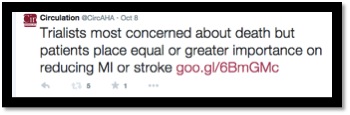
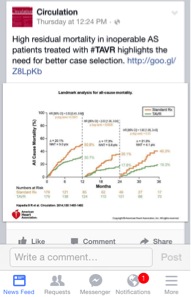
On the day of publication, we tweeted about articles in the social media arm on the official Circulation Twitter page (@CircAHA) and the official Circulation Facebook page. Articles in the control arm received no formal, journal-based social media exposure. Here are examples of a tweet and a Facebook post that we have published during the past year:
With respect to the primary endpoint — article page views within 30 days — articles in the two arms showed no significant difference (median, 409 for social media exposure vs. 392 for control; P=0.80). Among basic science articles, social media exposure showed a trend toward greater page views, but the study was not powered or designed to detect a significant difference.
We think this social media strategy did not affect page views for three reasons:
- Researchers who are interested in articles in Circulation may already be inclined to read them on the journal’s website and not rely on social media to learn about journal articles.
- Cardiology still occupies a minute space on Twitter, where 350 million tweets are posted daily.
- Most Twitter and Facebook users access social media on their phones. In that setting, simply seeing a headline on a newsfeed may suffice, rather than accessing entire papers on the handheld device. Plus, Circulation followers may find our post and the key figure we provide to be enough to satisfy their interest.
According to our work, a social media strategy for Circulation did not increase the number of times an article is viewed. Further research is needed to help us understand and quantify the effect of social media on the reach of published cardiovascular research.
Note: Comments on this news story are closed, but please join the discussion about this topic over at Larry Husten’s discussion of the challenges those in traditional medicine have when using social media to promote research.
2 Responses to “Intention to Tweet: Does Social Media Exposure Matter for Journal Articles?”
 NEJM — Recent Cardiology Articles
- Digital Twin–Guided Ablation for Ventricular Tachycardia April 2, 2026In a 10-patient feasibility study, heart digital twins were used to guide VT ablation. Afterward, VT was noninducible in all patients; at a mean follow-up of 13 months, 8 patients were free of recurrence, without drug therapy.
- Discontinuation of Beta-Blocker Therapy after Myocardial Infarction April 2, 2026Among patients with a preserved ejection fraction at least 1 year after myocardial infarction, stopping beta-blockers was noninferior to continuing therapy with respect to major clinical outcomes.
- Simulating and Teaching the Physiology of Pulsus Paradoxus April 2, 2026In a simulation involving 15 healthy trainees, slowing respiration to 10 seconds per breath produced pulsus measurements exceeding 20 mm Hg, enabling improved teaching simulation and understanding of underlying physiology.
- The Age Illusion — Limitations of Chronologic Age in Medicine April 2, 2026Chronologic age plays an outsized role in various aspects of medicine. Yet people of the same age can differ dramatically when it comes to aging-related risk factors.
- Left Atrial Appendage Closure — Another Overused Method in Cardiology? April 2, 2026Untreated atrial fibrillation carries an approximately 3 to 5% annual risk of ischemic stroke. Long-term oral anticoagulation therapy decreases this risk to 1.7% with warfarin and to 1.5% with edoxaban, as shown in the ENGAGE AF-TIMI 48 (Effective Anticoagulation with Factor Xa Next Generation in Atrial Fibrillation–Thrombolysis in Myocardial Infarction...
- Digital Twin–Guided Ablation for Ventricular Tachycardia April 2, 2026
JR, this is a great and provocative study! Some thoughts…
– Does clicking on the link take you to the article, or do you have to go through a complicated signing in process?
– Could this be a failure of how Circulation is advertising the papers? Simply tweeting something or posting on facebook might not be enough. Do the people doing the facebooking/tweeting have a background in marketing? What if it was tweeted by someone in science who has a following?
– What are the other predictors of what gets circulation papers read? Is the journal not publishing enough papers that might be interesting to the reader?
Thanks Tariq for the feedback. Regarding your questions:
– clicking on the link does take you to the article (at least when you are within a University that has a Circ log in).
– The SoMe posts were done by the authors of the study- so not necessarily people trained in tweeting or with marketing background. And they were posted on the @CircAHA feed- which one criticism has been that the account seems impersonal.
– I think the journal is publishing interesting papers, I just think, to quote Dr. Fuster during our presentation, “cardiologists just aren’t reading anymore”.