
November 16th, 2011
Experts Clash Over AIM-HIGH
Larry Husten, PHD
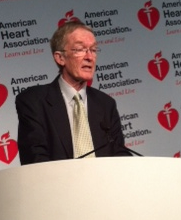 Sparks flew at the AHA press conference yesterday when the designated discussant for the AIM-HIGH trial, Australia’s Philip Barter, said that “the design was such that in no way could it test the hypothesis” that niacin therapy may be beneficial. “This trial disturbs me greatly,” he said. The trial co-principal investigator, William Boden, defended his trial, but admitted that it was far from perfect.
Barter’s case began with the trial’s design, as it was only powered to detect a 25% reduction in cardiovascular events. However, although HDL levels in the trial increased by 25% with niacin, substantial increases in HDL were also observed in the placebo group, so that there was only a 4-mg/dL difference in HDL between the groups. In addition, LDL levels reached similar levels in the two groups (68 and 63 mg/dL in the placebo and niacin arms, respectively). According to Barter, these small differences between the groups would predict at best a 12.5% reduction in CV events, only half the amount for which the trial was powered.
“Given that this study has not tested the hypothesis, I do not believe our practice should change” because of its results, said Barter. He added that any decision about niacin should await the much larger HPS2-THRIVE study in a few years, as it is sufficiently powered to answer the question.
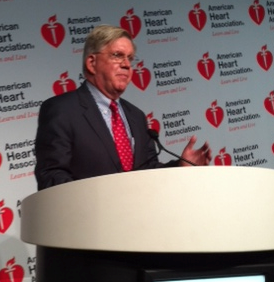 Boden countered that the results of the trial ruled out a large benefit for niacin, and that the VA HIT trial with gemfibrozil had turned up a large clinical benefit associated with a small increase in HDL. Boden said there is no evidence to support the continued use of niacin in the statin era, though he stopped short of saying that the drug should no longer be used. He agreed with Barter that HPS2-THRIVE would provide a definitive answer about the utility of niacin.
AHA spokesperson Roger Blumenthal said that although there is no current evidence to support the use of niacin, it is reasonable to give it to patients who continue to have high LDL levels after maximal statin therapy. But for people with LDL levels in the 70s, he said, “it would be hard to justify.”
Commenting on the striking difference between Boden and Barter during the press conference, Elliott Antman, the AHA program chair, observed: “If ever you saw an example of clinical equipoise, this is it.”
November 16th, 2011
AHA Lessons on Emotions and Heart Disease: Depressing Data but Hopeful Trends
Amit Shah, MD, MSCR
Several Cardiology Fellows who are attending AHA.11 this week are blogging together on CardioExchange. The Fellows include Revathi Balakrishnan, Eiman Jahangir, John Ryan (moderator), and Amit Shah. Read the previous post here. Check back often to learn about the biggest buzz in Orlando.
The many studies and sessions devoted to depression and heart disease at AHA — especially the session Depression and Cardiac Disease (where I also presented) — gave renewed focus and drive to this researcher into the psychosocial factors of cardiovascular disease.
The studies collectively support the role of depression in heart disease, but many questions remain, particularly regarding the direction of causality. Does heart disease cause depression, or does depression cause heart disease? Or does a third factor, such as inflammation, cause both? If so, what drives the inflammation?
Several points during the session were salient:
- Persistent depression is associated with a 100% increased relative risk of incident ischemic heart disease (IHD) in the general population
- Inflammation and other traditional risk factors such as obesity and serum cholesterol are associated with depression, thereby suggesting mechanisms by which IHD risk may be increased.
- Temporally, inflammation may precede development of depression in a peri-operative setting. Other work has supported the role of inflammation in the etiology of depression.
- Medication nonadherence and depression are related, and they have additive effects on heart disease outcomes.
The scientific community has been stumped by negative studies such as ENRICHD that call into question the importance of depression as a modifiable CVD risk factor. Nonetheless, more studies are needed, and depression treatment is always warranted, given that depression itself is debilitating, regardless of whether heart disease is comorbid.
I hope that with the trends toward increasing attention to this topic, as seen at AHA, more screening of depression in CHD patients will occur, and more clinical trials will try to find better strategies for treating it. The potential benefits that could be reaped are enormous: better quality of life, cost savings from reduced hospitalizations, and improved survival. Nonetheless, with the national shortage of primary care doctors and psychiatrists, as well as rising copays, many challenges face us.
What do other people think? Should cardiologists screen for depression, anxiety, etc., in their patients, and if they screen positive, what’s the next best step? Is there even time for this consuming task in a 15-minute clinical visit?
November 16th, 2011
POWER to the People
John Ryan, MD
Several Cardiology Fellows who are attending AHA.11 this week are blogging together on CardioExchange. The Fellows include Revathi Balakrishnan, Eiman Jahangir, John Ryan (moderator), and Amit Shah. Read the previous post here. Check back often to learn about the biggest buzz in Orlando.
Tuesday, I heard the presentation of the Practice-Based Opportunities for Weight Reduction (POWER) trial, which was concurrently published with accompanying editorial in The New England Journal of Medicine.
It is important to delineate the three arms of this study them clearly before I comment on the results:
- Remote support through a website and telephone and email contact
- Remote support, plus individual and group in-person weight counseling sessions
- Self-directed weight loss, which included meeting with a weight-loss coach at the beginning of the study and after 24 months
At 6 months, the average weight loss in the remote and in-person groups was significantly greater than in the self-directed group. More important, the improvement in the intervention groups was well maintained in the two years of follow-up (about 11 lbs, vs. < 2 lbs in the control group).
This study demonstrates to me two key lessons:
- Simply telling patients they need to lose weight does not work. We need to do more.
- Internet technology and user comfort with it have improved enough that we can now direct our patients to online, personally convenient counseling.
How do you counsel your patients regarding weight management?
Will you be directing your patients to a website such as the one developed for this trial?
November 15th, 2011
An Event, Not a Conference
Eiman Jahangir, MD
Several Cardiology Fellows who are attending AHA.11 this week are blogging together on CardioExchange. The Fellows include Revathi Balakrishnan, Eiman Jahangir, John Ryan (moderator), and Amit Shah. Read the previous post here. Check back often to learn about the biggest buzz in Orlando.
This is the last day of the conference for me. While I am sad that I will be missing some of the sessions tomorrow, I am definitely ready to go home. Each day has been packed full of plenary sessions, forums, posters, etc. It truly is an event and not a conference. You can’t just lay low and relax: The conference requires both mental energy — science to be learned, posters to be read, and a program book the size of an encyclopedia to maneuver through — and physical energy — to hike to the various sessions spread all over this large conference center. I am sure that I have walked over 10 miles. That may be an overstatement, but my dress shoes were definitely not designed for cross-country walking. All of the conference employees commute around the center on Segways, which I’ve been thinking would be a nice mode of transportation for us all. Then I remember that I am a cardiologist and that I tell all of my patients to walk regularly. Therefore, I should walk around the conference center instead of being a hypocrite and using a Segway.
My favorite session of the weekend: Martin Leon’s presentation on the future of interventional cardiology, on which I’ve already commented. Which was yours?
November 15th, 2011
After SATURN, What Role for Rosuvastatin? A CardioExchange Panel
CardioExchange Editors, Staff
With the publication and presentation of negative data from the SATURN trial (see our news summary), CardioExchange convened a panel to answer this question:
In light of the data from SATURN and the impending arrival of generic atorvastatin, what is the appropriate role of rosuvastatin at this point?

Steven E. Nissen, MD (senior author of SATURN)
The SATURN Trial demonstrated statistically significant regression of coronary disease in patients treated with the maximum approved dosages of the two most efficacious statins (atorvastatin and rosuvastatin) administered at their highest approved dosages. Despite moderate differences in LDL and HDL favoring rosuvastatin, for the primary efficacy measure, the extent of regression did not differ between treatment groups.
These findings suggest that most patients can be optimally treated with atorvastatin when it becomes generic, which may offer excellent benefits at a lower cost.
Although a small difference in efficacy was observed for the secondary intravascular ultrasound endpoint, this finding should be interpreted with caution. It must also be acknowledged that SATURN was an imaging trial, not a morbidity/mortality trial. We need more comparative effectiveness trials with clinical endpoints to optimally chose the most effective therapies. The excellent safety observed in SATURN suggests that most patients can be readily treated with maximal dosage of these two statins.

SATURN suggests that in patients with CAD and LDL levels treated to below current clinical guidelines, atorvastatin and rosuvastatin are equivalent in terms of regression. In light of atrovostatin’s (soon to be) generic formulation, and its efficacy, potency, and known clinical outcomes in a wide range of patients across both primary and secondary prevention, it seems that rosuvastatin should be reserved for patients intolerant to high-dose atorvastatin, patients unable to achieve clinical guidelines for LDL reduction, or patients in whom clinical trials such as JUPITER inform use.

Atorvastatin will continue to be the dominant statin since it can be used with calcium channel blockers and it is nearly as potent as rosuvastatin. Perhaps a longer follow-up than 104 weeks would have shown a modest benefit for rosuvastatin, but we will never know. The cost of atorvastatin will be much less in 2012. Of note, the HDL-C levels on rosuvastatin were not much higher than on atorvastatin therapy. There is a signal that rosuvastatin may promote more regression than atorvastatin but the clinical significance is unclear.
The limitations of using intravascular ultrasound to assess regression of atherosclerosis were also discussed in the editorial about ASTEROID that Navin Kapur and I co-wrote in JAMA in April 2006. It is interesting that the REVERSAL trial did not find any regression with atorvastatin, but SATURN does. Nevertheless, the pioneering work of Drs. Nissen and Nichols has revolutionized the current approach to understanding the pathophysiology of coronary atherosclerosis as well as its responsiveness to therapy. I think that rosuvastatin will be used more than atorvastatin when the starting HDL-C is low or when there is concern about drug interactions.
November 15th, 2011
After AIM HIGH, What Future for Niacin? A CardioExchange Panel
CardioExchange Editors, Staff
With the publication and presentation of negative data from the AIM HIGH trial (see our news summary), CardioExchange convened a panel to answer this question:
What if any role remains for niacin after AIM HIGH?
The AIM HIGH Study provides no evidence for benefit from niacin in the very patients in whom this drug is most commonly used. However, the differences in administration of LDL-lowering therapies in the two treatment groups represents a serious design flaw. Furthermore, the study was underpowered and stopped at a point where the lower limit of the 95% confidence interval could not rule out a modest benefit. The decision to stop the trial prematurely for futility was unwise and deprived the medical community of a more robust assessment of the benefits and risks of niacin treatment. Despite these flaws, it seems unlikely that niacin represents an overall benefit to patients and its routine usage should be discouraged.
Quite frankly, AIM-HIGH doesn’t change much for me, but rather underscores the continued necessary focus on LDL reduction with statins to improve CV outcomes. I will likely continue to use niacin (a) in combination with statins in very high risk individuals with far higher LDL levels than seen in AIM-HIGH and (b) alone in statin-intolerant patients or individuals with extremely elevated Lp(a). None of these groups were included in this study.
Niacin will still be useful as (a) a second-line therapy in patients whose LDL-C or non-HDL cholesterol is not at goal despite maximally tolerated statin therapy or (b) as a first-line agent in patients who cannot tolerate a statin. Niacin did not show benefit as an add-on therapy in AIM-HIGH when the baseline LDL-C was 70. It may be beneficial when the baseline LDL-C on maximally tolerated statin is 100.
I think that this study also tells us that there is little future role for serial carotid IMT testing to determine the best cholesterol lowering therapy. The ARBITER 6 – HALTS investigators were thrilled with a 0.014 mm improvement in carotid IMT vs. no change with ezetimibe. The AIM-HIGH clinical trial showed that this was associated with no benefit over a three year period, unfortunately. The insightful editorial that Erin Michos and I wrote about ARBITER 6 in the NEJM seems to have been right on the mark. I wonder if we will ever get an apologies from the few niacin zealots who were so critical of what we wrote. Vindication is a nice feeling, but I wish that the clinical trial results had been positive so that we could help our patients more.
 William Boden, MD (PI of AIM HIGH)
An important therapeutic role clearly remains for niacin. What does AIM HIGH tell us then? If you are a patient with stable, non-acute cardiovascular disease who meets an indication for statin therapy AND who is able to achieve and maintain a very low level of on-treatment LDL-C as we attained in AIM-HIGH (in the low 60 mg/dL range), then there is no clinical benefit for HDL-C raising therapy with niacin to further reduce clinical events over and above what is achieved by statin therapy alone.
But how many patients fall into the above category? Data from 3 large data sets/registries (GE Healthcare, United Healthcare, NHANES) indicate that only 13% to 19% of high-risk CHD patients actually can achieve/maintain the very low levels of LDL-C we accomplished in our study. One can only apply the results of RCTs to the population that we actually enrolled in the trial and should not extrapolate the study findings to subgroups of patients who were not enrolled or those who, by trial design, were excluded (e.g., AMI or ACS patients).
AIM-HIGH also enrolled only a small percentage of women (15%) and an even smaller percentage of ethnic minorities (8%)—important subsets for whom these results may not apply.
Lastly, AIM-HIGH was plagued by an intensity and duration of prior statin therapy that may have made it difficult to discern an incremental clinical treatment effect, especially given the very low mean starting LDL-C in the 94% of trial patients who had been on a statin for at least 1 year (76%). Indeed, many of these patients had been on statin therapy for much longer (40% for 5 or more years). Such long-term therapy, superimposed on a background of optimal medical therapy and secondary prevention (e.g., ASA and antiplatelet drugs, beta-blockers, ACE inhibitors and ARBs), may have, in the aggregate, converted vulnerable coronary plaques destined to rupture (as the putative inciting event/trigger to clinical events) into stable, quiescent plaques where the the soluble constituents of the necrotic core was “delipidated.” This is yet another reason we should be cautious in how we apply the results of AIM-HIGH to the broader population of patients that we did not enroll. Niacin still has a therapeutic role to favorably alter the lipid profile in high-risk patients and we need to reserve judgment on the long-term usage of this agent, pending the results of the ongoing HPS-2 THRIVE Trial.
[EDITOR’S NOTE: See also our coverage of the debate at the AHA news conference, a fellow’s take, and our earlier panel discussion on what stopping AIM HIGH means for the HDL hypothesis.]
November 15th, 2011
Hype Aside, Hope for Stem Cell Therapy May Be Emerging from Hibernation
Larry Husten, PHD
Two small studies of cardiac stem cells for the treatment of heart failure have shown promise, but ABC News, CBS News, and other media outlets are throwing around words like “medical breakthrough” and “heart failure cure.” ABC News correspondent Richard Besser was so enthusiastic that anchor Diane Sawyer commented that she had never seen him “so excited.” The first author of one of the studies, Roberto Bolli, said the work could represent “the biggest advance in cardiology in my lifetime.”
The reality may be somewhat more prosaic. In the first paper, published in the Lancet, Roberto Bolli and colleagues, including senior author Piero Anversa, report on a phase 1 study still in progress in which 16 patients with post-infarction left ventricular (LV) dysfunction received cardiac stem cells (CSCs) harvested during bypass surgery and subsequently expanded. Seven patients served as controls.
In the treatment group, LV ejection fraction (EF) increased from 30.3% to 38.5% some 4 months after infusion. There was no change in LVEF in the control group. At 1 year follow-up among eight patients in the CSC group, the LVEF had increased by 12.3 EF units.
“Although the primary purpose of our phase 1 trial was to assess the safety and feasibility of using this distinct and unique population of cells, the treatment effects are very encouraging and compare favourably with previous trials of bone marrow cells. The present results provide a strong rationale for further studies of CSC treatment in patients with severe heart failure secondary to ischemic cardiomyopathy, who have a poor prognosis,” the authors wrote.
The results “raise new optimism because the study is based on rigorous quality standards and the reported benefits are of an unexpected magnitude,” wrote Gerd Heusch in an accompanying comment. “Of course, we will have to see whether further data will meet the promises of the present study…”
In a second study, presented by Eduardo Marbán at the AHA, 31 patients were randomized on a 2:1 basis to intracoronary infusion of cardiosphere-derived cells (CDCs) or a control arm. CDC therapy was safe, and the investigators found evidence that it reduced scar and increased healthy heart muscle. The results suggested that regeneration of cardiac tissue had taken place. Positive trends suggesting improved EF and end systolic and diastolic volumes were also observed. The results, the authors concluded, suggest that this could be the “first therapeutic modality to shrink scar while regrowing viable, functional tissue.”
November 15th, 2011
MI FREE: A Free Lunch for Patients and Insurers Alike?
John Ryan, MD
Several Cardiology Fellows who are attending AHA.11 this week are blogging together on CardioExchange. The Fellows include Revathi Balakrishnan, Eiman Jahangir, John Ryan (moderator), and Amit Shah. Read the previous post here. Check back often to learn about the biggest buzz in Orlando.
In MI-FREEE presented by Dr. Niteesh Choudhry today at AHA and published online in the New England Journal of Medicine, 5855 AETNA-insured patients were randomized at discharge for MI patients to either normal coverage or no copay for statins, beta blockers, ACE inhibitors and ARBs. Patients in the no-copay group were significantly less likely to have another major cardiac event (MI, angina, heart failure, or stroke) compared with the normal coverage group: 11 per 100 person-years vs 12.8 per 100 person-years, respectively; P=0.03). Not surprisingly, removing copay increased medication adherence.
What did surprise me was that this protocol so substantially decreased costs for Aetna — which sponsored the trial — that they are now introducing the Aetna Rx Healthy Outcomes program, which will decrease copays for MI patients.
There is often skepticism surrounding the results of pharmaceutical-sponsored trials in light of the financial benefits to the company. Here removing copays saved Aetna over $5000 per patient, with a total pool of 40 million people covered by Aetna insurance plans. Should the same concerns that apply to pharmaceutical-sponsored research apply to the insurance industry? Why or why not?
November 15th, 2011
Go Red: Highlights from the Women and Heart Disease Session
Reva Balakrishnan, MD, MPH
Several Cardiology Fellows who are attending AHA.11 this week are blogging together on CardioExchange. The Fellows include Revathi Balakrishnan, Eiman Jahangir, John Ryan (moderator), and Amit Shah. Read the previous post here. Check back often to learn about the biggest buzz in Orlando.
The past two days have been a fast-paced whirlwind of big clinical trials, so today I decided to take a break from the late-breaking madness, hang with the girls, and attend the women and heart disease oral abstract session. When I initially entered the room, I was taken aback by the sea of people dressed in red; today was Go Red for Women day at AHA, and we were asked to wear red in support. I unfortunately didn’t pack anything red to wear; but luckily I had my little red dress pin in tow!
The session was fascinating, with abstracts that highlighted the complex, multifactorial spectrum of heart disease in women. Some highlights:
Coronary vascular dysfunction, vulnerable plaque composition and response to statin therapy and the role of sex: Naser Ahmadi and colleagues used coronary CT to measure differences in the coronary distensibility index (CDI) and vulnerable plaque scores between men and women on statin therapy at LDL goal, and found that women had significantly more vulnerable plaque burden and lower CDI.
Depression is a stronger risk factor for obstructive CAD and major cardiovascular events in young women than in men and older women: Amit Shah (our CardioExchange fellow co-contributor) quantified the relationship of depression in 700+ women using PHQ-9 questionnaires with CAD using CASS scores, and found that after adjusting for traditional risk factors, depression was a significant predictor of CAD and MACE in women younger than 55 years of age, but not men or older women.
Severe physical and sexual abuse in childhood and adolescence predicts cardiovascular events in women: Janet Rich-Edwards and colleagues studied women enrolled in the Nurses Health study and the relationship between physical and sexual abuse and cardiovascular outcomes. Using the nurses health survey, they found a significant relationship between sexual abuse (forced sexual activity) and development of cardiovascular disease (hazard ratio, 1.34 – confirmed by medical record review).
Are you surprised by these results? What frontiers in cardiovascular disease in women do you think are most interesting or are still not addressed?
November 15th, 2011
My First Oral Presentation: Life on the Other Side of the Podium
Amit Shah, MD, MSCR
Several Cardiology Fellows who are attending AHA.11 this week are blogging together on CardioExchange. The Fellows include Revathi Balakrishnan, Eiman Jahangir, John Ryan (moderator), and Amit Shah. Read the previous post here. Check back often to learn about the biggest buzz in Orlando.
My experiences of AHA conferences have been a progression, as they probably have been for others as well. It started with coming just for the experience; no presentations, just pure learning with my eyes wide open. What fun! The next AHA, I had the privilege of presenting a poster. While it was an honor to be selected for it, I felt some frustration because of the limited attendance and vast competition from other sessions and exhibits. At times I felt as if I was standing alone, handcuffed to my poster! This time, I timidly came to AHA with the opportunity to present my abstract in an oral session. It was a refreshing change from a poster and an honor, but definitely a challenge as well.
It was a blessing and a curse. I loved not having to drag around a huge poster container, but I felt that I was dragging around my dread instead. What if I mess up my slides? I found myself tweaking them at the last minute, and missing sessions just to practice. Why did I sign up for this? Thoughts were racing as I became tachycardic in anticipation. Deep breaths…
The talk went…well, it just went. I never became completely comfortable, and found myself talking too fast several times. I felt like a mechanical speaking robot, reading off my slides at the speed of sound with little inflection or emotion.
Before I knew it, the talk ended. On to questions! Two were asked. They were really insightful, actually, but my brain was still not working. Although I did my best to answer the questions, I felt like a politician; it sounded like I was answering, but I didn’t really answer the question completely to the satisfaction of the audience.
Afterwards, I ran into some friends, which was a breath of fresh air; they were all very encouraging. Overall, I valued the experienced, learned a lot, and would do it again in a heartbeat, even though I know I’ll be nervous again. Hopefully I will be a little bit less tachycardic at least.
Does anyone else have stories to share about their first experience given an oral presentation? Perhaps any tips?
[EDITOR’S NOTE: for more on the experience of presenting at for the first time see John Ryan’s post from last year’s AHA and his interview earlier this month with Thomas Ryan].