
An ongoing dialogue on HIV/AIDS, infectious diseases,
February 26th, 2026
Some Ruminations on CROI — Still the Best HIV Meeting
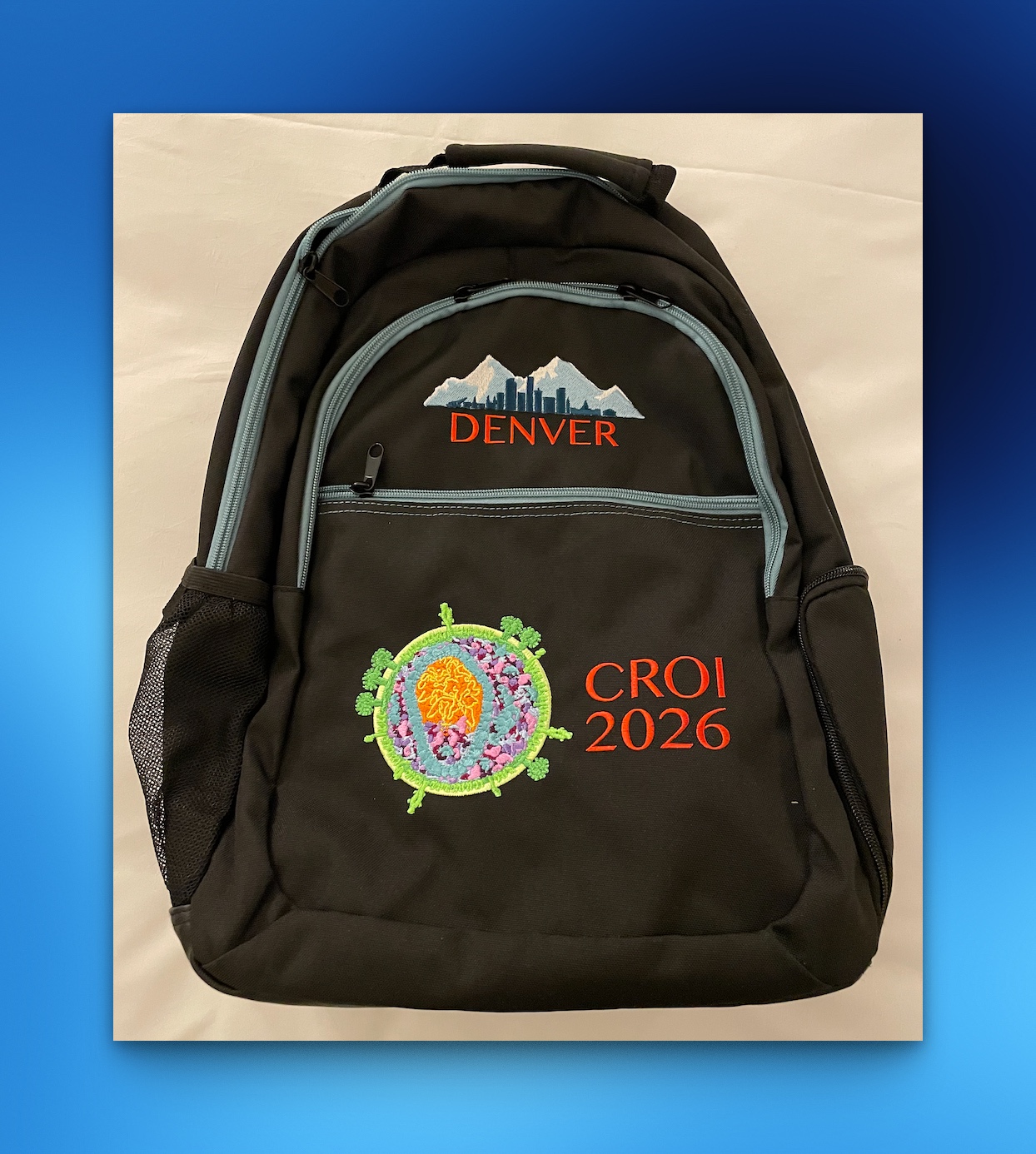
The famous CROI backpack. I have a stack of these in my closet.
CROI, which just wrapped up in Denver, is not like other scientific meetings — it’s quirky. Let me count the ways.
- There’s the name — the Conference on Retroviruses and Opportunistic Infections — coined in the early 1990s, when fax machines were cutting-edge technology. It’s pronounced to rhyme with boy, by the way. No one remembers who decided this.
- There’s the application process. If you’re not presenting or listed as a coauthor on an abstract, you don’t simply register — you apply. You’ll be asked to list your publications and credentials. It can feel like petitioning entry into a scholarly guild.
- There’s the delicate dance with industry. CROI accepts pharmaceutical support, as most major meetings do, but limits industry presence and attendance. No exhibit hall. No satellite symposia. No branded merch. The goal is scientific independence without pretending industry doesn’t exist. You got that?
- And then there’s the weather. CROI is always held in a cold city in winter. Boston. Seattle. Chicago. Denver. Montreal. Atlanta is the furthest south they’ve ever ventured, and the first time the meeting was held there, it was freezing — record cold and high winds, as if the Gods of CROI insisted that suffering be part of attending this serious conference. (Can you imagine if this year’s meeting had been in Boston?)
But then the conference begins, and all that quirkiness melts away. In the field of HIV medicine, CROI remains the best scientific meeting there is.
This year, over 3000 attendees gathered — clinicians, laboratory scientists, trainees, policymakers — a reminder that this corner of medicine remains a global enterprise, one that spans many disciplines. I was pleasantly surprised that international attendance held up well, even given our current administration’s aggressively isolationist stance.
The opening plenary was delivered by long-time activist Peter Staley, who helped shape the modern era of HIV advocacy. His talk, delivered without slides, was moving, urgent, and inspiring. He spoke about the current political climate and the need, once again, to defend medical progress and research integrity.
But he also did something more subtle toward the end: he thanked the clinicians and researchers in the room for working alongside activists, not in opposition to them. I couldn’t help thinking back to the early days of the epidemic, when we were the targets of understandable anger and panic. What a wonderful irony that we’re now on the same side! Cue the standing ovation, much deserved, for this talk.
There are real questions about whether academic conferences still matter in the age of preprints, livestreams, social media, and Zoom. I think they do — and CROI makes the case well. There’s nothing quite like watching new data presented in real time: clinical trials, cohort studies, translational research. The excitement in the room when something significant is revealed is hard to replicate through a screen.
The culture of the meeting remains distinctive, in the best way. Questions from the audience are precise and unsparing. One of my long-term friends and colleagues asks such incisive questions that seeing him come to the microphone generates true excitement in the audience (though perhaps panic in the presenter). Over-interpretation is gently dismantled. Even negative trials, if conducted rigorously, are treated as meaningful contributions. Enthusiasm is welcome; exaggeration is not.
There’s also the thrill of watching a new generation of investigators emerge. When a junior researcher walks to the podium, you can see the nerves — the careful grip on the lectern, the quick breath before the first slide. When they do well, the applause at the end is genuine: for the work, yes, but also for the growth we’ve just witnessed.
And there’s something else. CROI is partly a reunion — the place where you spot a former fellow in the audience, now leading studies of their own, now mentoring trainees of their own, now asking the kind of incisive questions they once rehearsed nervously in a conference room years ago. At the other end of the career trajectory, you also see your mentors, now semi-retired but still drawn to the meeting for the energy and excitement it generates.
That said, the broader context in which this meeting now exists gives reason for concern.
One challenge is the very success of antiretroviral therapy. When essentially everyone who takes their medications is successfully treated, it’s tempting to ask whether the work is done. It isn’t. Innovation continues to push the limits of what’s possible — and it’s no exaggeration that a twice-yearly injection could become a standard treatment option within the next 3 to 5 years.
Another challenge is the global one. CROI has always been international in scope and spirit, with much of its research depending on global collaborations and long-standing U.S. investment. Although AIDS was first described in the United States, roughly two-thirds of the 38 million people with HIV today are living in sub-Saharan Africa, where prevalence in some regions reaches 15% to 20%, compared to less than 1% here. Recent decisions to curtail NIH funding for international research and to cut global HIV programs through USAID continue to cast a long shadow over this field.
For 4 days, though, we tried to set all of that aside. As the meeting wrapped up, there was a clear sense that CROI had once again demonstrated how much fascinating work is being done right now — and how much is left to do. Despite knowing how to treat and prevent this infection, there are still over 30,000 new HIV diagnoses each year in the United States, and over a million globally, with at least a third of the people in our country without virologic suppression despite all our advances.
And hey, look at this: the location for next year’s meeting was announced. San Diego, March 21–24. For the first time, we’ll be meeting in a warm city in the spring. There hasn’t been measurable snow in San Diego since 1967 — let’s hope Gods of CROI don’t want to update that record!
5 Responses to “Some Ruminations on CROI — Still the Best HIV Meeting”

Paul E. Sax, MD
Associate Editor
NEJM Clinician
Biography | Disclosures & Summaries
Learn more about HIV and ID Observations.
You are so inspiring , you are a true Renaissance physician, so fortunate your students, residents and fellows to be witnessed to such a real disciple of Hipócrates . May the Gods of CROI keep you living for ever .
Beautifully said. A nice reminder of why we do this work.
You make an exciting meeting
Seem even more exciting in retrospect. A beautiful homage to our big conference of the year.
I never attend CROI but always watch out for the updates from folks who did. Information there always seems at least thought-provoking if not practice-changing.
Great article, Paul! While there are always multiple “origin” stories to any historic event, as I recall, it was largely Chip Schooley and Connie Benson who saw the need for CROI early on. There was some concern on the part of the (then) older generation that the field of ID could not support two meetings- what would eventually be called ID week and another AIDS focused meeting. Happily the first CROI was a big success!