
An ongoing dialogue on HIV/AIDS, infectious diseases,
March 27th, 2024
Think Again Before Sending Your Patient Home on Intravenous Vancomycin
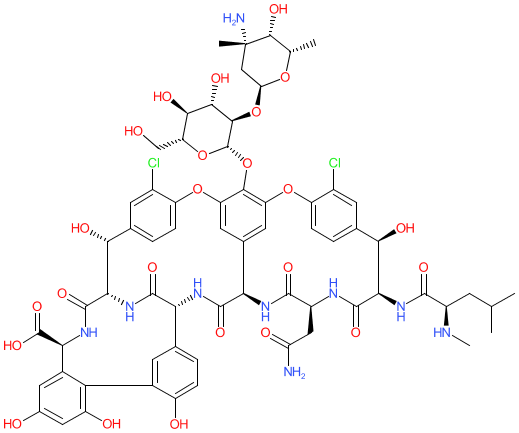
Chemical structure of vancomycin — you knew that, right?
I took care of a patient many years ago with MRSA. The severity of the infection required a prolonged treatment course, and vancomycin was the default option. Cripes, it was the only option. He ultimately was discharged on home IV therapy, and as usual we had a plan to monitor his renal function and vancomycin levels weekly.
The twist was that his wife was a nephrologist. Weekly blood tests weren’t enough; she wanted twice-weekly labs. She scrutinized all the results with meticulous intensity, plotting them on a spreadsheet so we could stop the drug “at the first hint of trouble.”
When we spoke, I was strictly instructed to dose the drug so that the trough concentrations never exceeded 10 mcg/mL. “Vancomycin is poison,” she said. A memorable quote!
(The patient did fine, low troughs notwithstanding. It was a team effort! And yes, I changed some details for patient confidentiality.)
Fast forward to today, with our target vancomycin troughs between 15–20 — or with area under the curve monitoring — and there’s no doubt that some of this nephrologist’s heightened concerns about nephrotoxicity have come to pass. Any doubts that vancomycin has nephrotoxicity have been dispelled by study after study showing a clear dose relationship between drug exposure and renal injury. It’s particularly problematic in older patients or those with other risk factors for renal disease.
The problems with vancomycin are much on my mind, as a trio of great first-year ID fellows just reviewed a particularly difficult outpatient vancomycin case. They cited one study of 130 patients on outpatient vancomycin where a whopping 28% developed some sort of renal injury. Risk factors were higher cumulative dose, a longer duration of therapy, underlying kidney disease, and use of other nephrotoxic meds. No surprise, there are a lot of studies with similar findings.
Of course, when I was treating my patient way back when, options for MRSA treatment were highly limited. What’s changed today is that we now have several alternatives to vancomycin — alternatives that are better in many important ways. As a result, it’s time we demote vancomycin substantially when discharging patients who need ongoing antibiotic therapy.
Here’s why:
- Other options are less toxic. Daptomycin, linezolid, ceftaroline, trimethoprim-sulfamethoxazole, and doxycycline aren’t perfect; all drugs have side effects, after all. But in OPAT land, vancomycin troubles greatly exceed issues caused by these other antimicrobials. For the comparison between vancomycin and daptomycin, our astute ID fellows identified two typical studies (one from 2014, the other 2018) showing significantly fewer adverse events for daptomycin. Bottom line — it’s safer!
- Monitoring vancomycin levels is hugely resource intensive. Area under the curve monitoring, now the preferred method for people with stable renal function, requires the input of a pharmacist, and isn’t available in many settings. Targeting the optimal trough concentrations, especially in people with changing renal function, is an obstacle course that could lead to an awful lot of falls, sometimes with no safety net. It’s never quite right!
- What’s a “trough,” anyway? If you haven’t had a “trough” vancomycin level checked at the wrong time — the error disclosed to you by your observant patient, their caretaker, or your home care service — you haven’t yet experienced the deep frustrations of monitoring home IV vancomycin. On some extreme misfires, a peak level is drawn accidentally, scaring everyone, but providing essentially useless data that needs to be repeated as a “true trough.” Fun times.
- Oral therapy can be substituted for intravenous in a high proportion of patients. Cue Dr. Brad Spellberg here for his very convincing, “Busting 75 Years of ID Myth” talk!
- Who’s paying for all this careful monitoring? As I’ve written before, home IV therapy is the classic hot potato clinical service, terribly reimbursed, and vancomycin is definitely the most common culprit in adding to this burden. For us physicians, the measures of our productivity still predominantly come from face-to-face patient visits and procedures — not calling skilled nursing facilities to chase down creatinine results and vancomycin levels.
- Prolonged infusion times make patients prisoners of vancomycin administration. Each dose takes more than an hour — sometimes much longer. This is true for all home vancomycin recipients, but the ones I truly feel bad for are those who require every 8-hour vancomycin dosing — they are spending what must feel like most of their waking hours watching IV vancomycin slowly infuse. With its once-daily dosing and an administration time lasting just a few minutes, it’s no wonder patient satisfaction is significantly higher with daptomycin than vancomycin. I bet they’d be even higher with dalbavancin or oritivancin prior to discharge, though unfortunately the clinical research on using these drugs for severe MRSA infections is limited.
- There’s no longer a cost advantage. Daptomycin and linezolid prices have (at last) dropped substantially from their stratospheric peaks in their brand-name days. Trimethoprim sulfamethoxazole and doxycycline are even less expensive. Additionally, alternatives to vancomycin spare the additional costs of drug level monitoring and drug toxicity.
Conspicuously absent from the above list are citations about treatment effectiveness. If we knew that vancomycin had superior efficacy to alternatives for home IV therapy, then one could justify all the hassle. But if such studies exist, I’m certainly not familiar with them.
So prior to discharging that patient on home vancomycin, think very carefully about safer and more convenient alternatives. There is almost always going to be a better option.
14 Responses to “Think Again Before Sending Your Patient Home on Intravenous Vancomycin”

Paul E. Sax, MD
Associate Editor
NEJM Clinician
Biography | Disclosures & Summaries
Learn more about HIV and ID Observations.
 FROM NEJM — Recent Infectious Disease Articles
- Minocycline-Induced Hyperpigmentation April 2, 2026A 68-year-old woman with rosacea presented with a 6-week history of dark patches on the skin of her arms and legs. Two weeks before the onset of the skin changes, she had started taking minocycline daily.
- Legislating Medicine — Directed Donation and the Politics of Patient Choice April 1, 2026A Tennessee bill focused on directed blood donation exemplifies a pattern of efforts to legislate medical practice in ways that override scientific consensus while invoking the language of autonomy.
- Probable Japanese Encephalitis Virus Transmission through Organ Transplantation March 26, 2026Infection with Japanese encephalitis virus, a mosquito-borne flavivirus, was identified in a patient who received a liver transplant from a donor who resided in California.
- Communicating about Vaccines in a Politically Contentious Climate March 26, 2026Recent changes in U.S. vaccine policy are sowing confusion and threatening the health of children and the wider population. How should pediatric clinicians communicate with parents to stem the damage?
- Eczema Herpeticum March 26, 2026A 33-year-old pregnant woman with previously controlled atopic dermatitis presented with 3 days of fever and an itchy, painful rash. Erythematous vesiculopapular lesions were noted on the face, neck, chest, and arms.
- Minocycline-Induced Hyperpigmentation April 2, 2026
Dr. Sax, I’m a nephrologist from India, and we often see MRSA from dialysis cath CRBSI. Vanc dosing is easy because it’s post-HD, and nephrotoxicity isnt an issue for patients on maintenance dialysis. Also, we typically don’t measure trough levels here, because of both cost and accessibility issues – this sometimes makes me wonder if we under-dose vancomycin (a lot of our patients are on dialysis twice-weekly, and not thrice-weekly)
Just curious if (oral) linezolid is an equivalent option in these cases? Dosing of daptomycin is also problematic in patients on dialysis
Oral linezolid is often a great option, especially if the treatment duration is short. However, there is a component of renal clearance, so watch for adverse events (esp low platelets) in your HD patients!
-Paul
Thanks a lot, Dr. Sax !
Thanks for this great post, Paul. I had once read that “older” versions of vanco were the culprits in the reports of nephrotoxicity, but that is apparently incorrect. I do still teach my students that it is potentially nephrotoxic and that kidney function should be monitored closely. I had to smile at your description of a nephrologist: “She scrutinized all the results with meticulous intensity, plotting them on a spreadsheet so we could stop the drug ‘at the first hint of trouble.'” I tell my students that nephrologists are convinced that the rest of us are trying to kill their patients. The first thing most of them do when an outpatient is in front of them is go through their medications prescribed by others and either ditch some of them or lower the dose or change the frequency of the dose. Then they send a polite note to the other prescriber, essentially saying, “I saved you from killing my patient”. Ask me how I know. 🙂 I love them.
I greatly appreciate this post- we are still seeing tremendous pushback from insurance companies for daptomycin coverage, especially in patients going to inpatient rehab facilities.
Despite all the above, I bet that Vancomycin is the #1 DOT measured antibiotic at your institution (like my hospital). I also bet that 90% of the empiric use of Vancomycin, if retrospectively reviewed, was never necessary in the first place. I am still waiting for any large study proving that higher troughs lead to improved outcomes! Thanks for this discussion.
I am internist from Ethiopia
I read this with great interest! What a coincident I today had one patient in whom AKI is attributed to Vancomycin!
The sad thing though is vancomycin trough levels are known only in text books where I practice and even worse the safer alternatives are never available.
Dear Paul is there any opinion you suggest for set up like mine ?
I am the OPAT director at the Atlanta VA and since 2016 when I started here… I made it my number 1 priority to stop using vanco for OPAT. I cringe when I review a request from an OSH asking for vanco. I will go at great lengths to avoid this including calling the OSH ID doctor and negotiating the change to Dapto or something else. Conveniently Daptomycin became less expensive for the VA a couple yrs after I started working here. I also have been an early adopter of off-label Dalbavancin use for certain candidates. Orals area also looking more appealing!
Agree with your point but one comment for those who may not have options. Continuous vanco infusion with a pump in a “Fanny pack” makes for easy dosing with predictable linear adjustments and gradual changes in levels so can just do random levels and cr. Does away with most of the hassles and risk of renal toxicity. Just change the bag once a day.
Dear Dr. Sax, Thank you for your insights. At this stage, I see minimal value of vancomycin in the hands of infectious disease physicians. In addition to cumbersome dosing and risk of AKI, we can do so much better in treating serious infections. It’s a drug right up there next to daylight savings time..it served a purpose once, but it’s killing people and it’s time to move on from it, yet it is almost impossible to make it go away.
Hi Paul
Thanks for this post. It is very time intensive for physicians to monitor Vancomycin in an OPAT setting. We found however that nurses using a clinical treatment algorithm with standardized physician orders could do this very safely and effectively at low cost. The program used trough concentrations rather than area under the curve to determine treatment goals but I am not aware of any evidence that area under the curve is superior to troughs in the stable patients that tend to be treated in OPAT clinics (as opposed to hemodynamically unstable patients with acute S. aureus bacteremias who are still hospitalized).
See our study JAC Antimicrob Resist. 2021 Mar; 3(1): dlaa113. Published online 2021 Jan 18. doi: 10.1093/jacamr/dlaa113
Thank you for the timely and excellent post. I echo another responder who describes persistent difficulty placing patients on daptomycin in extended care facilities. Refusal is not unusual, with the facility demanding a less expensive alternative.
Any comment on the trending need for higher and higher doses of daptomycin and signs of growing resistance?
When talking about IV vancomycin, I often allude to or borrow Winston’s Churchill’s comment on democracy – Vancomycin is the worst MRSA drug, except for all of the others. To my knowledge, vancomycin is still the only abx approved or used for MRSA left-sided endocarditis. For MRSA osteomyelitis, the Spellberg et al. option, I believe, is rifampin plus TMP/SMX DS TID. That’s a very tough regimen to take. I don’t believe or remember this regimen being studied for left-sided endocarditis. POET, for instance, didn’t have very many MRSA pts. Most of our pts with MRSA osteomyelitis are diabetics on several other chronic medications, making rifampin a tough choice. Daptomycin, the big disappointer, has poor bone penetration. I think we use dapto to treat ourselves, like Venodyne boots or late Tamiflu. Oral or IV TMP/SMX data on severe S. aureus infections aren’t robust or confidence boosting. (1,2)
As for vanco troughs, I learned early in my career that changes in vanco renal clearance occur prior to changes in CrCl. I had an elderly pt with MRSA osteo. Initially, his troughs were appropriate on 1 gm IV Q12; by the end of six weeks, his trough was appropriate on 1 gm Q24, despite having no changes in serum Cr level. My group, via experience, knows that if we get a trough above 17, to reduce the vanco dose, because, more than likely, the next trough will be >20 if we don’t lower the dose.
As for vanco at home, we rarely ever use it and we send pts to home OPAT frequently. Basically, we do not trust the Home IV companies to appropriately draw vanco levels. A long time ago, I learned to only check OPAT labs on Mondays and Thursdays. Well, Thanksgiving, it turns out, is on a Thursday. The company called our NP and asked if they could delay the draw until Saturday. The Monday vanco trough and Cr were normal and unchanged from prior values. On Saturday, the vanco trough was >30. The OPAT company didn’t call use and decided that this vanco level was a peak, not a trough. Of note, the pt’s Cr had increased minimally, if at all. On Monday, well, that changed. The vanco trough >70 and the serum Cr >4. Even in retrospect, I don’t know how we could have handled that case differently. Another mistake I have often seen is interpreting a normal Cr as normal for that pt. If the pt’s Cr = 0.6 yesterday and today = 1.0, you’re in trouble.
A few other observations –
1. I don’t know who started vanco trough after the 4th dose, but, like anything rote, the practice makes no sense.
2. CrCl as a measure of GFR only works when the serum Cr is stable. When the Cr is going up or down, you just don’t know.
3. Most pts on IV vanco have other risks for AKI. By frequently checking vanco troughs, we can, when acute renal failure occurs, confidently say that vanco didn’t cause the renal failure.
4. Empiricism rules. PharmD’s keep trying to calculate the appropriate vanco regimen. After doing this for 30 years, I know I can’t guess which pts clear vanco as predicted. But there is no point is trying to soothsay. Just check the vanco trough or vanco level.
5. Twice, I have used vanco in ICU pts to guesstimate GFR. I don’t have radio-labelled inulin available and GFR in ICU pts is often very difficult to determine.
6. There is no such things as CRRT. CRRT clears abx levels much more than HD. Pts, who are put on CRRT, are unstable, by definition. In >90%, pts receive ICRRT, meaning Intermittent Continuous Renal Replacement Therapy. By checking vanco levels frequently, you can be confident that at least one of your abx is being dosed properly.
As for vanco being poison, I don’t think the data support that claim. I guess I am getting older, but the impurities or most of them, which made early vancomycin preps be called Mississippi Mud, were removed a long time ago. I believe data from Albany showed that vanco wasn’t nephrotoxic unless ≥4 gm/ day were used. I have never used >4 gm/day. I think vanco’s nephrotoxicity is somewhere between Mississippi Mud and Albany’s claim.
So, we check vanco troughs and Cr at least twice per week.
1. de Górgolas M, Avilés P, Verdejo C, Fernández Guerrero ML. Treatment of experimental endocarditis due to methicillin-susceptible or methicillin-resistant Staphylococcus aureus with trimethoprim-sulfamethoxazole and antibiotics that inhibit cell wall synthesis. Antimicrob Agents Chemother. 1995 Apr;39(4):953–7.
2. Markowitz N, Quinn EL, Saravolatz LD. Trimethoprim-sulfamethoxazole compared with vancomycin for the treatment of Staphylococcus aureus infection. Ann Intern Med. 1992 Sep 1;117(5):390–8.