
An ongoing dialogue on HIV/AIDS, infectious diseases,
December 17th, 2025
What Use Is the Physical Examination in Current Medical Practice?
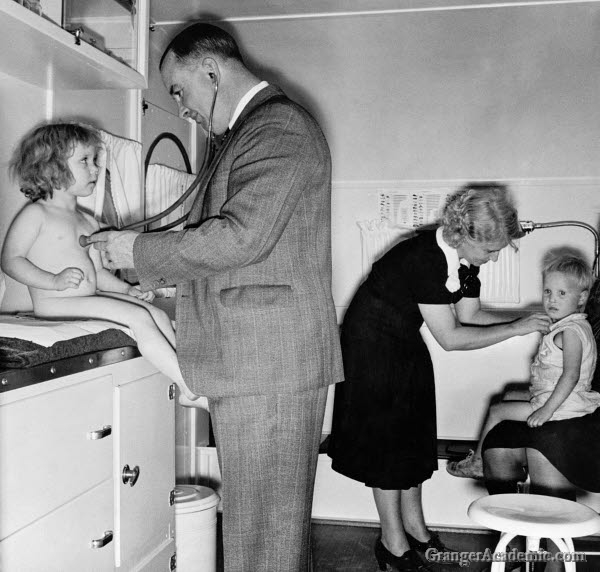
A doctor and nurse examine children in a trailer clinic at a mobile camp in Klamath County, Oregon. Photograph by Dorothea Lange, October 1939.
A very interesting, quite scholarly perspective appeared in the NEJM last month called, “Strategies to Reinvigorate the Bedside Clinical Encounter.” Drawing plenty of attention on social media, it elicited the usual hand-wringing from clinicians who bemoaned the way modern medicine has evolved — away from direct care of patients and toward an ever-expanding reliance on technology for testing and communication.
With the hungry electronic medical record that always needs feeding, the innumerable administrative burdens placed on clinicians, and the simple fact that most doctors are paid per unit of service they document — not by time spent at the bedside or in the exam room — we simply don’t spend enough time with our patients.
Not enough time looking at them. Talking to them. Listening to them. Instead, we’re perched in front of that glowing screen, its shining flat-panel computer face named years ago by Dr. Abraham Verghese as the iPatient. Clever!
Why would more time with patients be so valuable? Because I strongly believe that there’s nothing worth more in an effective clinical encounter than taking a good history — and, if I may be so immodest, this is where we ID doctors shine. (It’s certainly not doing bedside procedures.) Since I’ve devoted a whole post to taking histories and spend a whole lot of time and energy with our ID fellows stressing the importance of history in what we do, let’s shift to another part of the direct clinical encounter, which is the physical examination (PE).
There are several opinions and perspectives about the PE that repeatedly come up in both the medical literature and in conversations with students, colleagues, and other health care professionals. Let’s take a look at five of them one at a time, starting with the beginners:
1. The Medical Student, the Learner
Wow, I’m going to have to learn how to use these new tools — stethoscope, reflex hammer, the ophthalmoscope … Each time I see a patient, I’m so nervous about doing something wrong that I can barely concentrate on what I’m seeing, feeling, or hearing … Is that an S3? A systolic or diastolic murmur? What’s the difference between rales and rhonchi — I think I know what wheezes are … Is that 1+ or 2+ edema? What is shifting dullness again? Which cranial nerve are we testing when we ask them to shrug their shoulders, and why is it a cranial nerve anyway? And can the patients tell that I have no idea what I’m doing, basically all of the time? Oh, to have the confidence of the senior resident on this rotation, who somehow always knows what and how much to do! And the attending does even less …
2. The Pediatrician, the True Believer
The physical exam is absolutely critical … especially in babies! After all, they can’t tell you what’s wrong … A parent’s intuition (usually the mom’s, let’s be honest) is helpful, but still — she’s not going to pick up hip dysplasia, or the absence of a cornea reflex, or scoliosis, or a heart murmur … My entire career is filled with these pick-ups, each a little win for early detection … I can’t imagine a clinic visit without a good physical exam … And get the clothes off, please! No one can do an exam on a screaming toddler in a snowsuit …
3. The Proud Expert of the Physical Exam (Usually but Not Always Played by an Older Cardiologist)
Hey, have a few minutes to go to the bedside? Allow me to show you how the Valsalva maneuver differentiates between hypertrophic cardiomyopathy and aortic stenosis … And while I’m at it, listen how the handgrip exercise intensifies the mitral regurgitation murmur by increasing afterload, and note how you hear the aortic regurgitation murmur better while the patient is leaning forward and exhales fully … For my money, the hepatojugular reflux test is much better than peripheral edema assessments for volume status in chronic heart failure … And by the way, I’ve never met a patient in whom I didn’t carefully assess the neck veins … it’s just a matter of finding the perfect angle, ideal lighting, understanding the difference between the arterial and venous pulsations, and making sure you’re looking at the internal jugular waveforms, preferably while shining a light tangentially across the neck … Got that?
4. The Busy and Overworked and Beleaguered Provider at the End of the Day (We’ve All Been There)
I heard a systolic murmur … Let’s get an ECHO … because the data are really limited on the accuracy of what we hear in the office and what an ECHO shows anyway … and meanwhile, I have 10 prior approvals to complete and multiple disability forms to fill out and quality metrics to meet and in-basket messages to return and abnormal tests to follow-up on, and of course everything is required sooner rather than later … and how is this even possible in a 15-minute follow-up visit, especially when my 3:15 p.m. patient arrived at 3:45, insisting that they be seen even though I’ve double-booked my 4:00 p.m.?
5. The Orthopedic Surgeon
What’s a stethoscope?
If you want my take, I’m here to say that all of these views on the physical exam have validity — each has their place, their sound justifications. That busy doctor who moves quickly to order the ECHO? The cardiologists will get the ECHO too, even after all their fancy maneuvers. And show me an orthopedic surgeon who does a careful complete PE, listening for carotid and femoral bruits, doing a Romberg test, and percussing the liver span, and I’ll show you one who doesn’t operate often enough. A more comprehensive exam isn’t always better, despite what some old-timers say.
But clearly doing some aspects of the PE is almost always better than nothing at all — and there are two reasons why.
First, a physical exam targeted by the patient history can be immensely valuable. As an example, a memorable pick-up was thanks to a resident rotating with me in ID clinic. In seeing a patient in follow-up while he was still on intravenous antibiotics for endocarditis, she heard the murmur of aortic insufficiency while doing a careful cardiac exam. After confirming her findings, and noting that they were new since discharge, I contacted his cardiology and cardiac surgery teams who were understandably alarmed; they expedited his lifesaving valve-replacement surgery.
(She’s now a cardiologist, of course. You can be sure I sang her praises and cited this case when she was applying.)
Second, most patients want us to do them. One of my current colleagues, Dr. Mary Montgomery, was an ID fellow here a bit over a decade ago. Observing her physical exams, I noted she always looked in her patient’s ears, even when they had no ear complaints. When I asked her why, she said:
I remember hearing that patients don’t feel that they are having a complete exam unless their ears are checked. So I try to look in everyone’s ears. Takes me a minute at most, so why not?
Sounds good to me!
Happy holidays, all!
(H/T Drs. Sonja Solomon, Beret Amundson, and Mary Montgomery, all three of them graduate Chief Medical Residents, for helpful feedback on drafts of this post.)
15 Responses to “What Use Is the Physical Examination in Current Medical Practice?”
Leave a Reply

Paul E. Sax, MD
Associate Editor
NEJM Clinician
Biography | Disclosures & Summaries
Learn more about HIV and ID Observations.
 FROM NEJM — Recent Infectious Disease Articles
- Postpartum Persistence of Ebola Virus in Breast Milk March 12, 2026To control EBOV outbreaks, defining potential sanctuary sites where the virus may persist and lead to transmission is important. In this report, persistence of EBOV RNA in breast milk was identified and characterized.
- Soft Tick Relapsing Fever March 12, 2026A 74-year-old man was admitted to the hospital with a 3-week history of intermittent fevers, muscle aches, and vomiting. Thin blood smears showed spirochetes.
- Case 8-2026: A 57-Year-Old Woman with Chest Pain, Dyspnea, and Syncope March 12, 2026A 57-year-old woman was evaluated because of 2 days of chest pain and dyspnea. Ultrasonography showed a pericardial effusion with diastolic inversion of the right ventricle. A diagnosis was made.
- Massive Intravascular Hemolysis from Clostridium perfringens Bacteremia March 12, 2026A 73-year-old woman presented in shock with a 1-day history of malaise, dyspnea, and confusion. Serum samples could not be processed owing to gross hemolysis. Dehemoglobinized red cells and bacilli were seen on a peripheral-blood smear.
- The Eyes Have It March 5, 2026A 47-year-old man was brought to the ED by EMS after being found dyspneic in his car. He reported having been drinking for 6 hours before presentation. He noted a sensation of tongue swelling and difficulty breathing.
- Postpartum Persistence of Ebola Virus in Breast Milk March 12, 2026
Thank you, Dr Sax. I am retired, but all clinicians have an opportunity to build rapport when they touch patients. I did careful physical exams on my gyn patients until the day I left. Why? They expected it and thought I was a brilliant clinician for doing them. Touch patients! Look them in the eye! I was always running behind, but every one of my colleagues would comment at one time or another, “Patients tell you such intimate details. How do you do it?” I touched them! I looked them in the eye! I asked the questions we are supposed to ask, and then I listened, and then I documented. Happy Holidays!
Totally agree. The ritual is important. I had one AIDS patient who, whenever I looked in his ear, would hold up his hand next to the other ear to see if the light came through. I never forgot his little joke. My wife knows what it means when I say someone has a positive otic transcranial illumination test.
I have been diagnosed over the years with fibromyalgia, osteoarthritis, exocrine pancreatic insufficiency, and degenerative spine disease. And then there’s the symptoms no one can figure out. I’ve seen numerous specialists over the past 20 years. Rare is the doctor who actually touches me. I understand the importance of tests — I’ve had more of them than I can count — but actually touching me (and looking at me) suggests care. When my primary care physician — who has treated me for 30 years) sighs at my latest problems, I know he wishes he could do more. He says I am an anigma, hard to treat. I see him every three months. Without fail, when I leave he tries to encourage me, both with his words and by touching me — a handshake, a hug, or a gentle hand on my shoulder.
I don’t expect doctors to “fix” me. I know there’s little they can do for me. However, every doctor can be kind, thoughtful, and friendly. Sadly, I have known a few doctors who are arrogant, self-entitled $*##$@#$. Years ago, I visited a teenager in the hospital who was having major surgery on her heart (which required stoping her heart). She was scared, to say the least. When the doctor came in before the surgery and asked her to sign the consent form, she freaked out and refused to sign it. Instead of trying to understand where the girl was coming from, he yelled at her and threw the clipboard on the bed. Needless to say, I gave him an earful. I then quietly, patiently talked with the girl and she signed.
I’ve met some wonderful doctors over the years; men and women who loved their work and their patients. Unfortunately, as with every profession, there are some doctors who lack the ability (or desire) to be thoughtful human beings.
Other wise the patient feels you are treating a lab value, not a patient, and may be less willing to comply with medical advice.
Very enjoyable. Retired family doctor, I had once heard–and learned–that patients expect to be examined. Maybe not the younger adults, but certainly my more geriatric ones did. I tried to do so. Those few moments were invaluable for my findings and their confidence in me. As aluded above, I also recall doing my routine exam and hearing a heart mumur. No prior comment of it in my record. A new aortic valve problem needing surgery. As above also, I had occasion to have cardiologist exam at world famous medical center. I was 77, and he was older than I. He performed exams I hadn’t thought of since medical school.
Physical exams can even be a little fun for the patient! When I suspect the patient may have pneumonia and I check for egophony, I tell them “This is the Sesame Street portion of the exam” as I ask them to say EEEEE while listening to their lungs. That always brings a smile, even in someone both of us are worried may have pneumonia.
Also want to give a shoutout to JAMA’s long running series, The Rational Clinical Examination. Each entry is specific-problem-based, but I have learned a lot about general physical exams from those articles over the years. https://jamanetwork.com/collections/6257/the-rational-clinical-examination
I think back to significant abnormalities I’ve picked on routine physical examinations in asymptomatic patients. Plenty of skin lesions, the occasional significant heart murmur, a hepatoma in a patient with chronic hepatitis B. But I can’t think of a time when auscultating the lungs of a patient with no respiratory complaints was ever useful. That being said, what would a patient think if I examined him without including the “take some big breaths through your mouth” portion, a necessary ritual!
As a retired ID doc who also had a small Internal Medical practice in a semi rural New England county, I resonate with the above comments. Maintaining eye contact with our patients instead of the computer,
listening to and communicating with as well as touching another person – whether a handshake, a targeted exam or a more complete “old fashioned physical” – I always found was a more satisfying encounter both for me and my patients. Hopefully, advancements in facilitating documentation and streamlining the tedium of authorizations and other infringements on time will allow clinicians to return to the practices of medicine which are rewarding to both the patient and the practitioner.
I’m a reader from the very beginning, as a multi-specialty NEJM Journal Watch subscriber (until it went away a few weeks ago).
I’m a neurologist, and like ID docs, most of us still take time with our patients by taking a careful history, actually reading through prior records, and doing a physical exam, many components of which non-neurologists never mastered.
After 30 years of doing Neurology, I have transitioned to only doing EMG/NCS. Even so, with only a 5 minute history and physical exam (sensation/strength/tendon reflexes),, I find critical things on history and exam that were previously unknown by the Orthopedic docs, Ortho NPs, Family docs, and Family NPs that send the majority of patients. I diagnose things like stroke, MS, RLS, parkinsonism, myelopathies, RA, lower extremity claudication, neurogenic claudication, and deQuervain’s multiple times daily with just a brief history and exam that is non-billable. None of these diagnoses are made by EMG/NCS, nor did they need the test. But, I understand that sometimes the test is necessary to rule out a peripheral neurogenic cause of symptoms that could also be present.
It is truly shocking how many of them tell me that no one checked their sensory exam or reflexes when I find major abnormalities.
The poor history/exam (? due to limited appointment time vs. limited skills) leads to more tests, often unnecessary if they’d had their reflexes or sensation tested, or sometimes been allowed to tell the whole story.
I was always taught that if you don’t know what the problem is after a thorough history, 90% of the time the exam will not make the diagnosis. I agree. A seasoned doc after taking a thorough history should use the exam and testing (if necessary) to pin down the final diagnosis from a short differential diagnosis.
Nothing is more important than the PE … being dermatologist it’s always Inspection, Inspection and inspection. It’s a visual speciality. I have learnt to talk to the skin…the lesions themselves say ‘ I am so and so ‘ …
I would like to posit a contrary thought. Why do a physical examination of organ systems/body parts that are not relevant to the patient’s problem? It is the same as doing irrelevant lab tests. It leads to finding abnormalities of unknown significance. I think most doctors agree full body scans without medical indication should be discouraged because they can lead to more harm than good.
What is the difference with physical examination?
(Of course I agree it leads to better rapport with the patient, which probably can make up for my above point.)
My wife, a primary care internist, tells me she diagnosed atrial fibrillation, aortic stenosis, thyroid cancer, and three melanomas in asymptomatic patients. Her main reason for listening to their lungs was to examine the part of their skin that they could not see.
Most of us have made diagnoses based on an exam in symptomatic patients – a swollen node, tender, joint, rash or other skin lesion, murmur, etc.
I also used the physical exam as an excuse to get family and visitors out of the room, for the sake of the history or my sanity.
On a related note, I didn’t use a templated normal exam because this seemed to be the cause of a lot of documented normal findings that were not correct. The most common cause of a new murmur was failure to document an old murmur. I had one patient with a grade 3 murmur that was documented as absent by everyone except the surgical resident. How embarrassing.
I’m an ID doctor, longtime lurker and superfan, and just want to add, having worked for many years in sub-Saharan Africa as part of my clinical job, there are may places where the physical exam has been indispensable and one of the only tools you have and not everyone will end up practicing in settings where tests are available ad nauseam. I never thought I would have to use our anachronistic Canadian Royal College IM exam scenario of differentiating neurosyphilis from B12 deficiency until I was actually able to diagnose someone with B12 deficiency in Malawi because of a history and physical. More important is that not only do most patients expect a physical exam as part of our clinical encounter, the “laying of the hands” helps build a therapeutic relationship, not to mention buys some silent time with your own thoughts, to quickly think about what is going on, what you are doing before you present things to the patient. I would hate for it to become a lost art in current times in Canadian and American training. I feel this one strongly…it’s the first time in 20 years of following your blogs I have been motivated to comment 🙂
The physical exam shouldn’t be celebrated as a whole. Instead, we should abandon ineffective maneuvers and embrace the ones that work well.
I agree with the commenter who mentioned JAMA’s series but many of the articles there are getting dated and the 6th edition of Steven McGee’s Evidence-Based Physical Diagnosis came out in August.
The merging of evidence based medicine with the physical exam is THE strategy to reinvigorate the bedside clinical encounter.
Careful history taking is the start of a rapport building with the patient,
It almost gives 60% of the diagnosis.The diagnos is confirmed by the physical examination and the labs.A good physical examination adds to the percentage confirmation to reach definitive diagnosis besides offering to patient the satisfaction of having been examined by the doctor,The labs completes the diagnosis reached almost 99% in most common medical situations seen in primary care.