
October 17th, 2011
National Lipid Association Responds to Coverage of Its Statement on Biomarkers
Christopher Seymour, MBA
Editor’s Note: This contribution from Christopher R. Seymour, Executive Director of the National Lipid Association, is a response to Larry Husten’s October 13 blog post titled “National Lipid Association Expert Panel Has Many Deep Ties to Industry.”
On behalf of the National Lipid Association (NLA), I want to address your inquiry regarding the paper titled “Clinical Utility of Inflammatory Markers and Advanced Lipoprotein Testing: Advice from an Expert Panel of Lipid Specialists.”
To begin, this paper is not a guideline. Rather, it is a statement to the NLA membership. Our goal was to inform our membership when and how to best apply the tests in certain clinical scenarios to achieve the best outcomes for patients.
As the preamble to the paper articulates, this paper was written in response to a survey of our membership, in 2010, which clearly delineated our need to address this topic. Each of our contributing authors, through extensive effort, personally researched and drafted his or her assigned portion of the paper.
Next, let me address your comments regarding Biofortis and Provident Clinical Research. Kevin Maki, PhD, has been a member of NLA since 2007. He is a certified Clinical Lipid Specialist and a published author in lipidology. His company, Provident Clinical Research, conducts research and reporting in the area of dyslipidemia and has provided technical writing assistance on other NLA projects. He was selected because of his credentials and understanding of the topic, as well as his ability to manage an extensive project of this nature.
Additional Background
As discussed in the summary paper, the expert panel was assembled, at the direction of the NLA leadership, based on the knowledge and clinical experience among our members in the area of advanced lipoprotein testing and emerging biomarkers. Our goals were to provide the best clinical advice to our members and to assemble a diverse yet representative group of leaders in dyslipidemia who have studied and applied these markers routinely.
The debate — informed by a full complement of research, evidence, and clinical expertise — was extremely lively and candid. The advice paper underwent additional review and was approved by the NLA Board of Directors and regional Board of Directors prior to publication. All conflicts were disclosed and collected in advance of the proceeding, discussed at the opening of the conference as a matter of process, and adjudicated within the parameters of the protocol and the ground rules of the conference.
The Biofortis team included Dr. Maki and Mary Dicklin, PhD. Both attended the meeting in a primarily administrative capacity, facilitated the aggregation of literature and data at the time of the conference, and worked with each lead author to memorialize the discussion. They were an integral part of bringing the extensive discussion together in a very admirable fashion.
With this clarification of our efforts, we welcome comments from your readership.
Christopher R. Seymour, MBA
Executive Director, National Lipid Association
October 17th, 2011
Sapien Transcatheter Heart Valve Might Be Delayed
Larry Husten, PHD
Approval for the highly anticipated Sapien transcatheter aortic heart valve might be delayed for 6 months, until April 2012. The FDA had been expected to reach a decision this month. But now a member of the FDA advisory panel that recommended approval for Sapien, Jeffrey Borer, in a public statement made at the ACC/AATS Heart Valve Summit in Chicago, said that FDA approval would be delayed until April. Borer’s remarks were reported by Wells Fargo medical device analyst Larry Biegelsen, who said he believed that Borer was only speculating and that the most likely scenario is that Sapien will gain approval this month.
An Edwards spokesperson told the Associated Press that the company still anticipates Sapien’s approval in October.
October 17th, 2011
My Doctor Is a Technophobe
William Kent Cornwell, MD
I’m a patient, not a doctor. In the past two years, I’ve seen two different primary care physicians and three specialists. The details of my case would probably bore an audience of cardiologists (peroneal nerve damage and related orthopedic problems), so I’ll skip those. What’s more interesting — and surprising to me — is what I witnessed when each of these 5 physicians interacted with my electronic medical records.
I live in the Boston area — hardly a healthcare backwater. So most of my lab tests and imaging were available to my doctors right on their office computers. But all five had a great deal of trouble accessing what they needed.
One of the primary care docs couldn’t manage to navigate the system after he logged in and gave up right there in front of me. The other PCP (filling in for the first) was so slow using the system that, at a moment when I sensed it wouldn’t be embarrassing, I reached over the desk to point at her monitor and show her how to get what she wanted. “I need a little more practice at this,” she admitted. We both laughed and moved on.
The specialists had to download MRI images. Not one of them managed to access all the desired scans on the first try. One called in a front-office worker to help her. Another said to me, “We’ll make do with the ones we can see here.”
The last specialist was the most intriguing. After he tried unsuccessfully to locate the desired images, I offered to help, and we quickly found what he was looking for. Then, in a moment of candor, he confessed to me that he usually reviews scans in private because he’s “bad with computers” and it takes him a while to “work the thing” (his words). Then he said, “I may be an MD, but I’m a technophobe.” Yes, he used that term.
“That’s okay,” I said. “I’ve got my own phobias.” Again, we laughed and moved on.
All 5 of these doctors are competent professionals. I never questioned the quality of their care. But their discomfort with technology took me by surprise, especially given that the oldest of the five is in what I would guess to be his late fifties, the youngest barely 40 — certainly not old fogeys.
Now I suppose it could be that cardiologists are a notch above PCPs, neurologists, and orthopedists. You technology whizzes may be scoffing at these amateurs. And, of course, these records systems should be more user-friendly. But the consistency of my physicians’ awkwardness with systems that I (no technology whiz) was able to help them navigate does make me wonder how pervasive technophobia is among MDs.
Are there substantial percentages of physicians who are hiding their lack of computer skills out of shame? Or did I, by chance, find myself encountering some of the few who fit this technophobe profile? Are you personally as comfortable with technology as you’d like to be? What do you do when technology stumps you on the job?
October 14th, 2011
FDA Advisory Panel Recommends First DES For PAD
Larry Husten, PHD
The FDA Circulatory System Devices Panel voted 11-0 on Thursday to support the premarket approval application for the Zilver PTX drug-eluting stent, manufactured by Cook Medical. The self-expanding, paclitaxel-coated stent would be the first DES approved for use in peripheral arterial disease of the above-the-knee femoropopliteal arteries.
October 13th, 2011
Coronary Heart Disease Prevalence in U.S. Continues to Decline
Larry Husten, PHD
The prevalence of coronary heart disease in the U.S. continues to drop, according to the CDC. Data from the Behavioral Risk Factor Surveillance System (BRFSS) surveys, published in Morbidity and Mortality Weekly Report, show a significant decrease in overall CHD prevalence from 6.7% to 6% from 2006 to 2010.
In an apparent paradox, the authors note that the decline in CHD mortality that has been occurring for the past 50 years should result in an increase in CHD prevalence. Therefore, they write, “the decline in prevalence is consistent with the reported decline in the prevalence of a population at high risk (i.e., persons with uncontrolled hypertension, uncontrolled high levels of low-density lipoprotein cholesterol, and current smokers).”
The MMWR report includes extensive data about the differences in CHD prevalence based on age, sex, race/ethnicity, education, and state of residence. “The data from this report can help health planners develop more targeted prevention programs for states and populations with greater CHD prevalence (e.g., American Indian/Alaska Native men and black women),” the authors write.
CHD prevalence was generally highest in the south. In 2010, Hawaii and Washington, D.C., had the lowest prevalence (3.7% and 3.8%), while West Virginia and Kentucky had the highest (8.0% and 8.2%).
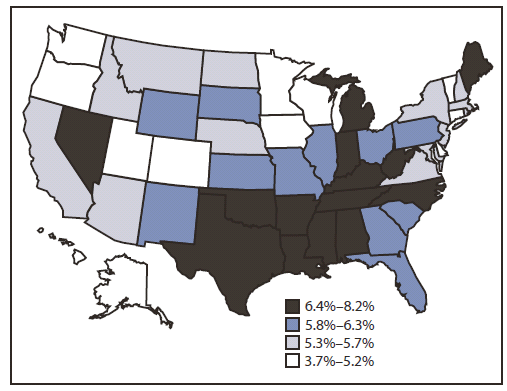
Age-adjusted prevalence of coronary heart disease among adults --- Behavioral Risk Factor Surveillance System, United States, 2010
October 13th, 2011
National Lipid Association Expert Panel Has Many Deep Ties To Industry
Larry Husten, PHD
[Editor’s note: see here for a reply post to this news story by Chrstopher Seymour, MBA, Executive Director of the National Lipid Association].
An “expert panel” assembled by the National Lipid Association (NLA) is recommending a dramatic expansion in the use of new biomarkers for the diagnosis and management of cardiovascular disease. The recommendations, if widely adopted, would significantly increase not just the use of these diagnostic tests but also lead to much greater use of lipid-lowering drugs. But every member of the panel has extensive ties to industry, and the “consensus conference” that led to publication of the guidelines was funded by an array of diagnostic and drug companies that stand to gain from the new recommendations.
The NLA panel recommends a greatly expanded role for 5 out of 6 new biomarkers– CRP, Lp-PLA2, Apo B, LDL particle number, and Lp(a). (HDL or LDL subfractions did not receive an expanded recommendation.) However, these same biomarkers received a much more critical review in the ACCF/AHA guidelines for cardiovascular risk assessment and in the USPSTF guidelines. The ACCF/AHA guidelines, for example, allow a very modest role for CRP; the other biomarkers are simply not recommended:
Measurement of lipid parameters, including lipoproteins, apolipoproteins, particle size, and density, beyond a standard fasting lipid profile is not recommended for cardiovascular risk assessment in asymptomatic adults.
Panel members, along with the NLA itself, have a dizzying number of industry relationships. The chair of the panel, Michael Davidson, “has received research grants from Abbott Laboratories, Daiichi Sankyo, GlaxoSmithKline, Merck & Co. and Roche… has received consulting fees from Abbott Laboratories, Aegerion Pharmaceuticals, Amgen, AstraZeneca, Atherotech Inc., Daiichi Sankyo, DTC MD, Esperion, GlaxoSmithKline, Intelligent Medical Decisions, Kinemed, LipoScience, Merck & Co, Novo Nordisk, Roche, Sanofi-Aventis, Synarc, Takeda Pharmaceuticals, and Vindico Medical Education…. has received honoraria related to speaking from Abbott Laboratories, GlaxoSmithKline and Merck & Co…. [and] has served on the Board of Directors of DTC MD, Omthera, Professional Evaluation Inc., and Sonogene.”
Chrystie Ballantyne, a co-chair of the panel, has a disclosure list even longer than Davidson’s. Another member of the panel, W. Virgil Brown, is the editor of the Journal of Clinical Lipidology, the NLA journal in which the expert panel appears. He “has received consulting fees from Abbott Laboratories, Amgen, Anthera, Genzyme, Pfizer Inc., LipoScience, and Merck & Co…. [and] has received honoraria related to speaking from Abbott Laboratories, LipoScience, and Merck & Co.”
One of the 17 panel members, James McKenney, had no disclosures in the paper, but this may not tell the entire story. A Pharm.D, McKenney is a former president of the NLA, and a faculty disclosure statement online indicates that McKenney has had extensive ties with industry in the past.
An NLA webpage about the document includes the statement that “contributors to this paper have provided full disclosures and their thoughts on this matter were discussed in advance and the contributors have affirmed that their participation has not been influenced by bias or commercial interest…”
The authors acknowledge financial support to produce the document in the form of “unrestricted grant funding” from 9 companies, all of whom stand to benefit from the changes endorsed by the panel: Abbott Laboratories, Atherotech Diagnostics Laboratory, Berkley Heart Lab, Inc., Boston Heart Diagnostics, diaDexus, Inc., LipoScience, Merck & Co., Inc., and Spectracell Laboratories. After thanking the companies for their support the authors then assert that the document is free from commercial influence:
The NLA would like to thank each company for its support of this endeavor. In accordance with the National Lipid Association Code for Interactions with Companies, the NLA maintained full control over the planning, content, quality, scientific integrity, implementation, and evaluation of the consensus conference and this inflammatory markers and advanced lipoprotein testing consensus document. All related activities are free from commercial influence and bias.
At least one company has already gone ahead and started to use the document to promote its product. Even before the paper had a chance to receive wide distribution, LipoScience, which markets a test that measures LDL particle number (LDL-P), issued a press release announcing the publication, and trumpeting the new indications for its product:
The consensus panel recommends that the use of LDL particle number for initial clinical risk assessment of CVD is reasonable for many patients at intermediate risk, including patients with a family history of coronary heart disease (CHD) and recurrent cardiac events. In addition, LDL particle number should be considered in the risk assessment of selected patients with known CHD or CHD risk equivalent.
The panel also recommends that LDL particle number for on-treatment management of CVD risk is reasonable for many patients at intermediate risk, including patients with coronary heart disease, a CHD risk equivalent and in patients with recurrent cardiac events. LDL particle number should be considered in the management of selected patients with a family history of CHD.
Here’s another question worth asking: how much of the paper did the expert panel actually write? The end of the paper acknowledges “Biofortis-Provident Clinical Research for writing and editorial assistance.” This company has extensive connections with the NLA and the lipid community (some of its current employees were also involved with an Abbott marketing study that was published in the American Journal of Cardiology). In fact, two “non-panel scientists” who are listed as co-authors of the expert panel paper are Kevin C. Maki, PhD and Mary R. Dicklin, PhD. In addition to their numerous other relationships with industry, the disclosures section of the paper states that they receive “salary support from Biofortis.” In fact, they are employees of the company, and a cursory look at Maki’s resume reveals that he is the President and Chief Science Officer of Provident Clinical Research.
A recent study in BMJ examined the role of conflict of interest in published guidelines for diabetes and cardiovascular disease over the past decade and found numerous problems with the way most organizations manage conflicts of interest on these panels. But, says Mt. Sinai’s Jennifer Neuman, lead author of the study, the NLA paper is an egregious example of these problems:
The Institute of Medicine has made a number of recommendations on how to manage conflicts of interests on guideline panels in order to limit potential bias, and the NLA appears to have disregarded most of these recommendations. This flies in the face of national and international efforts to improve the credibility of the guideline development process.
See articles about the NLA from earlier this year on CardioBrief.org.
October 11th, 2011
Cardiologist Who Accused Famed Surgeon of Misconduct Is Fired by Northwestern University
Larry Husten, PHD
Northwestern University has dismissed the cardiologist who raised troubling questions about Patrick McCarthy, its star cardiac surgeon.
The controversy began in 2008 when Nalini Rajamannan, an assistant professor of medicine, accused McCarthy of implanting in one of her patients an experimental annuloplasty ring, the Myxo ring, manufactured by Edwards Lifesciences. McCarthy, who had invented the device, implanted it without obtaining the patient’s consent, and Edwards was accused of circumventing the FDA approval process. The incident eventually led to investigations by the FDA and a U.S. senate committee, and was covered extensively by TheHeart.Org, the Wall Street Journal, and the Chicago Tribune.
Prior to firing Rajamannan, Northwestern had eliminated her clinical privileges and turned down her application for tenure, according to an article in the Chronicle of Higher Education (subscription required to read full article). Northwestern claims Rajamannan was dismissed only because she had been denied tenure. Rajamannan, however, contends that she was fired because she uncovered evidence from a patient’s ECG recording that one of McCarthy’s patients had an MI shortly after surgery, contrary to McCarthy’s published claim that no patients had had an MI.
Rajamannan told the Chronicle that when she first spoke about the incident with Robert Bonow, who was then the chief of cardiology at Northwestern, he said to her: “You don’t cross Pat McCarthy…. We’re going to separate you, so don’t pursue this.” Bonow told the Chronicle he did not want to respond “without first consulting his lawyer.”
October 10th, 2011
TTOP-AF Trial Proves Efficacy of RF Ablation System, But Not Safety
Larry Husten, PHD
A new trial demonstrates that an investigational RF ablation system is more effective than medical management in treating persistent AF, but the trial failed to meet a key predefined safety goal.
At the Venice Arrhythmias 2011 conference, Lucas Boersma presented the results of the TTOP-AF (Tailored Treatment of Persistent Atrial Fibrillation) trial, in which 210 patients with persistent AF were randomized to medical management or treatment with the Medtronic Phased RF Ablation System, which has been approved in Europe but is available only for investigational use in the U.S.
According to ClinicalTrials.gov, safety was the primary outcome measure of the trial. The acute safety event rate in the ablation arm was 12.3%, but the upper 95% confidence interval, which was 19%, exceeded the predefined 16% performance goal. A total of 21 acute safety events occurred in the ablation arm, including 4 strokes and 2 cases each of cardiac tamponade, pseudoaneurysm, and pulmonary infiltrates with fever.
The primary effectiveness endpoint, which was defined as a greater than 90% reduction in the AF and atrial flutter burden and freedom from antiarrhythmic drug therapy at 6 months, was reached in 55.8% of patients in the ablation group but only 26.4% of patients in the medical management arm, a highly significant difference (P<0.0001).
On October 27 the FDA Circulatory System Devices Panel is scheduled to discuss the PMA application for the Medtronic system.
October 10th, 2011
The Vagaries of Atrial Fibrillation
Shengshou Hu, M.D.
CardioExchange welcomes this guest post, reprinted with permission, from Dr. Westby Fisher, an electrophysiologist practicing at NorthShore University HealthSystem in Evanston, Illinois, and a Clinical Associate Professor of Medicine at University of Chicago’s Pritzker School of Medicine. This piece originally appeared on his blog, Dr. Wes.
I am always amazed at the different ways atrial fibrillation can present: sometimes with rapid heart rates, other times slow; sometimes it’s continuous, other times intermittent; sometimes it occurs without symptoms, other times it occurs with major symptoms like palpitations, stroke, or a peripheral embolus.
Atrial fibrillation is a strange, troubling, and often difficult disease to manage.
And so, when a patient with known persistent atrial fibrillation with rapid ventricular rates presents with a funny sense of lightheadedness with exercise once a week or so, you tend to think you know what you’re going to find: periods of super-fast heart rate associated with lightheadedness.
At least until you check the patient’s heart rhythm with a recording device. Now I’m beginning to think anything’s possible.
Here’s why.
Increasingly, I have been reaching for a newer form of heart monitor that combines continuous monitoring with patient feedback but lasts much longer than our older 24-hour Holter monitors. It is compact, has no dangling wires, and gives a continous single-lead EKG tracing for up to 14 days. It has a button that the patient can press to identify periods when symptoms are occuring. Best of all, it’s just a little flexible plastic patch that is applied to the surface of the skin. In that patch is a processor that records the surface EKG (even while in the shower) for the full 14 days. (Exercise has to be avoided to avoid sweat from dislodging the adhesive.) After that time, the patient drops the device in the mail (provided the post office stays open!) and sends the device to a processing center where the stored 14-day EKG is processed and pre-categorized by heart rate range, rhythm, tachycardias, pauses, PACs, PVCs and for the reviewing physician to overread. The data are then plotted and made available for clinical review on the company’s website. Here’s a few pictures of one of the earlier prototypes of this device (iRhythm – now a St. Jude Medical company) that I took:


So why is this important?
In my view, it’s because of what I’m finding the patient doesn’t perceive while wearing an event recorder. A more conventional event recorder is different than this patch-monitor because it relies on the patient to push the button when he or she experiences symptoms, and then it stores the heart rhythm from a minute or two before and after the button was pressed so that it can be uploaded to a monitoring station for interpretation. As a result, asymptomatic arrhythmias can be missed. Historically, since patient symptoms were what we cared about, we naively assumed this should be the best way to identify the patient’s problem.
Those were the “old days.”
Here are a few representative tracings from the earlier patient when this person pressed the patch’s button (denoted by the red circle) at the time of the patient’s “symptoms”:

As expected: nothing but atrial fibrillation with fairly rapid ventricular response. Certainly there’s no real emergent concern with these findings.
But then came the spouse’s addition to the patient’s history as I called them with the patient’s patch-monitor results:
“You know what’s been strange? Sometimes at dinner he/she just looks down at the plate for a second and doesn’t respond, then asks ‘What are you yelling at me for?'”
Here’s what the full-disclosure patch-monitor recording from Day 8 from meal time:

Needless to say, over nine seconds of asystole is probably the reason the patient failed to respond to their spouse and is the most likely cause of the patient’s rarely perceived periods of lightheadedness. Ten other pauses over three seconds had transpired at many times of the day amongst the 14-day recording, yet none were perceived by the patient.
Unusual?
Certainly.
But now I know it’s not too unsual for the vagaries of atrial fibrillation.
-Wes
(Disclaimer: I have no commercial interest in the ZioPatch, iRhythm, or St. Jude Medical)
October 7th, 2011
FDA Approves Juvisync, Combination of Sitagliptin and Simvastatin
Larry Husten, PHD
The FDA has approved a fixed-dose combination tablet consisting of sitagliptin and simvastatin, two drugs previously approved for type 2 diabetes and hypercholesterolemia. Merck will market the new drug as Juvisync.
“This is the first product to combine a type 2 diabetes drug with a cholesterol lowering drug in one tablet,” said Mary H. Parks, the director of the Division of Metabolism and Endocrinology Products in the FDA’s Center for Drug Evaluation and Research, in an FDA press release. “However, to ensure safe and effective use of this product, tablets containing different doses of sitagliptin and simvastatin in fixed-dose combination have been developed to meet the different needs of individual patients. Dose selection should factor in what other drugs the patient is taking.”
The FDA said it had approved dosage strengths for sitagliptin/simvastatin of 100 mg/10 mg, 100 mg/20 mg, and 100 mg/40 mg. Other dosage combinations are under development.