
An ongoing dialogue on HIV/AIDS, infectious diseases,
December 15th, 2021
Do We Need to Remind People that COVID-19 Is Truly Awful?
Last month, I read a deeply harrowing description of what it’s like to be hospitalized with severe COVID-19. I strongly urge you to read the full thread:
https://twitter.com/CRStoli/status/1458600993621430272?s=20&t=km6XxJ5IDsQGQKsygjXfWg
Something about the plain, direct language he uses to describe the patient experience hits home here like few other depictions I’ve read — it rings true in so many ways.
And many of us in healthcare might forget just how dehumanizing and uncomfortable hospitalization can be — not just the severe discomfort of being critically ill, but the added insults of daily early AM blood draws, terrible food, scratchy pillows, and loss of privacy.

Peter in the captain’s chair.
The author is Chris Stolarski, associate director of university communication at Marquette University in Milwaukee, who was kind enough to talk with me further on an OFID podcast, which is also embedded at the bottom of this post. You can tell from our chat that Stoli (that’s what everyone calls him) is by nature an upbeat person — a Groucho Marx fan and music lover, with a particular fondness for old dachshunds. Here’s his pup Peter, by the way.
Still, Stoli is quite clear that he nearly died — his hospitalization was a terrifying nightmare, and his recovery far from easy, the illness leaving him with permanent nerve damage and tachycardia. He’s hopeful that telling his story will convince more people to take COVID-19 seriously and get vaccinated. (He contracted COVID-19 before vaccines were available.)
Why is this still important? Well just this week, The Atlantic published a piece entitled, Where I Live, No One Cares About COVID, by Matthew Walther.
In a bemused, and at times openly mocking tone, he cites the ongoing concerns about COVID-19 as the domain of the coastal, urban elites. For him and his family, living in rural Michigan, life has been back to pre-pandemic normal for nearly two years.
Here’s a typical passage, in which he openly ridicules media coverage of how to gather safely during the holiday season:
As Christmas approaches, we can look forward to more of this sort of thing, with the meta-ethical speculation advanced to an impossibly baroque stage of development. Is it okay for our 2-year-old son to hug Grandma at a Christmas party if she received her booster only a few days ago? Should the toddler wear a mask except when he is slopping mashed potatoes all over his booster seat? Our oldest finally attended her first (masked) sleepover with other fully vaccinated 10-year-olds, but one of them had a sibling test positive at day care. Should she stay home or wear a face shield? What about Omicron?
I don’t know how to put this in a way that will not make me sound flippant: No one cares.
Yes, he’s an excellent writer. Also yes, he’s deeply wrong about this last sentence — No one cares should more accurately really read, I don’t care. Otherwise, he’s guilty of the same echo-chamber bias he’s leveling at “the professional and managerial classes in a handful of major metropolitan areas.”
Readers of this site will no doubt be aware that Walther chose to write this piece as cases and hospitalizations due to COVID-19 continue to increase rapidly in most of the United States — including in Walther’s state of Michigan:
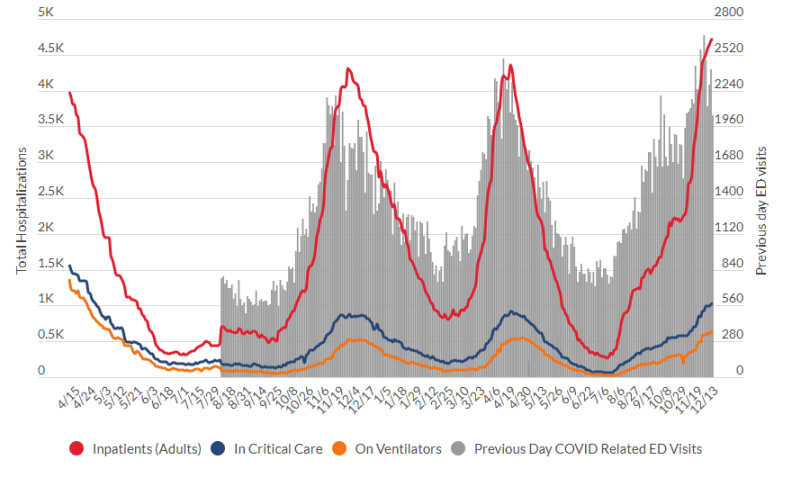
Source: Michigan Department of Health and Human Services
We’re sadly on the same grim trajectory we were last winter — and this is before the highly transmissible Omicron variant makes a major push into our country. We might deeply want COVID-19 to be over, but this doesn’t magically make it happen — the virus couldn’t care less.
Not surprisingly, Walther’s piece triggered the ire of many (raises hand!), in particular front-line healthcare workers who can’t hide from the disease. Here’s a particularly good (and angry) commentary from University of Colorado’s Dr. Josh Barocas, who kindly substituted * for certain letters so I could quote it here on these pages:
As an ID physician, frontline worker, & public health professional, I think I’ve generally held my sh*t together pretty well over the past two years (not lashing out, being civil) but this garbage @TheAtlantic article undid me (let me explain)-please readhttps://t.co/oWyLwtKmcj
— Josh Barocas, MD (@jabarocas) December 14, 2021
Well said, Josh. Because the answer to the question posed by title of this post is clearly YES.
(Transcript here.)
6 Responses to “Do We Need to Remind People that COVID-19 Is Truly Awful?”

Paul E. Sax, MD
Associate Editor
NEJM Clinician
Biography | Disclosures & Summaries
Learn more about HIV and ID Observations.

 FROM NEJM — Recent Infectious Disease Articles
- Oya Virus in a Patient with Severe Hepatitis, Enteritis, and Coagulopathy September 24, 2026Oya virus, an orthobunyavirus, was identified in a 54-year-old woman who had sepsis-like symptoms, including leukocytosis, thrombocytopenia, elevated liver-function values, and disseminated intravascular coagulation.
- Cerebral Schistosomiasis September 24, 2026A rice farmer presented to the ED after a 1-minute episode of arm and leg shaking on the right side. MRI showed linear enhancement associated with a cluster of enhancing nodules and surrounding edema in the left frontal lobe.
- The End of the War on Biomedical Science? September 24, 2026The turmoil of the past 20 months has inflicted lasting damage on American science and public health. But history and recent events suggest that the attacks will subside.
- Human Adenovirus B3–Induced Immune Thrombocytopenia and Thrombosis September 17, 2026Virus-induced immune thrombocytopenia and thrombosis after HAdV-B3 infection supports a shared platelet factor 4–targeted immune mechanism linking natural adenovirus infection and adenoviral vector–associated disease.
- Honoring the Legacy of the HIV Epidemic September 17, 2026Progress against the U.S. HIV epidemic is stalling, owing in part to government attacks and fear. But clinicians, patients, and activists can learn from the epidemic’s early heroes and find ways to advance.
- Oya Virus in a Patient with Severe Hepatitis, Enteritis, and Coagulopathy September 24, 2026
I live in southwest Michigan and work as a hospitalist in a community that serves primarily rural patients. I was on service last week and admitted many unvaccinated COVID patients. I have never seen our hospital so full or worked with nurses and allied staff so burned out. So it is pretty rich for Matthew Walther to write that incredibly patronizing and ignorant essay when he has no idea what is going on in his own backyard.
The Atlantic article is an exercise in hubris.
Thanks for the link to that Twitter series, Paul. (It’s now on Medium.com, too.) I will ask my nursing students to read it, so they can have an inkling of what patients go through when they are severely ill and hospitalized. (Why are we still making people anemic by drawing blood in such quantities every day of the week?)
I read Dr. Barocas’s thread the other day and was just as dismayed at The Atlantic as he and others were (yes, I am a subscriber). If you click on “History” on their front webpage, it says, “Since 1857, The Atlantic has been challenging assumptions and pursuing truth.” I fail to see how that article was evidence of “pursuing truth”. Essentially, it said only us elites (whatever that means) and academics are fussing about COVID and we have completely overblown it. Nothing to see here. There was no accompanying commentary, no counterpoint, nothing. Just that in-your-face, finger-pointing, smirking nonsense. Besides being nonsense, it was a slap in the face to everyone who has lost a loved one to COVID and the physicians, nurses, respiratory therapists, etc. who care for patients with COVID, This from the magazine that has given us brilliant writing by Ed Yong and others. Come on, Atlantic. You can do better than this.
I too witness the horror of Covid as a practicing PCCM doc. I think it’s important to recognize that I and others do not view that Atlantic article as pure evil. I do take issue with parts of it as well as its omissions, but I align more with this tweet thread by Dr. Shira Doron. Life is not worth living if in a constant state of fear and emergency. These vaccines are a triumph of humanity. 2 years of pandemic suffering is true, but public health policies ought not mirror policies circa March 2020.
https://twitter.com/ShiraDoronMD/status/1471289987081592842?s=20
We need unity. We need science. We need hope. Stop the hatred, denial, and fear.
Your comments on that dreadful magazine-article reminded me of something; and I found this superannuated clipping from a corrective review of one famous and equally meretricious book:
“…(A.J.P. Taylor’s The Origins of the Second World War) is full of inaccuracies or mis-statements of one kind or another and of varying degrees of importance, its use of evidence is occasionally selective and more frequently tendentious, it contains many internal inconsistencies and contradictions, and to the informed reader the interpretation which it offers accordingly carries no conviction whatsoever…. But it is so seductively written and so brilliantly argued that the inexpert reader can hardly avoid taking the view that: so clever a fellow must be right, and it is therefore of importance to show … that he is in fact very wrong”.