
An ongoing dialogue on HIV/AIDS, infectious diseases,
June 13th, 2009
Occupational Exposures and HIV Testing
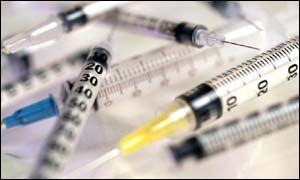 A couple of years ago, an ID-colleague of mine told me about a tough case: While working in the ICU, an anesthesiologist sustained a pretty severe needle stick. Approached for HIV testing, the source of the exposure felt threatened by the providers in the ICU, and refused to sign the consent.
The patient then deteriorated and required intubation. The intensivist, understandably in something of a panic, contacted my colleague for advice.
We’re about to post this case — actual details of which are slightly changed to protect anonymity — in AIDS Clinical Care. We’ve asked some experts (MD, lawyer, ethicist) on the matter a few key questions, including:
- How would you manage the intensivist who sustained the injury?
- Would you give post-exposure prophylaxis? If so, what specifically would you give, and for how long?
- How would you determine if the source patient has HIV? Would you perform surrogate testing (for example, obtain a CD4-cell count) to assess this? Would you consider testing him without written informed consent?
- If he is tested, would you give him the results after he recovers if the test is negative? If the test is positive?
This case is different from the this one, but many of the issues are related. (Different from this one too, obviously.)
And it’s a reminder that amidst all the controversy over “opt-out” testing and HIV screening, there’s another big issue out there regarding HIV testing that’s hardly been settled.
4 Responses to “Occupational Exposures and HIV Testing”

Paul E. Sax, MD
Associate Editor
NEJM Clinician
Biography | Disclosures & Summaries
Learn more about HIV and ID Observations.
When I sustained my stick injury in the ICU the laws in my state clearly gave the patients treating physician the right to either test an existing blood sample or obtain a new one to determine if any transmissible pathogens could be identified (without patient consent). Most ICU patients have a lot of blood work in the lab or on the way there. My patient had undiagnosed, advanced HIV and was subsequently offered treatment which was accepted by the family. I received triple prophylaxis and never seroconverted. This is an occupation hazard issue and also meets the common sense/decency/fairness standard unpon which many laws are derived. At this point there are now two patients to consider and not just one although respect for the autonomy of the index case is clearly important. There is a double effect and one might argue to just treat the worker as though positive although hep C and HIV prophylaxis for six months would not be a picnic. Mediation via hospital clergy or ICU nurses who often have close relationships with the family or others to find a solution for all concerned might help if the patient refused or was suspicious of the ICU attendings. If my patients family had refused testing but given me some reasonable explaination for the refusal I would have understood and just taken the drugs anyway.
>>>When I sustained my stick injury in the ICU the laws in my state clearly gave the patients treating physician the right to either test an existing blood sample or obtain a new one to determine if any transmissible pathogens could be identified (without patient consent).
I have heard that this is the case in many states — very sensible. Not so in MA, unfortunately!
Paul
a newborn’s “need to know” not only trumps the source case’s right to refuse, but even takes precedence over a parent’s right to consent or refuse intervention on one’s child.
Doesn’t a health care worker who sustained a needle stick have an equally compelling need to know that ought to be recognized by the state?
Liz Jenny,
I tend to agree. Protection of the worker, an OSHA issue.
However, our opinion on this matter seems — at least in public statements — to be in the minority.