
An ongoing dialogue on HIV/AIDS, infectious diseases,
February 13th, 2014
Jeter is Retiring, and Certain ID Doctors Are Getting Old(er)
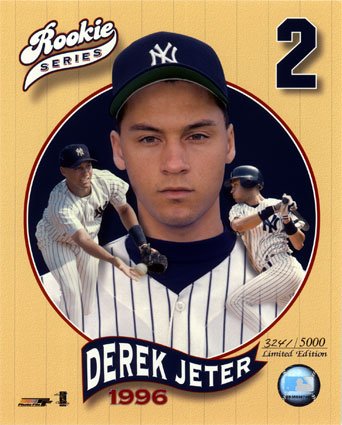 It’s safe to say that most of the perspectives on Derek Jeter’s retiring from baseball will not be written by ID doctors, so let me seize the opportunity.
And since it’s always risky to dwell on players from a certain team while living in Boston — I have friends for whom a central component of their identity is Hatred for the Yankees — this will be less about Jeter’s retirement and more about how the news made me feel.
In a word — old.
You see, I was at the game when Jeter hit his first major league home run — opening day in Cleveland, April 2 1996, weather a balmy 38 degrees. That was a remarkable year on many fronts, both personal and professional, as my daughter was born, Boston experienced its snowiest winter ever, HIV became suddenly treatable (How About That!), and well, the Yankees won the World Series, in part thanks to their rookie shortstop.
So what was it like to be an ID doctor 18 years ago? Let’s take a look at the Wayback Machine, and I caution those of a certain age that this is guaranteed to make you feel downright ancient:
- You were still doing gram stains in a hospital lab that was on the patient floors.
- Aminoglycosides were a regular part of “triples” — you know, amp, gent, clinda.
- Amphotericin B had no liposomal formulation, and was co-administered with all kinds of magic potions (diphenhydramine, meperidine, hydrocortisone, pixie dust) to make it better tolerated.
- Erythromycin was used as an actual antibiotic — sometimes even intravenously.
- Ritonavir was used as an actual antiretroviral, and the dose was 600 mg twice daily (yes kids, you read that right).
- Severe C diff was extremely uncommon, and almost never happened in an outpatient.
- Community-acquired MRSA might be presented at an ID case conference given its rarity.
- There was hardly any vancomycin-resistant enterococcus — good thing, too, since there was no linezolid.
- If you wanted a quinolone to treat community-acquired pneumonia, you were out of luck — levofloxacin wasn’t approved until December 1996.
- If your patient needed indinavir, he/she needed to get it from a single mail-order pharmacy called “Statscript.”
- No echinocandins, oseltamivir, tigecycline, cefepime, daptomycin.
- Some days you spent half of your time on rounds looking for X-rays. These were actual films, viewed on a light box — or, if you were in the radiology department, on those noisy contraptions that rotated light boxes. (What did they do with those things?)
- These numbers/letters meant nothing: HLA-B*5701, HPTN 052, K65R, E138K, CCR5, CXCR4, Q80K, PrEP, TDF.
- Target vancomycin trough level: 5-10.
- Some people were actually taking ddC — which, despite the medical “information” from Dallas Buyers Club, was a pretty horrible medication.
- Best place for drug information was often the “PDR”. If you’ve never heard of it, don’t ask.
I could go on like this all day, but why not finish on a high note?
4 Responses to “Jeter is Retiring, and Certain ID Doctors Are Getting Old(er)”

Paul E. Sax, MD
Associate Editor
NEJM Clinician
Biography | Disclosures & Summaries
Learn more about HIV and ID Observations.
Thanks for including 6,7,12,15 and 16 so I could feel included! I assume Jeter played baseball? 😉
How about 1976, when:
1) Interns did their own Gram stains
2) Gent was part of the big 2: Gent + Cephalexin
3) It was called ‘amphoterrible’ no matter what we gave it along with it
4) When you spoke of macrolides you still heard ‘trolandeomycin’ mentioned
5) Antiretroviral would have been considered being prejudiced against old viruses
6) Clostridia only caused soft tissue and veterinarian infections
7) No one knew what an MRSA was but on rounds someone would claim it was mentally challenged SA
8) Enterococcus was easy to kill and didn’t shoot back
9) The only Quin- was quinine
10) And the only ‘vir’ was virulent
11) You could pronounce all the antibiotics easily and say them 3Xs real fast
12) We spent a lot of time at those things called ‘view boxes’ but they were really noise boxes
13) The only acronyms with were HLAs
14) Vancomycin was called Nafcillin
15) We would have thought ddC was Washington, DC pronounced with a stammer
16) The PDR was something you looked at when your Chief resident wasnn’t around
17) Derek Jeter was 2 years old and we didn’t have marvelous videos like the one you shared
18) Thanks for a ride in Rocky the Flying Squirrel’s “Wayback Machine”
6, 7 and 8 and actually frighten me, given what we routinely see today. 🙁
I remember the rarity of MRSA at the VA during my fellowship 28 years ago, when we had to follow every infection procedure known to man at the time: full gown, goggles, gloves, mask, and shoe covers. The patients were housed in respiratory isolation rooms. We followed the same precautions with HIV patients, as no one at the time knew the means of transmission. Then, it was the “gay disease” which also affected hemophiliacs, and Western Blot was the only test to detect the virus. Before protease inhibitors, HIV was a death sentence, usually from Kaposi’s sarcoma or pneumocystic pneumonia. Do we even see those two diseases anymore?