
An ongoing dialogue on HIV/AIDS, infectious diseases,
March 15th, 2013
Tom Seaver Has Lyme Disease, and the Baseball, ID, and Wine Trifecta
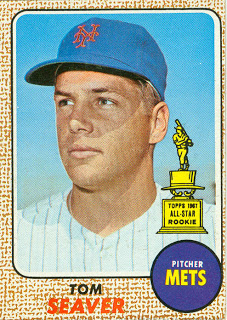 In my never ending quest to link up various passions in life — especially baseball and Infectious Diseases — I bring you this news story:
But for Seaver, after months of private denial, the scariest incident came when his head vineyard worker, who has been with him for seven years, came into the house one morning. “I looked at him and I didn’t know his name,” Seaver said. That’s when Seaver’s wife, Nancy, made him finally go see a doctor. After Seaver underwent an examination and a battery of tests, the doctor informed him that he did not have dementia, had not had a stroke and was not terminally ill. He had Lyme disease.
Fans of Tom Seaver will be pleased to hear that he’s doing better. Additional thoughts:
- His case sounds familiar, as the worst complications of Lyme not surprisingly occur when the diagnosis is delayed for months. These are truly tough cases, much in need of both better treatments and some sort of marker of disease activity.
- One of the first baseball games I attended in person was this one at Shea Stadium. Eleven strikeouts, no walks, 1 (9th inning) hit — game score of 96! Wow! Probably way more than you want to know about game score here — it’s basically a marker of pitching dominance. Anything over 90 is outstanding, over 100 of historical greatness.
- But that’s not all: Seaver and his wife own a highly esteemed Napa Valley vineyard (check out the top of that wine bottle), and their limited-production cabernet regularly scores in the mid-90s in the wine press, once scoring a 97. That’s almost as rare as a game score of 96 — think of it instead like an ERA of under 3.00 for the season. And yes, it’s another reason why this Seaver story caught my eye.
Get well soon, Tom Terrific!
March 10th, 2013
Really Rapid Review — CROI 2013, Atlanta
 As noted previously by Carlos del Rio in his nice summary, the Conference on Retroviruses and Opportunistic Infections (CROI) turned 20 this year. It also made it’s first-ever stop in Atlanta, home of many things that begin with “C” — CDC (note that insiders rarely say, “the CDC”), CNN, Coca Cola, and Carlos himself.
I’ll spare you the boring saga of just how messed up the travel was back to the Northeast as the conference came to a close — ugh — and jump right in on this Really Rapid Review™, loosely organized by prevention, treatment, and complications.
- Baby “cured” of HIV. Need I say more? Nah.
- In the VOICE study of pre-exposure prophylaxis (PrEP), none of the interventions worked — not oral TDF, oral TDF/FTC, or vaginal TDF gel. The adherence was dismal — it seems that only around 25-30% of the more than 5000 African women took their assigned treatment. At the conference, the “joke” was that at least the side effects were minimal — hey aren’t we a funny bunch of HIV researchers. The unfunny part was the alarmingly high HIV incidence among the participants, especially the young women in South Africa.
- No excess in HIV incidence or high risk behavior after stopping PrEP in the iPrEx study. Quick aside — do you like it when the study title is declarative about the result, as in these two papers? I do.
- Interestingly, even after the 052 results were released to the study subjects, many of those randomized to deferred therapy still chose not to initiate ART. Several possible explanations — they felt fine, they had many months of clinical stability, and importantly were initially counselled that their CD4 cell counts were high enough to defer therapy.
- Can the long-acting injectable integrase inhibitor GSK1265744 be the answer to PrEP adherence issues? We’re talking REALLY long acting, with protective drug levels potentially months after the dose. If it’s an injection every 3 months, this crazy idea just might work.
- Here’s an interesting diagnostic tidbit — the 4th generation combined HIV antigen/antibody tests may have a small “window” when p24 antigen turns negative before the HIV antibody becomes detectable, analogous to the hepatitis B surface antigen/antibody window. The combined test is still better than antibody alone for early infection, but it does highlight how useful it would be to have HIV RNA (viral load) licensed for diagnosis.
- More evidence that the earlier treatment is started after HIV acquisition, the smaller the size of the latent reservoir. More reasons to treat (rather than observe) patients with acute HIV.
- In a CDC-sponsored study of 10 sentinel sites in the USA from 2007-2010, the prevalence of transmitted drug resistance among newly diagnosed patients was 16%. Breakdown by drug class: NNRTI 8.1%, NRTI 6.7, and PI 4.5%. Compared with their prior report, the overall rate is around the same, while NNRTI resistance is rising. Given the improvement in virologic suppression rates that happened in the late 2000s, I expected transmitted drug resistance to drop — maybe next time!
- In a randomized, double-blind clinical trial in over 700 treatment-experienced patients, once-daily dolutegravir was superior at 24 weeks to twice-daily raltegravir. Every year there’s a study that gets the award for “CROI Poster That Most Deserved an Oral Presentation,” and this is the 2013 winner. FDA approval of dolutegravir expected this summer.
- On the topic of dolutegravir, treatment response in 2 treatment-naive studies was consistent among various demographic and clinical subgroups. A third study (vs. boosted darunavir) is ongoing.
- If a patient has failed treatment using the three original drug classes (NRTI, NNRTI, PI), and has more than two active drugs besides NRTIs on resistance/tropism testing, do you need to include NRTIs in the salvage regimen? According to this ambitious clinical trial, the answer is no. Virologic responses were similar, with or without the NRTIs. Oddly, there were six deaths in the NRTI arm, zero in the “no nukes” arm — hard to see that as being related to anything but chance, as the causes of death did not seem drug-related, but it’s weird nonetheless.
- After a first-line failure of a standard two NRTIs + NNRTI regimen, lopinavir/r + NRTIs and lopinavir + raltegravir were similar in efficacy. One might expect the latter to be better (two new fully active drugs, after all), but most likely adherence was the key determinant of outcome in both study arms. This was a poster too, by the way — winner of second place in that above-mentioned award.
- Could tenofovir alafenamide (TAF) be a safer version of tenofovir (TDF)? In this phase II study, renal and bone parameters were both significantly better with TAF than TDF. Virologic outcomes were similar, but the study was not powered for efficacy. Phase III studies ongoing.
- Maintenance therapy after virologic suppression with a two-drug regimen of raltegravir + maraviroc didn’t work very well (5 of 44 with virologic failure), but the study authors sure had a nifty title — ROCnRAL.
- Splitting up the TDF/FTC/EFV didn’t impair virologic suppression in this report of 478 stable patients switched to separate TDF, 3TC, and EFV. Would be interesting to see how this flies in a more challenging group of patients — e.g., inner-city Baltimore — and for a longer duration.
- Cenicriviroc is a CCR5 inhibitor that also blocks CCR2 — and hence may have anti-inflammatory properties; it was compared with EFV in this phase II study. There were more virologic failures in the cenicriviroc arm, more discontinuations for adverse events in the EFV arm, but the study was small and the formulation highly problematic. Hard to know where this is going — is cenicriviroc potentially a replacement for “key third drug”, or will it be coformulated with 3TC and replace one of the NRTIs? Or will drug development stop, since it’s not as if there’s a driving need for another CCR5 antagonist? We’ll see.
- A first look at at the antiviral effect of MK-1439, an investigational NNRTI. Decent potency, QD dosing, good activity vs 103N, 181C, 190A. The issue, of course, is that NNRTI development has been so very challenging — lersivirine the most recent example.
- In the COAT study of timing of ART initiation in cryptococcal meningitis, the early ART group had significantly shorter survival, prompting early termination of the study. Those with the lowest CSF WBC and impaired mental status did particularly poorly with early ART. A truly important study, done in Africa but with global implications.
- Do OIs still happen once the CD4 is > 500 on ART? According to this massive cohort study, the answer is yes, but very, very infrequently. And here’s a surprise — OIs are more common in those with CD4 500-750 than >750. With such rare events, the sample size needed to be gargantuan — how does 149,730 sound?
- A first report of treating acute HCV (all in HIV positive MSM) with three drugs — peg IF, RBV, and telaprevir. Not surprisingly, it works, and works fast.
- Preliminary results were encouraging in two studies (telaprevir in one, boceprevir in the other) for HIV/HCV coinfected patients with prior HCV treatment failure on IF/RB, but …
- Enough about that inferferon stuff already! Three IF-free approaches: 1) ABT-450/r + a non-nucleoside polymerase inhibitor + RBV; 2) simeprevir + sofosbuvir +/- RBV; and 3) sofosbuvir + ledipasvir (formerly GS-5885) + RBV. Bottom line on all three was that results were outstanding, virtually guaranteeing that interferon-based treatments will soon be a thing of the past. The third of these studies — 100% response in both naives and prior null responders — provided one of the more exciting clinical trial results I’ve seen in years, small sample size notwithstanding.
Apologies if I’ve left out your favorite, would love to hear what I missed — and I reserve the right to add a few based on your suggestions. As for the conference venue, the meeting rooms were comfortable, audiovisuals reliable, the posters easy to see, and there were plenty of Coca Cola products available during the breaks.
Last but not least, I don’t think anyone announced where or when CROI 2014 will take place. Let the speculation begin!
March 5th, 2013
Exploring the Media Fascination with the Baby Cured of HIV
Here’s the story: The mother didn’t know she was HIV positive until delivery, and the baby was found to be infected by both HIV DNA and RNA right at birth. The doctors started combination antiretroviral therapy approximately one day later, essentially as soon as the results came back. There was a good response to treatment, with declining HIV viral loads over the next few weeks that quickly became undetectable.
Successful treatment continued for 18 months, at which time mom and baby were lost to follow-up; the mom stopped the baby’s antiretrovirals. When the two returned to care 5 months later, the baby’s HIV RNA and antibody were both negative — much to the surprise of the doctors. Supplemental testing, using evaluations similar to those done on the Berlin patient, did not yield any evidence of replication-competent virus, and the baby remains off therapy today.
In short, baby cured of HIV. Stop the presses!!! (Do they still say that?) Front page story, New York Times. Look at this Google News Page and the search gadget at the top of this post! Here at CROI, my colleagues and I are all getting e-mails from our friends/family/etc. asking about this “breakthrough.”
And we’re kind of baffled. Because this case will have about as much immediate impact on the HIV epidemic in the United States as the prior cure — that’s right, virtually none. Maybe it will have an impact globally, but that will be a major challenge.
Thinking about it more, however, I understand why this is such compelling news:
- It’s a baby. The media love stories about HIV in babies. The whole “innocent victim” thing is hard to shake.
- It’s a cure. Can’t miss that. And the press is probably hypersensitive about not missing out, since they initially whiffed on reporting the last HIV cure. It was first presented at CROI in 2008 and barely got a peep. Took a resuscitation of the story by the Wall Street Journal and, ultimately, publication in the New England Journal of Medicine for the case to receive major media attention. For the record, rumor has it that a certain highly prestigious medical journal (hint) also initially whiffed on it, rejecting the case report when it was first submitted.
- The public probably doesn’t really understand that HIV in babies is all but 100% preventable. Not emphasized nearly enough in most of the media reports is that the mom didn’t know she was infected until delivery, so she missed out on the key intervention for preventing HIV transmission — treatment of the mom during pregnancy. And since treating pregnant women has long been standard-of-care, pediatric HIV in the United States is vanishing, a real triumph of prevention. Fewer than 200 cases/year in this country, and counting (down).
So what are the practical implications of this case?
First, in developing countries with high HIV prevalence, where perinatal transmission remains a problem, strategies to aggressively treat the newborns of untreated HIV-positive mothers should be implemented pronto. Second, the case will probably teach us a bit more about how we might someday actually cure more than just a single person here and there.
But for now, the headline to this USA Today piece — “Child’s HIV Cure Won’t Mean New Treatments Immediately” — is the understatement of the year.
March 3rd, 2013
It’s Not Safe Sex If You’ve Just Had the Smallpox Vaccine
 One of my more memorable teachers used to love warning us about the hazards of sex.
No, this wasn’t in my 8th grade health class — this was during my first year of Infectious Diseases fellowship, and the teacher was one of our highly experienced attending physicians, now retired.
To him, sex carried limitless infectious risks. He demonstrated these hazards in lectures that featured an endless series of grisly Kodachromes projected in a dark classroom, explicit images that were not for the faint of heart. Think driver’s ed films, only substitute still shots of diseased genitalia.
Now, mind you, this man was married, and had three children. We ID fellows wondered how — literally — those children found their way to planet Earth given his obvious fear of procreation. We envisioned that they were most likely conceived by two people in hazmat suits, communicating via crackly intercom, with requisite background loud breathing.
Imagine the following verbal (and other) exchange, the voices similar to Darth Vader’s in Star Wars.
Him: Requesting permission for exchange of bodily fluids. Over.
Her: Permission granted. Place liquid in sterile receptacle, and evacuate area immediately. Over.
Him: Objective completed. Evacuating area. Over.
Her: Sperm transport initiated. Over
Then, nine months later, voila, a baby!
All of this came rushing back to me when I read this case report of sexual transmission — twice, no less! — of the vaccinia virus from the small pox vaccine. From the summary in Physician’s First Watch:
One man received smallpox vaccine through the U.S. Department of Defense, but he did not cover the vaccine site as instructed. After intercourse with the vaccinee, a second man was hospitalized for painful perianal rash and upper-lip sore, as well as fever and emesis; he reported having had contact with “moisture” on the vaccinee’s arm. The second man then had intercourse with a third, who was also hospitalized with genital and arm lesions.
Yet another infectious risk of unprotected sex — one not even considered by my fearful ex-attending. And here is an interesting comment from a colleague of mine, someone who specializes in HIV prevention:
What surprised me was that transmission was from an enlisted man to another man who presented with anal lesions and had contacted someone who then got penile lesions. Oh dear! Not what I expected as I began reading these case reports. And what’s with the contact with “moisture” on the arm (that could be anything). Did this rather unusual chain of transmission in these three cases occur among immunocompetent hosts, or was it an outlier series of events related to greater susceptibility conferred by underlying HIV infection?
Good question — the HIV status of only one of these men is reported (he was negative). Regardless, is it time to add vaccinia to the (long) list of potentially sexually transmitted infections? Might be enough to get my former attending back out on the lecture circuit.
February 28th, 2013
Guest Post: CROI at 20 — A Look Back
 The inimitable Carlos del Rio looks back at our premier scientific meeting, the annual Conference on Retroviruses and Opportunistic Infections (CROI), which starts this Sunday:
CROI, which started as a small national conference held in a hotel in Washington DC, will hold its 20th meeting this year . When CROI first took place, we had just returned from Berlin, and HIV scientists were frustrated because science was not making progress against AIDS. However, during the opening plenary, Robin Weiss of Chester Beatty Laboratories in London reminded us that AIDS would only be conquered though solid science.
How right he was — CROI quickly became the forum where the best science was presented. Over the years we have learned at CROI about ART management going from single to double to triple therapy and about phase I, II, and III studies of novel antiretrovirals such as ABT-378 (lopinavir), BMS-232632 (atazanavir), GW433908 (fosamprenavir), T20 (enfuvirtide), TMC125 (etravirine), TMC114 (darunavir), MK-0518 (raltegravir), GS-9137 (elvitegravir), and TMC278 (rilpivirine). Landmark ACTG and industry clinical trials and studies that have favored earlier initiation of ART — first presented at CROI — have resulted in modification of treatment guidelines. With HIV-infected persons now living longer, conditions such as lipodystrophy, cardiovascular diseases, and bone disorders have presented new challenges, and CROI has become more than a meeting of ID researchers.
While CROI initially had little international focus, the global epidemic is now a critical part of the conference. Results of important trials such as SAPiT and STRIDE have led to changes in national and international treatment guidelines. Prevention was not at first a major focus, but some of the most important biomedical prevention trials have subsequently been featured, with the result that the divide between prevention and treatment is now all but gone. Finally, at last year’s CROI, first steps toward cure were presented, and the gloomy mood of early years has been replaced by one of cautious optimism that the epidemic can be ended. If — or when— that happens, we can be sure that good science was the cornerstone of such accomplishment.
In this table, I’ve highlighted what I think has been the major news from each year’s conference.
Enjoy the trip down memory lane!
February 24th, 2013
Solve This Problem Please — Microbiology Results in Electronic Medical Records
 Our hospital and affiliated practices have had electronic medical record (EMRs) of some sort for decades, so I’ve had my chance to try my hand at multiple “platforms,” both commercial and home-brew.
(Weirdly — and I kid you not on this — a version of the first iteration from the 1980s is still around, running parallel to a more modern program. That old one remains the best at displaying simple things, like quickly showing a patient’s creatinine or white blood cell count.)
But one thing all these EMRs have in common is that they are pretty lousy at rapidly displaying microbiology results. I certainly see the problem — microbiology reports are a melange of obscure words, diverse numbers, and inscrutable abbreviations. And finding important results in a complex patient with dozens (or hundreds or thousands) of cultures is a major challenge for even the most tech-savvy clinician.
With current EMRs, it’s as if all the work that went into designing text macros and special “functionality” (cringe) had thoroughly drained the programmers’ brainpower, so by the time they got to the microbiology part they just gave up. I can just imagine a dialogue between team members as they faced writing the software for microbiology, realizing that there might be more to an EMR than just fast ways to spit out boilerplate text and nifty graphs:
Software Engineer 1: Hey, look at this — the clinician can now enter a complete normal physical examination just by typing “alt-PE”. And if they hit “control-alt-F7”, then it inserts three paragraphs that document a review of systems, patient education/counseling, and plans for follow-up — a guaranteed billing up-code.
Software Engineer 2: Cool! And watch this — we can graph this patient’s MCV, MCH, and MCHC going back to 1983 in 3 dimensions and using 9 colors. Nifty MP3 audio file adds a “swoosh” sound when the graphic appears.
Software Engineer 1: Awesome, great work! (Takes a swig of Red Bull, eats a few Doritos.) Hey, did you decide what to do with this information? (Hands over a piece of paper with the following printed on it.)
Specimen: Wound
Date collected:  February 16, 2013
Date reported:  February 18, 2013
4+ PROTEUS VULGARIS GROUP      VITEK AST-GN53 CARD
Antibiotic Result ---------------------------------------------- Amikacin <=2 S Ampicillin >=32 R Cefazolin >=64 R Cefepime <=1 S Cefoxitin <=4 S Ceftazidime <=1 S Ceftriaxone <=1 S Ciprofloxacin <=0.25 S Ertapenem <=0.5 S Gentamicin <=1 S Levofloxacin <=0.12 S Meropenem <=0.25 S Nitrofurantoin 128 R Trimethoprim/Sulfamethoxazole <=20 S Unasyn 8 S 4+ ESCHERICHIA COLI VITEK AST-GN53 CARD Antibiotic Result ---------------------------------------------- Amikacin <=2 S Ampicillin <=2 S Cefepime <=1 S Cefoxitin <=4 S Ceftazidime <=1 S Ceftriaxone <=1 S Ciprofloxacin <=0.25 S Ertapenem <=0.5 S Gentamicin >=16 R Imipenem <=1 S Levofloxacin <=0.12 S Meropenem <=0.25 S Nitrofurantoin <=16 S Tigecycline <=0.5 S Trimethoprim/Sulfamethoxazole >=320 R Unasyn <=2 S
Software Engineer 2: (Wearily.) Nah … too tired. (Drinks some Mountain Dew. Gets excited again.) I know, let’s work on building in even more ways to guarantee that people will forget their username and password!
Maybe I’m not being fair to our friends in IT, but it seems someone should have figured out by now how to make information from the microbiology laboratory more digestible — maybe even searchable! And as our institution is in the midst of a giant shift — one could even call it an EPIC shift — to a new EMR, I’m hopeful we’ll see some innovative work in this tricky area.
Any bright ideas out there?
February 13th, 2013
Medication Adherence: The Final Frontier
 Treatment of HIV has become so amazingly effective that when it fails, it’s no overstatement to say that it’s usually because the patient is not taking the medications. There are all kinds of provider-related reasons for this — inadequate patient education, prescribing and dispensing errors, failure to address language or education deficits — but here I want to focus on the patient-related causes.
In other words, on non-adherence.
(This used to be called “non-compliance.” That term has become un-PC; for some reason non-adherence is viewed as nicer. Please explain.)
Non-adherence in HIV care comes in a variety of flavors, including:
- Denial — “I feel fine, so why should I take those medicines? Yes, you tell me I have HIV, but I don’t really believe it’s a dangerous condition, or even that I have it, since as I said, I feel fine.“
- Stigma — “I won’t take those medications because each dose reminds me that I have HIV. And that makes me feel awful again and again, so until we can solve that problem, no chance I’m taking HIV meds.”
- Chaos — “You say I should take these medications, but how can I do so when my life is so horribly complicated because of family issues [or addiction or other medical problems or psychiatric disease or homelessness or …], so I’m going to ignore that recommendation to go on meds, and take my chances.”
- Deceit — “I’m taking the medications exactly as you prescribed. I rarely, if ever, miss a dose. Yes, my pharmacy told you I have not refilled my one-month supply of meds since 2009, but that doesn’t change the fact that I’m taking the medications exactly as prescribed. I told you that already.”
- Hypersensitivity — “I get side effects to everything. Literally everything. So I might leave the office today with a prescription, but I won’t fill it, because it will make me sick. Look, when I told you this, and you said that all medicines might have side effects, you proved my point.”
- Sicko — “Sure, I’ll take the medications if insurance covers the cost. But I lost my insurance, so rather than investigate getting on COBRA or an AIDS Drug Assistance Plan (ADAP) or some other program to keep me covered, I just stopped my meds. And that was 6 months ago.”
I’m sure there are others, but this list covers most of them. Note that these are not mutually exclusive, and some of the knottiest adherence problems come when more than one of the above is operative. Note also that I’m not counting the people who simply disappear from care — the “engagement in care” or “linkage” issue — which is a huge problem and responsible for lots of the drop-off in the infamous treatment cascade.
But the multifactorial nature of poor adherence is one reason why studies of adherence interventions so often have negative results. How can any single intervention address all of these factors?
Another reason for the negative studies is that the vast majority of patients do take their antivirals correctly — and this good med-taking behavior is probably especially common among those with the wherewithal to sign an informed consent for a clinical study. Most of these folks don’t need any help at all, so the intervention looks no better than the control; this study is an excellent example.
Yet if we can’t identify ahead of time the small fraction of our patients who will be non-adherent — and study after study says we can’t — how can we target our interventions to the people who need them the most?
(Next up: An Adherence Intervention that Actually Works — But There’s a Catch)
February 7th, 2013
Ciguatera Is Hot (But It Could Be Cold)
 The news about the cases of ciguatera fish poisoning in New York (NY Times here, MMWR here) reminded me of several unusual things about this form of “harmful algal bloom,” as it is so artfully called by the experts.
Specifically, here are six:
- Symptoms are bizarre. It starts out like a standard case of gastroenteritis — nausea and vomiting — but since ciguatera is a neurotoxin, here’s some of the weird stuff that follows: tingling, numbness, bradycardia, hypotension, muscle cramps, tooth pain, and most famously, “paradoxical dysesthesias”, where cold feels hot and hot feels cold. You ask 100 ID doctors about that last symptom, and 99 will shout, CIGUATERA! Just don’t do it in a crowded room.
- We can’t detect it. Vegetarian fish ingest the ciguatera toxin by eating algae off of seaweed and coral reefs; it’s then further concentrated inside larger fish (barracuda, grouper, snapper, amberjack, and surgeonfish) when these little fishies are eaten. (Don’t blame the big fish — this is what fish do — see image.) The problem is that the neurotoxin is odorless and colorless; fish with ciguatera toxin look and smell totally fine. Various folk remedies in Australia and the Caribbean (where ciguatera is common) have been proposed, including allowing cats to be our taste testers: if a cat eats some of the fish and is fine afterwards, then we will be too. Of course, this means adding a significant amount of time to your meal preparation — bad for work nights — and what if you don’t have a cat? Still, it sure beats the other method, which involves putting the fish in an ant pile, and seeing whether the ants avoid the fish — they apparently can tell. But would you want to eat the fish after it’s been in an ant pile? If you’re really worried, better get one of these gizmos, a Cigua-Check.
- We can’t prevent it. The toxin is heat- and cold-stable; our stomach acidity doesn’t touch it either. This means that fish that are perfectly handled, look and smell fresh, and are then cooked appropriately still can have high levels of ciguatera toxin. Freezing, pickling, and marinating also do nothing. What other kind of food poisoning is so occult and so impervious to best practices? Scary!
- Treatment is “supportive.” Beware any condition for which treatment is “supportive.” What this really means is that modern medicine is a lot like what it was several decades (OK, centuries) ago. We “support” the patient while he/she has nausea, vomiting, tingling, numbness, bradycardia, hypotension, muscle cramps, and tooth pain — and thinks that cold things are hot and hot things cold. No anti-toxin, no antibiotic, sorry. After a certain amount of time with this “support”, the patient slowly gets better, and we can take credit for it.
- The words are unfamiliar. We deal with bugs that have complicated names all the time, so barely bat an eye at Acinetobacter calcoaceticus–baumannii or parvovirus B19 or Diphyllobothrium latum. But the ciguatera toxin arises from marine dinoflagellates of the genus Gambierdiscus, specifically Gambierdiscus toxicus. What the heck is that?
- The ID boards are obsessed with marine toxins. Based on the number of practice board questions that deal with ciguatera, scombroid, and paralytic shellfish poisoning, you’d think that these conditions occur almost as frequently as the common cold. One way you can tell someone who is preparing for their ID boards is that they are suddenly experts on these weird diseases, casually mentioning scombroid as the possible cause of any sort of flushing, or red tide as the cause of diarrhea. Fortunately, this sort of diagnostic bias fades very quickly after taking the exam.
If the above six items are not enough, here’s a fun fact: Nobel Prize-winning novelist Saul Bellow had a severe case of ciguatera poisoning, using it as a key plot line in his final novel Ravelstein. One critic actually credited the ciguatera illness as making Ravelstein his favorite Bellow novel and concluded by making a bold proposal:
It certainly seems to me that a number of American novelists could benefit from a cruise to the Western Caribbean of the sort Bellow took, and as many sumptuous seafood meals (red snapper and barracuda especially recommended) as necessary to raise the level of their art through a slightly less-than-lethal dose of cigua.
I suggest that they bring their cats.
January 31st, 2013
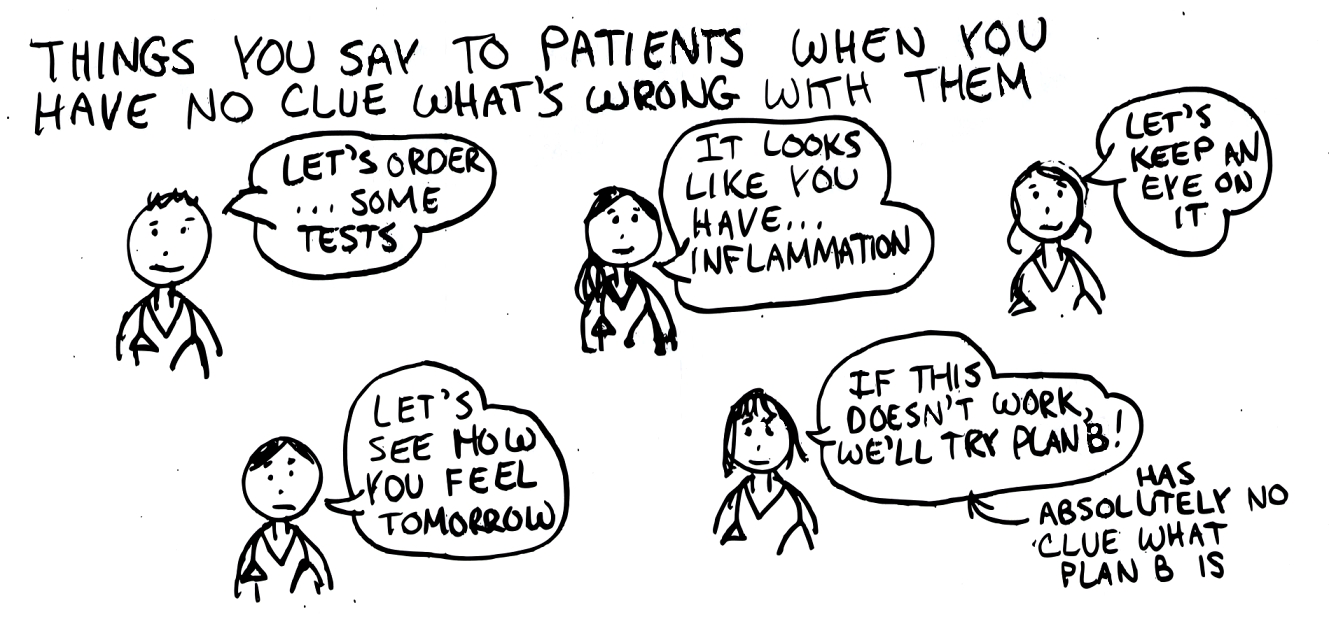
When Your Language Gives Away That You Don’t Have a Clue
 I was doing a clerkship in Medicine way back in my third year of medical school, and had this memorable exchange with one of the hospital’s Distinguished Professors during a case presentation on morning rounds:
Me (nervous): This is a 72-year-old man admitted with chest pain. He has a past medical history notable for a heart attack 2 years ago …
Distinguished Professor (clearly annoyed): Paul, now that you’ve been in medical school for a while, you can start using the appropriate medical terminology — especially during case presentations. We don’t say “heart attack” — we say “myocardial infarction”, or the abbreviation “MI.” When you use the wrong term, you sound like you don’t know what you’re talking about.
Me (now feeling around 2 inches tall): Can I press the rewind button on this day and go back 10 or 15 minutes?
Distinguished Professor (confused): What do you mean …
Me (now feeling 1 inch tall): Never mind. This is a 72-year-old man admitted with chest pain. He has a past medical history notable for a myocardial infarction 2 years ago …
At least that’s how I remember it — it’s possible I didn’t say the joke about the rewind button, but I certainly was thinking it. Was he too harsh? Perhaps — after all, most people (even doctors!) know what a heart attack is, but I suppose I offended his sophisticated medical sensibilities and sounded incompetent. Oh well.
Anyway, I was reminded of this unfortunate event with a recent e-mail that came my way:
Dear Dr. Sax,
I am writing to invite you to submit a chapter on HIV Infection and the AID Syndrome [bolding mine] for our proposed on-line medical textbook, [insert name of latest UpToDate challenger here]. We have already assembled a substantial roster of specialists …
Now I have no idea whether this latest web venture will succeed, but in at least our world, they’re not off to a very good start. Because you can bet good money that the woman who emailed me is one of the few inhabitants of planet Earth who has used the bolded phrase above — “the AID Syndrome” — in place of the full abbreviation “AIDS.”
Makes “heart attack” sound like sophisticated medicalese at its most rarefied!
And while “AID Syndrome” is technically correct — Acquired Immune Deficiency Syndrome = AIDS = AID Syndrome — it sure does sound like she is completely clueless.

Paul E. Sax, MD
Associate Editor
NEJM Clinician
Biography | Disclosures & Summaries
Learn more about HIV and ID Observations.

 FROM NEJM — Recent Infectious Disease Articles
- The End of the War on Biomedical Science? September 19, 2026The turmoil of the past 20 months has inflicted lasting damage on American science and public health. But history and recent events suggest that the attacks will subside.
- Cerebral Schistosomiasis September 19, 2026A rice farmer presented to the ED after a 1-minute episode of arm and leg shaking on the right side. MRI showed linear enhancement associated with a cluster of enhancing nodules and surrounding edema in the left frontal lobe.
- Human Adenovirus B3–Induced Immune Thrombocytopenia and Thrombosis September 17, 2026Virus-induced immune thrombocytopenia and thrombosis after HAdV-B3 infection supports a shared platelet factor 4–targeted immune mechanism linking natural adenovirus infection and adenoviral vector–associated disease.
- Honoring the Legacy of the HIV Epidemic September 17, 2026Progress against the U.S. HIV epidemic is stalling, owing in part to government attacks and fear. But clinicians, patients, and activists can learn from the epidemic’s early heroes and find ways to advance.
- Short or Long Antibiotic Regimens in Orthopedics September 16, 2026In a randomized trial involving adults who received local antibiotics during surgery for orthopedic infection, a short duration of systemic antibiotics was noninferior to a long duration regarding treatment failure at 12 months.
- The End of the War on Biomedical Science? September 19, 2026