
An ongoing dialogue on HIV/AIDS, infectious diseases,
May 30th, 2016
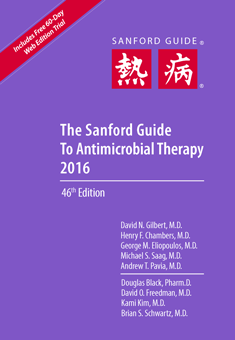
The Sanford Guide — 46 Editions Later, Still Going Strong
 I recently had a chance to visit Portland, Oregon, which for many will conjure up images of bicycles, hipsters, Mount Hood, roses, organic everything, and craft beers.
It’s also the lifelong home of Dr. David Gilbert, the lead editor of The Sanford Guide to Antimicrobial Therapy, an invaluable resource well-known to almost every clinician. Dave was kind enough to act as my host one afternoon last week, and he shared with me some interesting facts about this remarkable handbook; I’ll add some of my personal experiences with the guide as well:
- Dr. Jay Sanford provided the inspiration for the guide with a Medical Grand Rounds on newer antibiotics. The demand for the typed handout accompanying the talk was so strong that Drs. Sanford and Gilbert (who authored some of the original tables) realized they might be able to distribute it more widely. Oh, and this was in 1969 — the year of the Apollo 11 moon landing, Nixon’s first term, Woodstock, and the Miracle Mets, just to orient you to the time.
- There was never really a publisher of the guide, at least not in the traditional sense. The very definition of a home-grown enterprise: Sanford happened upon a small family-owned print house in New Jersey; they agreed to take on the project at a good price, and printed the guide for 10 years until the job became too large. It’s now printed by a large national printing company, and the publisher is “Antimicrobial, Inc” — essentially the Sanford family. Not aware of any other medical text with this arrangement.
- From 1989 through 2015, 24 million print versions of the Sanford Guide were sold. Sales peaked at 1.6 million copies/year. As with essentially every published work, print sales have declined due increasing use of the electronic version.
- The biggest challenge for the Sanford Guide was creating an electronic version. The complete process took 5 years, with the first electronic version released in 2010; the guide is now the top selling medical app in the Apple App Store. Says Gilbert: “The electronic version is frankly better in many ways… it’s much easier to express recommendations in the digital format.” Progress.
- The guide is strictly independent from industry. Before regulations on pharmaceutical gifts to physicians, we ID doctors (and I imagine others) would frequently receive a Sanford Guide gratis from various companies — often in a protective plastic cover, emblazoned with that company’s logo (only to be quickly covered with strategically placed masking or duct tape). Source of these guides notwithstanding, the content is solely created by the editors, using established guidelines and best judgment. Per Gilbert, industry might contact the editors regarding decisions on individual products, generating “spirited discussions” — but that’s it.
- The guide is published in 12 languages. Chinese, Japanese, Polish, Italian, Spanish, Portuguese, Russian, Georgian, Croatian, Turkish, Korean, and Vietnamese. (In case you were wondering.)
- I got my first Sanford Guide right before doing my “core” clerkship in medicine. A friend of mine, already an intern, offered this sage advice to me, a very nervous med student: “Get a copy of the Washington Manual and that little antibiotic book with Chinese letters on the front — that’s all you’ll need.”
- The Chinese characters on the front mean “hot disease.” Sanford was a consultant to the US Army, including the Medical Corp in Korea. That’s where he first saw these Mandarin Chinese characters, and confirmed with Korean physicians that this was a way of expressing “fever”.
 The Guide is the first of the “Handy ID Resources” I list in a talk on curbside consults. In a lecture entitled “Can I Ask You a Quick Question?” (all ID doctors will recognize that phrase), I show the slide on the right. Allows me to make a joke about the challenges of presbyopia — aren’t we doctors funny? — and to mention that the Sanford Guide comes in large print versions since the original text size became unreadable for many of us years ago.
- A friend and co-resident belittled my specialty choice of ID by citing the Sanford Guide. “How could you choose a field,” the future cardiologist asked, “where everything you need to know is in a little book small enough to fit in your pocket?” Wish I had a clever response at the time — something like, “How could you go into a field that is just an electronic pump and some tubes?” But when you think about it, there is a ton of information in each little Sanford Guide; any person who knows all its content is pretty smart indeed. (For the record, that co-resident has done quite well for himself, thank you — and I doubt he reads this blog.)
- Some ID doctors only pull out their Sanford Guide when no one is looking. I’ve had more than one ID attending — usually in his or her first year on the faculty — say they were too embarrassed to admit needing to look stuff up. The implication is that everyone should be able to remember the dose of IV ciprofloxacin with an estimated GFR of 30, or whether meropenem covers Stenotrophomonas. (It doesn’t.) But think about it — would you want your airline pilot to just try and remember the route from Chicago to Istanbul, or prefer that they consult a guide of some sort? If you need Sanford — or the Hopkins Guide, or UpToDate — no need to worry. I promise you will not be reported as deficient to IDSA, or have your board certification rescinded.
- The guide has given me numerous “teachable moments” when answering ID questions. For many years, a colleague and I answered the ID questions of a large multi-site group practice in the Boston area. Not surprisingly, the answer to many of these queries was clearly listed in the Sanford Guide. When confronted with a question on endocarditis prophylaxis, or when to give rabies shots, or whether antibiotic X covered bacteria Y, or whatever, I’d sometimes start this dialogue:
Me: Do you have one of those little antibiotic books, a Sanford Guide?
Curbsider: Yes.
Me: Now go to the index, and look up, “rabies”… you’ll find a table that tells you exactly what to do.
Curbsider: Hey, so it does! What a cool little book.

One last thing — please note that it’s the “Sanford Guide,” not the “Stanford Guide”, as newbies to medicine will sometimes wrongly say.
Those of us at the “Stanford of the East” are sensitive about this kind of mistake.
15 Responses to “The Sanford Guide — 46 Editions Later, Still Going Strong”

Paul E. Sax, MD
Associate Editor
NEJM Clinician
Biography | Disclosures & Summaries
Learn more about HIV and ID Observations.
Odd to me that it hasn’t been translated into French yet…
How funny. I was recently cleaning out my basement and found the 1983 Sanford Guide. I had been considering mailing it to Dr. Sax thinking he would like looking at it. No quinolones, cefepime, or carbapenens.
Stu — would love to see that version! Probably very close to the one I purchased as a med student … maybe a year or two earlier.
Paul
I remember clearly doing a medical student rotation in Wales in the late 80’s and the ‘microbiologists’ there (as the ID team called themselves) asked me to send them some copies of the Sanford guide upon my return to the US. Other highlights – visiting BATH with a local rheumatologist and getting served tea and biscuits by the ‘ward sisters’ at 11 am daily!
As an ID fellow I rounded two months with Dr Sanford. He was a joy to talk to and an inspiration to follow. He never carried a copy of his guide on rounds, but could quote the latest information from it almost verbatim!
Love the Sanford Guide! Hopkins is great, too.
Off-topic, but the CDC travel site you reference in your PowerPoint slide is a life-saver for primary care clinicians like me. I recently had a patient who was going to Tajikistan. She is on some powerful immunosuppressant meds for autoimmune disease. I needed to know what vaccinations she needed and whether she would need malaria prophylaxis (she did, but only because of her immunosuppressants). The CDC travel site (and “the yellow book” that is part of it) had all the answers. Your tax dollars at work!
Dr. Jay Sanford was an amazing teacher at Southwestern Medical School (1972-76 for me) in Dallas. An energetic short man, he would lecture to 2nd year students in a lab coat that almost touched the floor. And, yes, we had his very useful Guide, before the Pharma logos and with legible print before it got so small. That and Nelson’s Pediatric Guide got us through our medical school rotations.
Dr. Sanford was the president of my medical school for many, many years. A wonderful man who loved teaching and all of his medical students. I met him my first week when he accompanied our class to field medicine exercises in the Texas heat of July. Later, at the campus in Bethesda he further impressed us by joining in on Airborne training and rappelling down the side of a four story building. He lead by example in all things. We all miss him.
Those of us at the Uniformed Services University of the Health Sciences, where Dr. Sanford was our President and first medical school Dean, are also a little bit sensitive about it being called “Stanford Guide” as well. He was revered here and is still a legend. Doesn’t surprise me in the least that the Guide is still going strong so many years later. As Dr. Secord said, we all miss him!
There is indeed a french version (truly Belgian-Luxemburg one)
I used to keep Sanford on my iPhone, til one year the newest version had a black background with purple text. It was absolutely unreadable. So, I purchased the Johns Hopkins guide, one time purchase with free updates. I also love Mark Crislip’s IDC app.
I got first one from american doctor, he was working for Peace Corps in Ukraine. One of the volunteers fell ill with diphtheria, she was treated in our ID Hospital in Kherson, Ukraine. It was 1995 edition. Then I purchased printed and downloaded electronic editions. That little book really changed my practice. I use it together with medscape.com app.
I have had not the chance to be student of Dr. Sanford but I always have been admiring this great man in my heart for the very clever method used in his guide book.
May God bless him and his soul stay in peace for his great work.
You are nearly as witty as you are smart. What a great serendipitous find! The video on Portlandia was an unexpected bonus.
You, Doctor, have made my Saturday morning even better. Thank you.
Is there any details about this subject in different languages?