
An ongoing dialogue on HIV/AIDS, infectious diseases,
June 12th, 2025
Why the Sudden Firing of ACIP Members Should Put Every Clinician on High Alert
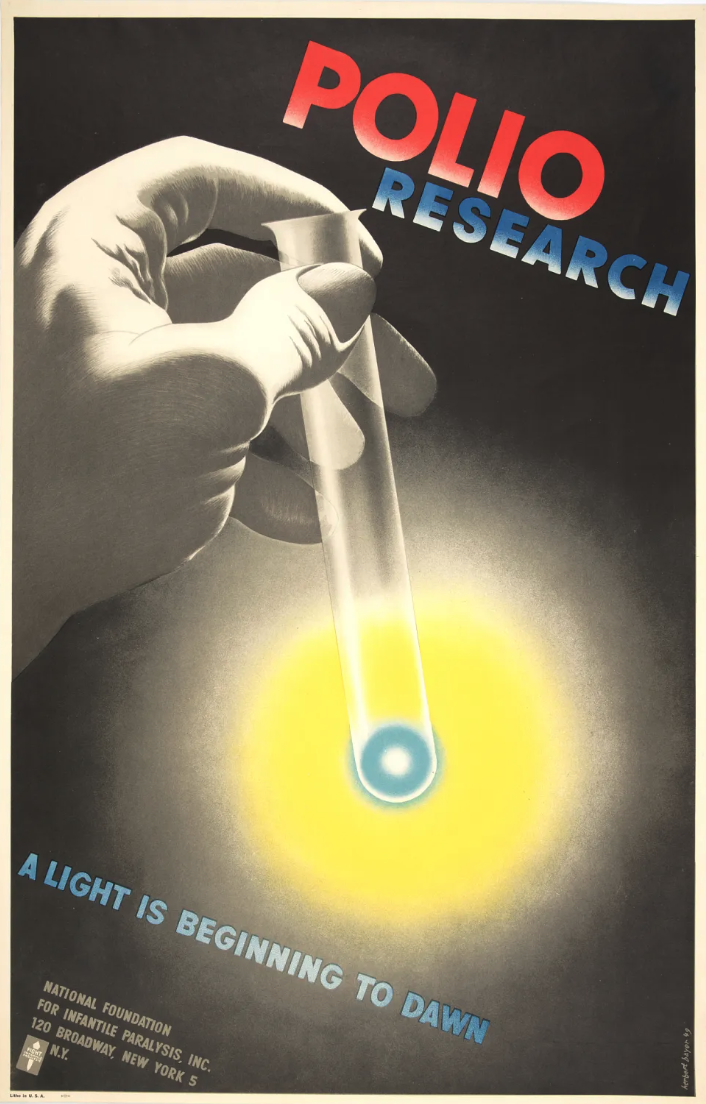
Public health poster, Herbert Bayer, 1949.
There are certain irrefutable verities when, like me, you’re an infectious diseases specialist married to a pediatrician. Here are our top two, which are deeply interrelated:
-
Infectious deaths in children, or severe illnesses that lead to lifelong disability, are more devastating than similar events in adults. Each such case in a baby or child is so very tragic. I’ll again quote Dr. Burton Grebin: “To lose a child is to lose a piece of yourself.”
-
The success of vaccines in preventing those deaths and illnesses stands as one of the great accomplishments of modern medicine.
Seen a case of Haemophilus influenzae meningitis in a kid lately, one so severe they have permanent deafness or other neurologic sequelae? The same bug causing epiglottis, forcing a child to lean forward, afraid to talk and struggling to breathe? Bad rotavirus diarrhea in a baby, leading to that awful look of sunken eyes and the clinical descriptor, “floppy”? Whooping cough in an infant who can’t catch their breath? Or measles complicated by pneumonia or encephalitis that required hospitalization?
Thanks to vaccines, even busy clinicians rarely if ever see such cases today. As I’ve noted here before, if you combine the total number of cases of measles seen by my wife and me in our cumulative decades of practice, you’d fit that number on one hand, and have a couple of fingers left over. And we’ve witnessed first-hand the near disappearance of invasive disease from Haemophilus influenzae, severe varicella, and rotavirus disease.
It’s no wonder, then, that when the nomination of Robert F. Kennedy, Jr. to head the Department of Health and Human Services began circulating, my wife and I watched the proceedings with intense interest, and rising dread. I naïvely hoped that Sen. Bill Cassidy, a physician himself and ranking member of the Senate HELP Committee, would do the right thing and block the nomination, as he shared his concerns about Kennedy’s anti-vaccine views during the nomination process.
Alas, he did not block the appointment. In fact, he issued a statement explaining his support, citing Mr. Kennedy’s assurances that he would preserve the existing vaccine infrastructure:
He has also committed that he would work within the current vaccine approval and safety monitoring systems, and not establish parallel systems. If confirmed, he will maintain the Centers for Disease Control and Prevention’s Advisory Committee on Immunization Practices (ACIP) without changes.
Emphasis mine — because earlier this week, Kennedy announced the removal of all current members of ACIP. So much for those assurances. Yesterday, he replaced them with eight new members of varied backgrounds, some of whom clearly share his skepticism about the benefits of childhood vaccines.
His stated motivations for the firings, rife with misstatements and oversimplifications, reveal a profound misunderstanding of how ACIP works. It also provides a glimpse into Kennedy’s longstanding distrust of vaccine safety and efficacy.
Let’s be absolutely clear: ACIP was a group of unpaid vaccine experts who based their recommendations on clinical data, safety monitoring, disease surveillance, and cost-effectiveness. They were not shills for the pharmaceutical industry. They were not political actors. Their deliberations were public and open to commentary. For years, their work has been critically important in shaping policy and ensuring insurance coverage for vaccines in our byzantine healthcare system.
What policies will we get from the new panel? More importantly, what will be the health implications for our society? Time will tell — an ACIP meeting is planned for later this month, and their actions should be watched closely by pediatricians, ID specialists, and indeed all clinicians. Already, alarmist headlines predict dire health outcomes ushered in by this regime change, and many of us worry it will further undermine confidence in vaccines that are of critical importance to childhood health. We’ll see.
But one thing is certain: For anyone who expected that Kennedy would “maintain the Centers for Disease Control and Prevention’s Advisory Committee on Immunization Practices (ACIP) without changes,” this week’s events are a clear reminder that actions speak louder than words.
6 Responses to “Why the Sudden Firing of ACIP Members Should Put Every Clinician on High Alert”

Paul E. Sax, MD
Associate Editor
NEJM Clinician
Biography | Disclosures & Summaries
Learn more about HIV and ID Observations.
We must safeguard evidence-based use of ANY approved and many Experimental Vaccines and meds when it comes to saving a human life in the context of a thorough and caring medical context.
The recently dismissed ACIP members demonstrated their lack of application of basic efficacy, safety, and benefit/risk assessments based on robust data when they recommended the mRNA COVID-19 vaccines for infants and children.
That recommendation was shocking to me, based on my 15 years as a drug development ID physician specializing in safety and benefit risk analysis. The ACIP recommendation that these vaccines be included in the routine childhood vaccine schedule, including repeated periodic vaccinations, was done without anything close to adequate efficacy or safety data. There were no (and still aren’t) placebo controlled, randomized studies in this population designed to assess clinical efficacy, and the numbers of subjects in the studies were vastly inadequate to assess safety.
I am not against vaccines, but each vaccine does require adequate testing, efficacy and safety analysis, and assessment of benefit/risk for each population for which it is recommended. There are, in fact, no robust clinical trial data to provide such an assessment for the mRNA COVID-19 vaccines in infants or children.
Further, there were no long term safety assessments in adults provided from the initial placebo controlled trials, and there were failures to comply with post-EUA safety commitments. Pivotal clinical trials of subsequent versions of these vaccines (which did not include a placebo control) did not assess clinical efficacy, and were also far too small to assess safety. Yet they were published in the NEJM without strong criticism of these failures in clinical trial designs which left prescribers without critical clinical data.
Hence, physicians do not have the data required to educate patients and parents, nor to provide an opportunity for true informed consent, a necessity in the ethical practice of medicine.
This, and other, ACIP recommendations indicated that committee member changes were absolutely necessary.
I’m not yet familiar with the work and experience of all the newly appointed committee members, but the appointments of Drs Martin Kulldorff and Robert Malone are welcome. Both have demonstrated their commitment to regulatory and medical science, critical thinking and medical ethics throughout the COVID-19 pandemic. If only the IDSA and CDC had similar commitments.
The evidence was well summed up back in 2022 by Moderna at https://stacks.cdc.gov/view/cdc/118382/cdc_118382_DS1.pdf and addresses most of your points. I don’t know how a physician can’t find this to be “the data required to educate patients and parents” in the face of the massive harms of COVID that we all saw. In addition, once we had this evidence, any larger placebo controlled studies would have been unethical. In the years since 2022 there has not been any additional signal of significant harm, so why would you want to roll back the clock on this and expose young children to COVID?
I am confused why you would assert that “there were no (and still aren’t) placebo controlled, randomized studies in this population designed to assess clinical efficacy” – these original studies were all published in the New England Journal of Medicine with numerous follow-up studies on cellular immune responses, long-term safety, and effectiveness studies throughout the peer-reviewed published literature.
Ages 5-11
1. Walter EB, Talaat KR, Sabharwal C, et al. ; C4591007 Clinical Trial Group. Evaluation of the BNT162b2 Covid-19 vaccine in children 5 to 11 years of age. N Engl J Med 2022; 386:35–46. (PMID: 34752019) –> this is a randomized, double-blind, placebo-controlled clinical trial
2. Creech CB, Anderson E, Berthaud V, et al. Evaluation of mRNA-1273 COVID-19 vaccine in children 6 to 11 years of age. N Engl J Med 2022; 386:2011–23 –>–> this is a randomized, double-blind, placebo-controlled clinical trial
Under 5 years of age
1. Muñoz FM, Sher LD, Sabharwal C, et al. ; C4591007 Clinical Trial Group. Evaluation of BNT162b2 Covid-19 vaccine in children younger than 5 years of age. N Engl J Med 2023; 388:621–34. (PMID: 36791162) –> this is a randomized, double-blind, placebo-controlled clinical trial.
2. Anderson EJ, Creech CB, Berthaud V, et al. Evaluation of mRNA-1273 vaccine in children 6 months to 5 years of age. N Engl J Med 2022; 387:1673–87. –> this is a randomized, double-blind, placebo-controlled clinical trial.
As a double board emergency doc who also works urgent care, I am very disappointed with the controversy among patients and especially parents in vaccinating children, and how it has cascaded to almost every facet of medicine. The anti-vaxxers have been given generations of damaging fodder. However, I place MUCH of the blame at Dr. Fauci and his administration’s doorstep. It certainly seems to me that he collaborated with and/or used our tax money to fund bat research in China. I have absolutely no idea how this research could have legitimately been in the interest of public health. I continue to see numerous cases of COVID each week which are unnecessary, as were tragically the hundreds of deathbeds I presided over a few years ago. Couple that with the fiasco created for trust in public health, and the whole thing is inexcusable.
The third promise he made, in addition to not changing the ACIP and not establishing a parallel vaccine safety track, was that he would not alter the children’s vaccine schedule. Since he lied about the first two, it is only a matter of time until he changes the schedule. For the optimists who don’t believe me, consider that this has been a goal of his for a long time.
Alternative organizations are being formed to fill the void left by the new ACIP, which has no credibility, to put it nicely. It remains to be seeing how these efforts will pan out, and in particular, how insurers and healthcare organizations will deal with multiple inconsistent recommendations.
It is the FDA that decides what products are licensed and what are the indications. CDC recommendations fall within FDA indications, but are sometimes narrower. Although vaccines can be used off label, FDA removal of an indication would be an even more powerful suppressant of vaccine use than a change in CDC recommendations. It does not seem clear yet whether the FDA intends to proceed in that direction. If they do, obtaining some vaccines might require travel to a location with more enlightened policies. Unfortunately, most Americans do not have the resources for vaccine tourism in Greenland.