
June 28th, 2012
U.S. Supreme Court Upholds Most of Healthcare Law
The U.S. Supreme Court upheld the majority of the Affordable Care Act in a 5-4 decision on Thursday.
With Chief Justice John Roberts writing the majority opinion, the court upheld the central component of the law — the individual mandate — which requires that most Americans have health insurance or pay a penalty. The court determined that the law was constitutional based on Congress’s power to tax, but not its power to regulate interstate commerce.
The decision should allow most of the law’s more expansive changes to proceed, the bulk of which are scheduled to take effect in 2014.
Part of the law that expanded Medicaid by threatening noncooperating states with cuts to their Medicaid funding was struck down.
Here are the New York Times story and a timeline for the Affordable Care Act’s provisions.
Sorry, there are no polls available at the moment.The poll is now closed.
June 28th, 2012
What Reading That “Low-Carb Gives You Heart Disease” Paper Actually Told Me
Yoni Freedhoff, MD
The following guest post by Dr. Yoni Freedhoff is reprinted with permission from his blog, Weighty Matters. Dr. Freedhoff is an Assistant Professor at the University of Ottawa and the founder of the Bariatric Medical Institute in Ottawa, Canada.
The short version is it told me that — in this case — the British Medical Journal, and possibly the authors and this study’s peer reviewers, value the publication of unsubstantiated alarmist and media-friendly hype over true journalistic and scientific integrity.
Let me start the longer version of what it told me with a question: Is your style of eating — your dietary repertoire, if you will — the same today as it was 15 years ago? Mine’s certainly not. Fifteen years ago I was a bachelor doing my residency. My diet consisted of burgers, steaks, sausages, pizza, chicken wings, french fries, restaurants, take-out, pots and pots of coffee, and horrible, horrible hospital cafeterias. The fact is, whether it’s consequent to life changes, medical conditions, dietary fads, new relationships, or new jobs, eating style for many varies wildly with time and circumstances.
Yet the researchers of this paper — which looked at the impact dietary style would have on cardiovascular risk among 43,396 Swedish women and concluded that women who followed low-carb diets had an increased risk of heart disease — used only one single baseline dietary data set upon which to base their 15-year-long study and its conclusions.
And about that single, solitary, data set: It consisted of a food-frequency questionnaire in which subjects were asked to identify how frequently they consumed 80 different food and beverage items over the course of the past 6 months.
Think that’d be accurate? Can you remember how many of anything, let alone 80 items, you’ve had over the past 6 months? And what if you ate and drank more than 80 items?
But let’s not guess about accuracy, let actually look at it. Taking the study subjects’ reported average caloric intake, it’s immediately evident that their dietary recall data are inaccurate as the authors report an average daily calorie consumption of only 1,561 calories. That’s an incredibly small number, and one which flies in the face of the Food and Agriculture Organization of the United Nations report of a Swedish per capita average calorie consumption of 2,990 calories during the same time period this study’s data were collected.
But let’s for a moment pretend that the data were in fact accurate and that you could fairly extrapolate that your style of eating today will remain the same for the next 15 years. My next questions would be: Do you think the quality of your diet’s various proteins, carbohydrates, and fats might have a bearing on your risk of developing cardiovascular disease over the next 15 years? Would eating a diet higher in trans-fats confer a different degree of risk than a diet higher in unsaturated fats? Would eating a diet rich in whole grains confer a different risk than a diet rich in ultra processed pulverized flours? How about if you ate out regularly versus cooked from scratch? Deep fried versus baked? Sausages versus salmon? Quinoa versus white rice? Kale versus potatoes? Of course it would matter, and I’d bet even a straw poll of 10-year-olds would agree.
Not this paper’s researchers. You see, they simply reported and analyzed the data from that single-time-point questionnaire by means of 10 different centiles of carbohydrate consumption. They didn’t pay any attention to the quality of the macronutrients being consumed, just their total quantities. The only consideration they gave as to the quality of macronutrients was a very broad “animal protein” vs. plant sources. There was no consideration given to quality of fats (despite the well-known effect of trans-fats on increasing and unsaturated fats on decreasing cardiovascular risk), or carbohydrates (again, despite data that suggest cardio-protective benefits from whole grain and risks from refined grain).
But, okay, let’s even pretend for a moment that the data were well controlled for dietary factors known to affect cardiovascular disease. Is the risk reported in this paper worthy of concern and press release? The relative risk increase of 5% per increase in low-carb score means an extra 4 to 5 cases of cardiovascular disease per 10,000 women in the lowest carb group per year. Should we stop the presses? Given how incredibly small that is absolutely, and given how incredibly complicated it is to control for confounding variables (and I’m not just talking about the unbelievably glaring confounders that were explicitly ignored by the researchers, but also the non-dietary and lifestyle variables of which this study looked at very few), can and should cautionary conclusions truly be drawn let alone publicized?
Last, let’s pretend for a moment that the data are conclusive and that the risk is real and scary enough to shout from the rooftops. Do you think it would matter if the diets studied and being reported as risky weren’t in fact “low-carb” given that the caution being shouted is that low-carb dieting increases the risk of heart disease? Looking at the data, the 1st quartile of lower carb consumption is in fact a diet where the 154.7g of carbohydrates account for 40% of calories. Simply put, that’s not a low-carb diet! Atkins, for instance, starts at just 20g and then over time people tend to work themselves up to between 50-100g. 154.7g? Thats. Not. Low. Carb. Nor is their reported 10th percentile at 123.7g, or 32%, carbohydrate.
So, to review: The authors of this paper are basing their 15-years-worth of conclusions off of a single, solitary — and clearly inaccurate — baseline food-frequency questionnaire; they didn’t control for clearly known smack-you-in-the-face dietary confounders; they found just a miniscule absolute increase in risk; and the diet they are reporting on can’t even be fairly referred to as a low-carbohydrate diet.
Useful? Conclusive? Press worthy?
It gets worse.
The BMJ didn’t just publish a completely useless paper, they gave this very clear, yet completely non-evidence-based, advice to clinicians in their accompanying editorial:
Despite the popularity of these diets, clinicians should probably advise against their use for long-term control of body weight.
Worse still, highly reputable, socially networked curators of medical information tweeted the resultant media stories as relevant, and even Physician’s First Watch — a news alert from Journal Watch and the publishers of the New England Journal of Medicine — reported it as valuable to scores of physician subscribers who trust JW to keep them abreast of the latest important journal studies.
As far as the true state of the evidence on the long-term risks or benefits of low-carbohydrate diets goes, this paper, and the BMJ‘s editorialized conclusions, add absolutely nothing. Given the paper’s rather horrifying flaws, it is a useless contribution to the medical literature. In fact, I’d describe it as worse than useless in that it unforgivably, irresponsibly, shamefully, and knowingly misinforms – something our incredibly, nutritionally confused world really doesn’t need.
[For another take by someone who also actually read the paper, have a peek at Larry Husten’s piece on Cardiobrief (I’m quoted there, too).]
June 27th, 2012
Panel: Early Surgery for Infective Endocarditis
Larry M. Baddour, MD, Sabet W Hashim, MD and John E Brush, MD
CardioExchange has asked three experts to weigh in on findings from a randomized trial, published in the New England Journal of Medicine, comparing early surgery with conventional treatment for infective endocarditis.
Findings from the Trial
Seventy-six patients with left-sided infective endocarditis, severe valve disease, and large vegetations were randomized to undergo early surgery or conventional treatment. All participants received beta-lactam–based antibiotic therapy. The primary endpoint — a composite of in-hospital death and embolic events within 6 weeks after randomization — occurred in 3% of the early-surgery group and 23% of the conventional treatment group (1 vs. 9 patients; hazard ratio, 0.10; P=0.03). The difference was due entirely to a greater incidence of embolism in the conventional-treatment group. The two groups did not differ in all-cause mortality at 6 months. No additional embolic events occurred between 6 weeks and 6 months.
Opinions from the Experts
Question: Will the findings from this trial change your practice? If so, how? If not, why not?
Larry M. Baddour, Chair, Division of Infectious Diseases, Mayo Clinic
Although this is an excellent study, given its limitations, it will not prompt a change in practice for me. These limitations include the relatively small cohort size and the unusual distribution of pathogens that were identified (a predominance of streptococcal species). The work does focus us on the timing of surgical intervention, which deserves much more investigation, as there was no controversy as to need of surgery in the study cohort.
Sabet W. Hashim, Director of Valve Surgery, Yale New Haven Hospital
Surgeons can be reluctant to operate early on patients with infective endocarditis for two reasons. First, if the organisms are not sensitive to the antibiotic therapy, the operation may be associated with fulminating sepsis and vasoplegia, which can be fatal. Second, the presence of small foci of vegetations disseminated on the mitral valve leaflets may preclude the ability to perform a valve repair. With conventional treatment, the major risk in delaying the operation is the possibility of systemic emboli, particularly to the central nervous system.
In this trial, the antibiotic treatment with beta-lactam agents and, in about a third of the participants, additional amino-glycoside successfully controlled the bacteremia in all but one patient. The authors acknowledge the relatively lower incidence of Staphylococcus aureus (11%) in their trial than in other studies. Nevertheless, I wonder about the near-total absence of resistant organisms in the whole randomized group of patients. Did the selection process exclude such patients, given that in most practices, resistant gram-negative and S. aureus organisms are found? Endocartitis involving such organisms often requires changing the antibiotic regimen. The favorable outcome of the patients with early surgery is plausible for patients who have suffered from an infection with sensitive streptococcus organism. To generalize the trial findings to staph-resistant infections, one would need to use antimicrobial agents with a very low incidence of in vitro resistance, such as daptomycin, perioperatively (to provide greater assurance of controlling bacteremia).
Surgeons must concern themselves with whether to perform mitral valve repair or replacement in the early infectious process. This study validates such concern, but the authors do not discuss it. Of the patients with involvement of the mitral valve, only 8 of 22 (37%) in the early-surgery group underwent mitral valve repair, compared with 11 of 17 (65%) in the conventional-treatment group. The difference — 28% — equals the incidence of emboli in the conventional group. Some would consider a valve replacement to be a complication, compared with a valve repair. Therefore, there is a trade-off between emboli and valve replacement. Of course, the disability caused by emboli to the central nervous system is greater than the morbidity associated with a mitral valve replacement, and 5 conventionally treated patients in this trial developed cerebral emboli. On the other hand, the aortic valve patients all underwent replacement, and there is no concern about a lower incidence of reparability in those patients.
From this study, one can conclude that it is reasonable to perform early surgery in the patients with aortic valve disease who have streptococcal infection and large vegetations, but one cannot reach a similar conclusion for patients with nonstreptococcal infections or infections of the mitral valve.
John E. Brush, practicing physician, Cardiology Consultants, Ltd.
These findings favor early aggressive treatment for infective endocarditis. The numbers suggest that operating on 5 patients within 48 hours of making the diagnosis would prevent one occurrence of death or peripheral embolization over 6 months.
The study was well performed, but the participants were highly selected, which may limit applicability. Of 134 screened patients with infective endocarditis, 44 were initially excluded for unspecified reasons, and 26 of those underwent urgent surgery. Fourteen additional patients were excluded because of clinical reasons or refusal. The remaining 76 patients, recruited over 5 years, had infective endocarditis with a large left-sided vegetation and severe valve disease — yet no more than mild heart failure, no prior major embolic stroke with risk of hemorrhagic transformation, and no serious coexisting condition.
Unfortunately, patients with infective endocarditis are usually more complicated. Just 3 weeks ago, I cared for a patient with infective endocarditis and a large vegetation. My patient had an infection of a tissue aortic valve prosthesis. He also had several coexisting conditions, including chronic systolic heart failure and severe peripheral arterial disease. While awaiting a final decision regarding re-do cardiac surgery, he deteriorated and ultimately died.
In practice, infective endocarditis patients commonly have complicating conditions, probably because those conditions predispose them to infective endocarditis. For patients with infective endocarditis without complicating conditions, however, this informative study suggests that surgery within 48 hours of making the diagnosis is the best strategy.
What’s your take on the implications of this study for clinical practice? Feel free to pose questions to our experts.
June 27th, 2012
FDA Approves a New Weight Loss Drug, Breaking a 13-Year Drought
Larry Husten, PHD
The FDA announced today that it has approved its first new weight loss drug in 13 years. Lorcaserin, which will be sold under the brand name of Belviq, is manufactured by Arena Pharmaceuticals and will be distributed in the U.S. by Eisai.
Lorcaserin is indicated for use in obese adults (BMI 30 or above), or overweight adults (BMI 27 or above) with a coexisting weight-related condition such as hypertension, diabetes, or high cholesterol.
“Obesity threatens the overall well being of patients and is a major public health concern,” said the FDA’s Janet Woodcock, in an FDA press release. “The approval of this drug, used responsibly in combination with a healthy diet and lifestyle, provides a treatment option for Americans who are obese or are overweight and have at least one weight-related comorbid condition.”
The FDA is requiring Arena to conduct six postmarketing studies, including a long-term CV outcomes trial. The label will note that the effects of lorcaserin on cardiovascular morbidity and mortality have not been established and that its safety and efficacy when used with other weight-loss drugs has not been tested. During a press conference, the company said that Drug Enforcement Administration (DEA) scheduling normally takes from 4 to 6 months, indicating that the drug might not become available this year.
Arena said that the FDA has recommended to the DEA that lorcaserin be classified as a scheduled drug. The drug will not be available until after the DEA reviews the recommendation and decides whether the drug will be scheduled.
June 26th, 2012
Unlikely PARTNERs Support TAVR
Richard A. Lange, MD, MBA
I had the privilege of serving on both Circulatory Device Advisory Panels that recommended FDA approval of the Sapien Transcatheter Heart Valve (Edwards LifeSciences) in patients with severe, symptomatic, aortic stenosis — in June 2011 for those who are inoperable and in June 2012 for those at high risk for complications of surgical aortic valve replacement (AVR) — on the basis of the PARTNER B and PARTNER A trials, respectively.
Here’s an insider’s perspective on the process:
1) The collaborative support for TAVR by cardiac surgeons and interventional cardiologists is unprecedented. I never imagined I’d see the president of the Society of Thoracic Surgery (STS) championing a percutaneous cardiac procedure . . . much less doing so twice.
2) Sponsor collaboration with the FDA, the Center for Medicare Services (CMS), STS, and the American College of Cardiology (ACC) resulted in a groundbreaking collaborative national registry for TAVR. This sets the standard for future post-marketing studies . . . a long overdue development.
3) Edwards LifeSciences demonstrated a disciplined commercial rollout of this technology in the United States, a sincere commitment to training, and ongoing tracking of procedure success. Hats off to Edwards. Take a bow.
Any concerns about TAVR? Naturally!
1) Patient sex may influence effectiveness. A post hoc analysis of PARTNER A data showed noninferiority of TAVR to surgical AVR in women but not in men (in fact, treatment effects were in the opposite direction for men and women).
2) Strokes are more common with TAVR than with surgical AVR (at 1 year, 5.5% vs. 2.9%) and more common with the transapical then with the transfemoral approach (at 1 year, 9.6% vs .4.6%). Interestingly, the stroke rate in the Continued Access Protocol (nonrandomized) cohort appears to have decreased (at 1 year, 3.7%). Studies are needed to determine the role of procedural technique, patient selection, antithrombotic agents or other factors that may be responsible for this difference.
3) Approximately 15% of TAVR-treated patients develop moderate or severe paravalvular aortic regurgitation, which is associated with increased mortality.
4) Valve durability is unknown. It just hasn’t been around long enough.
The FDA and sponsor agree that post-approval studies are essential. In addition to extending follow-up for the patients enrolled in the PARTNER trial, a prospective registry of consecutively enrolled patients undergoing TAVR is needed.
Based on what we know, would you generally prefer TAVR over surgical AVR in patients considered to be high-risk (surgical mortality >15%)?
June 26th, 2012
Aspirin Reduces Risk for Recurrent VTE
John Ryan, MD and ceciliabecattini690
In the recent WARFASA study, published in the New England Journal of Medicine, Dr. Cecelia Becattini et al found that aspirin treatment in patients with first-time unprovoked VTE resulted in a significant reduction in subsequent VTE but did not increase the risk for bleeding, compared with placebo:
- VTE recurrence: 6.6% per year with aspirin versus 11.2% with placebo
- Major bleeding occurred in one patient in each treatment group.
In this study, patients received 6 to 18 months of oral anticoagulation followed by 100 mg of ASA or placebo daily for 2 years. CardioExchange’s John Ryan had the opportunity to interview Becattini of the University of Perugia in Italy.
Ryan: Dr. Becattini, congratulations on a wonderful study and thank you for taking the time to join us today. In your study, patients with unprovoked DVT/PE were treated with warfarin for anywhere between 6 and 18 months. What, in your view, is the optimum duration of warfarin therapy after DVT/PE, and how do your findings change that, if at all?
Becattini: As we shown in previous studies (WODIT DVT and WODIT PE) extending warfarin treatment for an additional 3 or 9 month period beyond the initial 3 months is not associated with a reduced risk for recurrent VTE after warfarin is discontinued. Thus, I believe that warfarin given for 3 months is probably enough to treat a first episode of unprovoked venous thromboembolism in the majority of patients. The results of the WARFASA study support the possibility of a long term secondary prevention of recurrent venous thromboembolism with aspirin after the initial anticoagulant treatment. If our results are confirmed by an ongoing study with a similar design, aspirin could be included among the options for extended treatment of venous thromboembolism.
Ryan: In the recent EINSTEIN-Extension study, DVT/PE recurrence was decreased ~80% by rivaroxaban therapy. With the introduction of novel anticoagulants, how does one decide between ASA and agents such as rivaroxaban and dabigatran and what does the evidence tell us?
Becattini: The new oral anticoagulants, including rivaroxaban and dabigatran, have the potential to change the current practice related to the treatment of venous thromboembolism. The risk reduction observed in the WARFASA study is only about 40%.
However, data on indefinite anticoagulation with the new drugs are not currently available and some concern remain after that placebo controlled trials showed an increase, although limited, in bleeding complications with these agents. These points should be taken into account when deciding on the agent to be used in the extended anticoagulant treatment.
Ryan: On the same line, in ROCKET AF, there were increased thromboembolic events noted when patients had their rivaroxaban discontinued. Did you observe any increased DVT/PE when the ASA was discontinued? If yes, why do you think so and if not, why not?
Becattini: We did not explore for this specific issue. However, this point could be assessed in a further data analysis.
Ryan: Almost all the patients in WARFASA were white (99%). How does that effect the application of your study to US population with the large number of African-American patients, many of whom have comorbidities?
Becattini: The WARFASA study is the first observation on the role of aspirin for secondary prevention of venous thromboembolism. Unfortunately, no data are currently available specifically for African-Americans. However, concerning the comorbidities, our study population is probably representative of the population with unprovoked venous thromboembolism.
Ryan: There were remarkably low rates of bleeding in WARFASA. How do you reconcile that with the recent findings published in JAMA by Giorgia De Berardis and colleagues from Puglia, also in Italy, who compared 186,425 people taking low-dose aspirin with the same number of matched controls not taking aspirin and found rates of major bleeding requiring hospitalization of 5.58 per 1000 person-years in patients taking aspirin compared to 3.60 per 1000 person-years in patients not on aspirin.
Becattini: The WARFASA study is not sized to show a difference of incidences of 3 to 5 per thousand. However, our results show that benefits probably overweigh harms in case aspirin is used in a definite population at a fixed 100 mg dose.
Ryan: The WARFASA study concentrated on unprovoked DVT/PE. How do you expect your findings would differ in a population with provoked DVT/PE and how do you feel the treatment options differ?
Becattini: Indeed, no data is currently available concerning the efficacy and safety of aspirin in patients with provoked DVT/PE. The main difference is that the risk for recurrence after venous thromboembolism associated with a transient risk factor is lower than after unprovoked venous thromboembolism. Thus, the benefit/risk balance could be different in this setting.
Ryan: I have a 62 year-old lady in clinic with an unprovoked DVT who has recently finished 6 months of warfarin therapy. What do you suggest I offer her now in the way of treatment?
Becattini: I suggest discussing with the patient risks and benefits of prolonging anticoagulant treatment and also the results of a recent study showing the possibility of a risk reduction lower than that obtained with oral anticoagulants but with lower bleeding risks and lower inconvenience for monitoring by shifting from warfarin to aspirin for extended secondary prevention of recurrence.
Ryan: What about young patients? How does your study impact the care of a 33-year-old female with unprovoked DVT/PE?
Becattini: In this case, the patient has about 60 years of treatment to be balanced with an active life to maintained. I believe this is the class of patients who can actually take an advantage from secondary prevention with aspirin in terms of every-day life (sports, pregnancy, etc.). Again I will discuss with the patient all the options above.
Ryan: Dr. Becattini, congratulations again on this landmark paper. Thank you for answering our questions today.
- How does WARFASA impact your practice?
- Do you have any questions for Dr. Becattini?
June 25th, 2012
Are Statins Equally Effective in Women and in Men?
Larry Husten, PHD
Jose Gutierrez and colleagues performed a sex-based meta-analysis, seeking to determine if statins yield a similar protective effect on both men and women in preventing recurrent cardiovascular events. In a paper published in the Archives of Internal Medicine, they report the results of their meta-analysis of 11 secondary prevention, double-blinded, placebo-controlled trials, which included 43, 193 patients (11,229 women and 31,962 men).
Overall, statin therapy was associated with a significant reduction in overall CV outcomes for both men and women. For all-cause mortality and stroke, however, the benefit in women did not achieve statistical significance.
All CV outcomes:
- women: RR 0.81, CI 0.74-0.89
- men: RR 0.82, CI 0.78- 0.85]
All-cause mortality:
- women: RR 0.92, CI 0.76-1.13
- men: RR 0.79, CI 0.72-.87
Stroke:
- women: RR 0.92, CI 0.76-1.10
- men: RR 0.81, CI 0.72-0.92
The smaller sample size of women is one possible explanation for the lack of a significant difference in mortality and stroke, according to the authors. Other factors — including the worse cardiovascular profile of women and lower use of antiplatelet agents in women — might also play a role, they speculate.
In an invited commentary, Fiona Taylor and Shah Ebrahim write that it is “misleading” to focus on the lack of statistical significance in women. “The real issue is not significance but whether the effect size in women is materially different from the effect size in men,” they write, and note that “the effect on stroke and all-cause mortality in women is consistent with the effect in men.” They conclude that “statins work just as well in women as in men.”
In an editor’s note, Rita Redberg states that we should not “assume women are the same as men.” She writes that “unless we increase inclusion of women in clinical trials and report sex-specific data, there will never be sufficient data to achieve optimal care of all of our patients.”
June 25th, 2012
FDA Once Again Delays Approval of Apixaban (Eliquis)
Larry Husten, PHD
The FDA has once again delayed approval of apixaban (Eliquis), the much-anticipated oral anticoagulant. Bristol-Myers Squibb and Pfizer announced today that it had received a a Complete Response Letter (CRL) to the New Drug Application (NDA) for the drug for the prevention of stroke and systemic embolism in patients with nonvalvular atrial fibrillation.
The two companies reported that the FDA had asked for “additional information on data management and verification from the ARISTOTLE trial.” No new trials were requested by the FDA, according to the companies, who said they “will work closely with the FDA on the appropriate next steps” for the NDA.
Following the widely praised publication and presentation of ARISTOTLE, it was widely anticipated that apixaban would sail through the FDA approval process. This view gained early confirmation when the FDA granted priority review for the NDA last November, but the picture grew cloudier earlier this year when the FDA extended the action date by three months.
Wall Street analyst Tim Anderson speculated that apixaban might still gain FDA approval in 2012, though firm predictions are difficult since Bristol-Myers Squibb and Pfizer have not released details about the questions raised by the FDA in the CRL.
June 25th, 2012
Selections from Richard Lehman’s Literature Review: June 25th
Richard Lehman, BM, BCh, MRCGP
CardioExchange is pleased to reprint selections from Dr. Richard Lehman’s weekly journal review blog at BMJ.com. Selected summaries are relevant to our audience, but we encourage members to engage with the entire blog.
JAMA 20 June 2012 Vol 307
Industry Regulation (pg. 2491): Most clinicians assume that the agencies which license new drugs – the Food and Drug Administration in the USA, or the European Medicines Agency over here – apply rigorous standards of effectiveness and safety before they let loose the latest products on the wider public. In fact they can only go by data from the few trials that have been conducted, invariably by the drug manufacturers, and then instruct the manufacturers to carry out phase 4 trials once the drug is in general use. This is a strangely lax system, and finally the US Institute of Medicine and the FDA are intending to do something about it and move towards a “lifecycle approach” in the evaluation of drugs, as Bruce Psaty explains in this article. But we need something much more rigorous and comprehensive, and soon.
The Chronically Comorbid (pg. 2493): Do try and get a copy of this piece by Mary Tinetti and two colleagues: to me it seems the best summary of the real agenda of medicine for generalists in the coming decades. I make no apology for giving you great chunks of it. “Adults with multiple chronic conditions are the major users of health care services at all adult ages, and account for more than two-thirds of health care spending.” Does that sound familiar? “Quality measurement largely ignores the unintended consequences of applying the multiple interventions necessary to adhere to every applicable measure. Uncertain benefit and potential harm of numerous simultaneous treatments, worsening of a single disease by treatment of a coexisting one, and treatment burden arising from following several disease guidelines are the well-documented challenges of clinical decision making for patients with multiple chronic conditions.” Does that sound even more familiar? “Patient goal–oriented health care involves ascertaining a patient’s health outcome priorities and goals, identifying the diseases and other modifiable factors impeding these goals, calculating and communicating the likely effect of alternative treatments on these goals, and guiding shared decision making informed by this information.” So isn’t it time we abolished the Quality and Outcomes Framework and started learning the skills of patient goal-oriented health care? It won’t be easy. It will require a co-ordinator (is that you?) and a team (is that your practice team?). It will be a smarter, better kind of general practice, organized to meet the goals of patients as individuals. It will require new and better science about what works for individuals. “As this evidence becomes available, point-of-care risk calculators will be required to synthesize it to determine the best options for each patient.” Bring it on, say I: this is what I had hoped for ever since I came into general practice.
Population Risk for Cardiovascular Disease (pg. 2499): The Emerging Risk Factors Collaboration must be getting despondent. Every time they publish a paper the conclusion is that whatever has emerged most recently makes little difference to risk scores derived from conventional factors. And happily the population risk for cardiovascular disease keeps going down. Here the Collaboration looked at the additive value of the combination of apolipoprotein B and A-I, lipoprotein(a), or lipoprotein-associated phospholipase A2 mass to risk scores containing total cholesterol and HDL-C. It’s a few per cent here and there.
Lancet 23 June 2012 Vol 379
(pg. 2352) Recombinant tissue plasminogen activator (rt-PA) for ischaemic stroke: a great therapeutic advance or a costly dead-end for health services? “Thrombolysis is of net benefit in patients with acute ischaemic stroke, who are younger than 80 years of age and are treated within 4•5 h of onset. The third International Stroke Trial (IST-3) sought to determine whether a wider range of patients might benefit up to 6 h from stroke onset.” Those who got rt-PA in this trial died faster, though there was no difference in mortality at six months; and at that time there was also no significant difference in the combined end-point of survival plus independence. So among the 3035 patients randomized, a clearly negative result. But wait: we must heed the wisdom of our superiors on this matter. “Didier Leys has been an investigator in European Cooperative Acute Stroke Study (ECASS) 3 (Boehringer-Ingelheim) and participated in two symposia organised by Boehringer-Ingelheim; and is current president of the European Stroke Organisation, which received subventions from several companies including Boehringer-Ingelheim. Charlotte Cordonnier has been an investigator in ECASS 3.” These editorialists declare: “The key message of IST-3 and the updated meta-analysis is that many eligible patients from subgroups excluded by the European licence should now be given rt-PA.” And who is the leading manufacturer of rt-PA? Why, it is Boehringer-Ingelheim.
(pg. 2364) The updated meta-analysis referred to here of rt-PA for ischaemic stroke is one conducted quite without industry influence, by pioneers of stroke research and leading proponents of open data access. And by combining the IST-3 data with those from 11 other trials, the authors do find some evidence of benefit in survival to independent living in all age groups treated within 3 hours: this is best seen in figure 3. The most striking feature is the small effect size. The industry-sponsored editorialists have only got two things wrong: the IST-3 trial shouldn’t appear in support of their declaration, and the words “be offered rt-PA within 3 hours if they are able to give informed consent” should take the place of “be given rt-PA”.
June 25th, 2012
What Constitutes a Professional Society’s Endorsement?
Harry Peled, md
One of the doctors I work with in my role as Medical Director of Inpatient Cardiology at St. Jude Medical Center in California requested that a patient of his be given an externally wearable cardioverter-defibrillator as primary prevention after hospital discharge. I had previously seen such a device used only in very high-risk patients or for secondary prevention — i.e., patients who do not meet ICD guidelines.
Currently, the only FDA-approved wearable cardioverter-defibrillator on the market is LifeVest, made by Zoll. So I contacted a Zoll representative to ask for studies about it in primary prevention. The rep sent me the Medicare coverage guidelines but no RCTs or society guidelines. After more inquiries, I eventually received from one of the senior reps a communication that included this paragraph:
FROM THE ZOLL REP
Bruce Wilkoff, MD, FHRS, CCDS President of the Heart Rhythm Society, and David R. Holmes, Jr., MD, FACC President of the American College of Cardiology, have written a public letter addressing the Medicare guidelines supporting the LifeVest wearable cardioverter defibrillator (WCD) as the only solution. The LifeVest provides a customized, non-invasive protection with a 99.2% survival rate (Chung study) and an 80% mortality reduction in post PCI patients as cited by Zishiri.
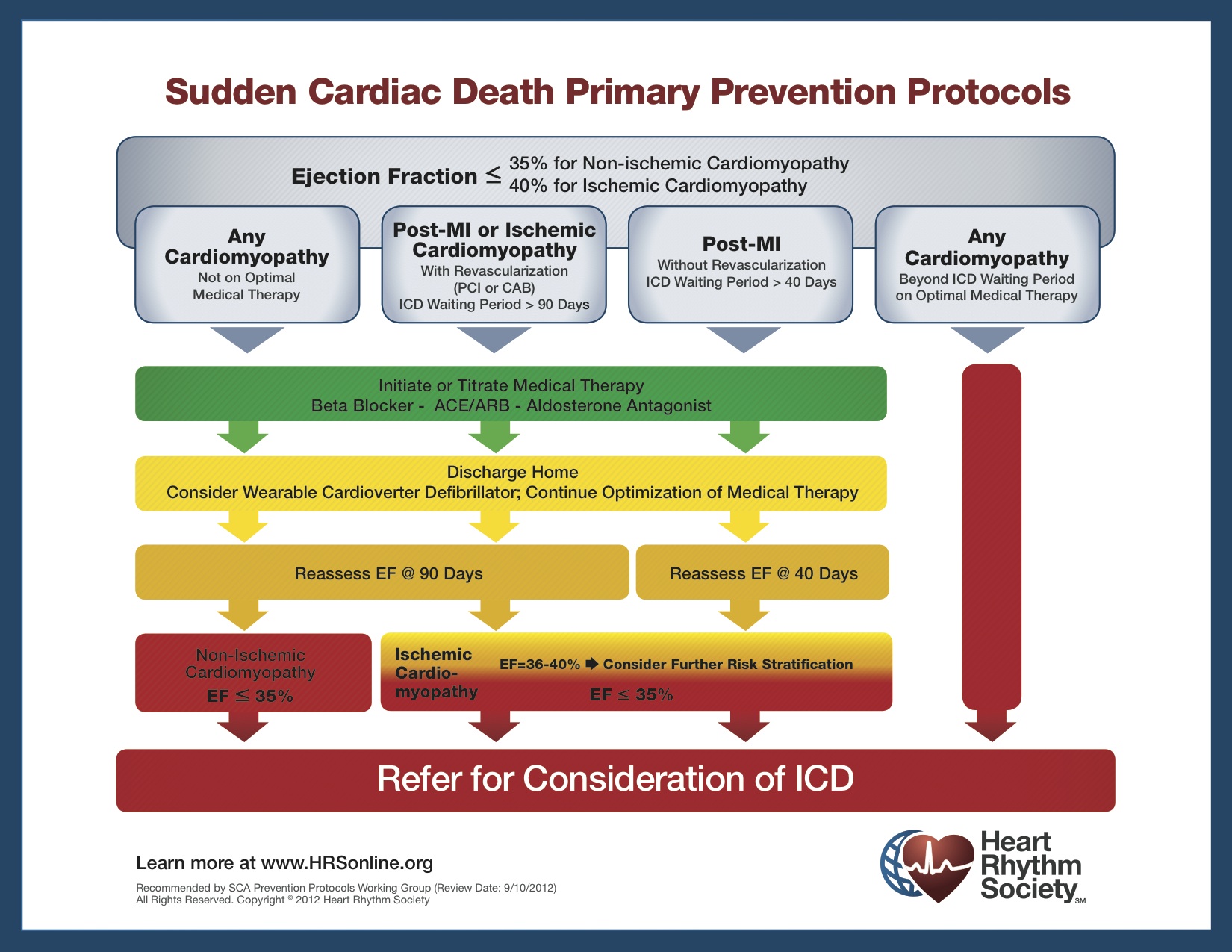
Click to expand
Given the reference to the Heart Rhythm Society (HRS) president, I dutifully went to the HRS website and found the HRS flow-chart protocol for sudden cardiac arrest (shown on the right). The flyer explicitly says to “consider” the wearable cardioverter-defibrillator and bears the HRS logo, along with language saying “recommended by SCA Prevention Protocols Working Group.”
Then I read a related disclaimer about the flow chart on the HRS website. Given the HRS logo on the protocol and the odd language of the disclaimer (which I discuss below), I decided to write to the HRS and describe my confusion and concerns.
MY EMAIL TO THE HRS
I am writing to inquire about the attached protocol for the prevention of sudden cardiac death, bearing the logo of the Heart Rhythm Society in the bottom right corner. The protocol indicates that a wearable cardioverter-defibrillator should be considered for patients who are discharged home and meet the referenced criteria.
I have read the related disclaimer on your website, which mentions the HRS SCA prevention working group that signed off on this protocol. However, there is no information about how this working group was chosen or why its recommendations are being disseminated. Given that a wearable cardioverter-defibrillator is not a guideline-recommended therapy (even though it is FDA-approved), this seems to me a curious element to include in a protocol.
The only wearable defibrillator on the market is the LifeVest, made by the Zoll Medical Corporation. It seems to me that the referencing of this therapy in your published protocol (bearing the HRS logo) is likely to lead many physicians to assume that the HRS endorses this therapy, website disclaimer notwithstanding. In effect, it is an endorsement of the LifeVest product without an adequate evidence base to support the recommendation. The inclusion of the logo on the protocol with an online disclaimer is, in my view, potentially confusing to clinicians like me and those I oversee. Clinicaltrials.gov does refer to 2 ongoing RCTs in this population.
Within a few days, the HRS’s Vice President of Marketing, Communications & Membership replied. I appreciated that the HRS took the time to offer a response, which is reproduced below with their express permission.
THE HRS RESPONSE
Thank you for your inquiry regarding the Sudden Cardiac Arrest (SCA) Primary Prevention Protocol. The document was produced as an educational tool to provide one possible care pathway for general cardiologists, primary care physicians, internists and other non-EP clinicians evaluating patients at risk for sudden cardiac death.
The suggested pathway states that, since the wearable cardioverter defibrillator (WCD) is an FDA released medical device with defined indications, it is a clinical option for consideration by physicians assessing risk for SCA. This pathway should NOT be viewed as a guideline-based recommendation on the part of HRS in support of the use of WCDs. Ultimately, use (or lack of use) of a WCD should be at the discretion of an individual practitioner, based on careful assessment of each patient’s individual risk for SCA by the treating physician.
And that’s all the HRS said. In effect, the HRS never explained to me who the SCA working group was or why an HRS logo appears on educational material that is “recommended” by the working group. I believe that any reasonable person would assume that the flow chart is officially HRS-endorsed, disclaimer or not — especially since the disclaimer is not on the educational flyer itself. So I remain puzzled and wonder if you are, too.
What are your thoughts about the flow-chart SCA protocol, the appropriateness of having the HRS logo on it, and the HRS’s response to Dr. Peled’s inquiry?