
July 21st, 2010
FDA Halts New Enrollment in TIDE
Larry Husten, PHD
The FDA has halted new enrollment in TIDE (Thiazolidinedione Intervention with Vitamin D Evaluation), the controversial Avandia safety study, by placing the study on “partial clinical hold.” Patients already enrolled in the trial will continue to participate. The FDA said in a statement that it had instructed GlaxoSmithKline to “update investigators, institutional review boards (IRBs) and ethics committees involved in the TIDE trial” with information derived from last week’s advisory panel meeting. Responding to the FDA action, GSK issued a statement saying that it would suspend enrollment of patients in TIDE and “will work with the TIDE Steering Committee” to send new safety data and a summary of the panel meeting to TIDE investigators and IRBs.
July 21st, 2010
Thoughts from a First-Year Fellowship Survivor
Shane LaRue, MD
Incoming fellows:
Surely you’ve already been inundated with advice. People have their little tidbits of wisdom that they think you must know as you start your fellowship. Some tidbits are true and useful; others — well, not so much. Unfortunately, it is not always obvious which is which. As one who has just finished his first year of cardiology fellowship, I wanted to share a few thoughts (pile on more advice?) to help make your first year as enjoyable and successful as possible.
- Smile. Relax; you’ve made it to fellowship. Your years of hard work and dedication (not to mention the occasional embellishment of your positive attributes, the feigning of interest when bored, and the buttering-up of people) have paid off in attaining this most important stage of training…. OK, that’s enough patting yourself on the back; it is mid-July already: get to work!
- Ask questions. My only regrets over the last year — when a patient could have done better, when I really got in trouble — occurred because I didn’t ask for help. You are not a cardiologist but a fellow. You will face some things that are beyond you; so, utilize your back-up. If people give you a hard time for asking for help, that demonstrates their flaws, not yours.
- Read. Make a reading program and stick to it. But be realistic. Maintaining a modest goal is much more useful than starting and abandoning a plan that is too aggressive. What to read? I found Mayo Clinic Cardiology: Concise Textbook an easy read and a good overview for topics I did not know well. Similarly, The Echo Manual by Oh and The Complete Guide to ECGs by O’Keefe can get you up to speed.
- Keep an open mind. As at every other stage of training, high-stakes decisions about your career await. You will soon need to determine your focus within cardiology and the setting in which you want to practice. How to decide? Ask your colleagues on staff what they like and dislike in their work life. What gets them out of bed each morning? (Or, why do they have to convince themselves to get out of the car and into work?) Express your interests earnestly, but keep an open mind throughout the year — your interests may evolve, and your eventual career choice may surprise you.
- HAVE FUN!! For most of you, this is your only first year of fellowship. So, enjoy yourself. Have fun at work, but also make time for life outside the hospital.
Ultimately, you have done well to make it to where you are. If you pursue your training as you already have, you will be absolutely fine. (And don’t forget — advice is generally worth what you pay for it!)
Now, let us at CardioExchange know:
First-year fellows, what do you most need, and haven’t yet gotten at your institution? What has surprised you the most?
Fellows who have survived the first year, what additional advice would you give to incoming Fellows?
July 20th, 2010
Avandia Panelist Received Money from GSK
Larry Husten, PHD
One of the voting members of last week’s controversial Avandia panel received speaking fees from GlaxoSmithKline, the manufacturer of Avandia, according to news reports in the Wall Street Journal and Pharmalot. The FDA had previously said that there were no relevant conflicts for any of the 33 voting members of the panel. David Capuzzi, an endocrinologist at Thomas Jefferson University, was paid by GSK to speak about Lovaza, GSK’s omega-3 pill, but said he didn’t believe that the FDA considered this to be a conflict of interest. Capuzzi was one of only three panel members who voted in favor of keeping Avandia (rosiglitazone) on the market with no additional restrictions.
July 20th, 2010
Who Should Treat Advanced HF/Transplant Patients?
Larry Husten, PHD
The ACC, AHA, and several other organizations have released the first Clinical Competence Statement on Management of Patients With Advanced Heart Failure and Cardiac Transplant. “The current statement describes the level of experience, knowledge, and technical skills necessary for competent performance in caring for these complex patients,” write the authors of the report, including the chair of the writing committee, Gary Francis.
July 20th, 2010
We’ve made some big changes…
Larry Husten, PHD
We’ve redesigned CardioExchange based on your participation and feedback! You’ll see a new look and feel, and functionality to make it easier to join the dialogue. New Ways to Connect with the CardioExchange Community The site includes two important new features to help you get the most out of your time on CardioExchange: The Recent Activity feed, and Following.
Follow the conversation When you discover an interesting discussion on a CardioExchange blog post, click “Follow this comment” to ensure that you don’t miss what happens next. New comments will appear in your Recent Activity feed under “Currently Following”. Comment anonymously
Nobody needs another inbox If a CardioExchange member is interested in contacting you, they can do so using the Private Message form in your profile. The message is forwarded to your email, and the member never sees your email address. It is up to you to decide if you want to reply or not. More privacy control
We hope that these features improve your experience with CardioExchange and that you continue to enjoy the content and conversations. We welcome your feedback on the new site, the content, or any other ideas. |
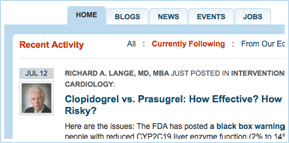 Front and center, the Recent Activity shows you what is happening right now on CardioExchange. Similar to the Newsfeed on Facebook or Network Activity on LinkedIn, Recent Activity is updated in real-time and brings you inside the discussions on CardioExchange as they are unfolding.
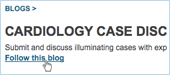 Make the most of your time on CardioExchange by Following blogs and topics that interest you. Simply click the “Follow” links on blogs and topics, then choose “Currently Following” in the Recent Activity stream.
 like making friends on Facebook — it’s more like Following on Twitter. There is no implied relationship — you’re just tuning into content and conversations of interest.
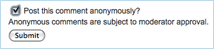 We’ve added the ability to request anonymity when you comment. Unlike named comments, which appear immediately, anonymous comments are forwarded to our editors for moderation.
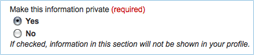 We’ve added more options within your profile to display personal information to the CardioExchange community.
July 16th, 2010
FDA reviewing link between ARBs and cancer
Larry Husten, PHD
Last month a meta-analysis appearing in the Lancet found a modest but statistically significant increase in the risk of cancer associated with the use of angiotensin receptor blockers (ARBs). On Thursday the FDA issued a safety communication and stated that it was conducting a review of ARBs. The FDA said that the review was ongoing and that it has not concluded that ARBs increase the risk of cancer, that it believes at this time the benefits of ARBs still outweigh the risks, and that it recommends that ARBs continue to be used as recommended in their approved labels.