
An ongoing dialogue on HIV/AIDS, infectious diseases,
May 13th, 2015
WHO Guidelines on Naming Diseases Are Well-Meaning, Sensible — But Kind of Boring
 From the World Health Organization (WHO), a recommendation on how to name a new disease:
The best practices state that a disease name should consist of generic descriptive terms, based on the symptoms that the disease causes (e.g. respiratory disease, neurologic syndrome, watery diarrhoea) and more specific descriptive terms when robust information is available on how the disease manifests, who it affects, its severity or seasonality (e.g. progressive, juvenile, severe, winter).
Ok, I get it. If you name a disease — especially an Infectious Disease— after a person, place, or even animal, that name can bring with it all kinds of problems. Tourist travel and trade down. Animals unnecessarily killed. People stigmatized.
We ID doctors are no stranger to this stigma by association, as all of us have faced the incredulous responses from seemingly kind strangers when we tell them what we do for a living.
“Well, someone has to do it,” they might say, as if we spend all our time putting ourselves in harm’s way of numerous nasty contagions. Bet they never say that to an ophthalmologist or radiologist.
So yes, there is stigma associated with infections of all sorts, and we have to be sensitive to that.
Not surprisingly, some have already criticized WHO that they are just practicing a particularly overzealous form of political correctness.
I’m not sure I’d go that far.
But think of what will be lost if and when these WHO guidelines are adopted: many of the current disease names designate something meaningful about epidemiology — MERS, for example, stands for Middle East Respiratory Syndrome, which quite accurately describes a disease that for now is overwhelmingly occurring in the Middle East. MERS may one day pull a West Nile Virus on us and become global. But even the West Nile Virus name, while no longer strictly correct, reminds us that the disease was first recognized in a particular region of Africa. Is that so terrible?
Plus, the English major in me can’t help but find a good story, or even poetry, in many of these inappropriately named diseases or organisms. For example:
- Lyme Disease. My friend Howard Heller, an expert in tick-related infections, says that Lyme was actually discovered in Old Lyme, Connecticut, and not Lyme itself — but it would have been too confusing to call it “Old Lyme Disease”, which would imply there’s also a “New Lyme Disease” out there. How fascinating! And while Lyme is a big problem in all of New England, I don’t see the name of this disease keeping down property values in southern Connecticut one bit.
- Powassan virus. Let’s stay with the ticks for a moment. Named after the region in Canada where it was first described, Powassan is the latest scary thing transmitted from our tick enemies. Here’s a little TV clip on Powassan from our local news station, where the interviewer energetically tries to drum up drama despite my efforts to make it clear that severe forms of Powassan are (fortunately) pretty rare so far. What if it were called “summer tick encephalitis (sometimes) virus beta”? Compared with Powassan — abbreviated POW! — that “generic” name sounds pretty blah, and am sure the networks would agree.
- Listeria monocytogenes. The bacterium that medical students love to love, listeria was named in honor of the pioneer of sterile surgery, Joseph Lister. How can we take that away from him? And I’m sure you could find many ID doctors gladly donating their name in honor of some interesting virus, bacteria, fungus, or parasite. Sign me up! The closest thing I have is this diabetes drug. And this weight loss one. Should have been an endocrinologist, could use the royalties.
- Rocky Mountain Spotted Fever. Back to the ticks. This one just sounds great, almost a line of pure poetry by itself — read it out loud for proof. Never mind the fact that the disease isn’t very common in the Rocky Mountains (peak incidence is in the southeastern states). Still, I ask you — how could we ever call infection with Rickettsia rickettsii anything else? It also gives us ID doctors a trick question to ask people at parties, where we are highly desired guests. Specifically, “Where is a person most likely to get Rocky Mountain Spotted Fever?” [Answer: North Carolina] is the converse of “What color was George Washington’s white horse?” [Answer: White].
- Iodamoeba bütschlii. When he read that Haemophilus aphrophilus had (sadly) changed its name, Joel Gallant sent me an email: “Tell me it isn’t true! I love saying ‘Haemophilus aphrophilus’ as much saying ‘Iodamoeba bütschlii,’ ‘Orientia tsutsugamushi,’ or ‘o’nyong’nyong fever’!” So who is our little friend with the umlaut? A non-pathogenic protozoan, Iodamoeba bütschlii was named after German biologist Otto Butschli by Stanislaus von Prowazek — who later had the cause of epidemic typhus named after him — Rickettsia prowazekii! Analogous to authors who review each other’s books, these biologists simply named organisms after each other, increasing their fame and fortune. You must agree it’s an impressive name for a parasite that doesn’t actually cause any disease.
Importantly, the WHO states that their guidelines apply to future diseases, so we won’t lose any of the above gems — or St. Louis Encephalitis, or Legionnaire’s Disease, or Kew Gardens Spotted Fever, or Pott’s Puffy Tumor. Or Coxackievirus. Or Mad Cow.
And somewhat grudgingly, I agree with Dr. Dr. Keiji Fukuda, assistant director general for health security at the WHO, that a boring name is better than one that stigmatizes people, diminishes trade or tourism, or leads to the unnecessary slaughter of thousands of animals. In defence of the charge that the policy is just political correctness run amuck, he gives an eloquent defence here in this NPR interview.
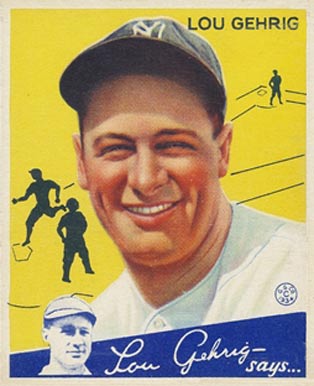
But I disagree with him about one thing — a few minutes into the interview, he says “we now live in an era where probably very few people are going to know who Lou Gehrig is.”
Now that is simply untrue.
Gets me every time.
9 Responses to “WHO Guidelines on Naming Diseases Are Well-Meaning, Sensible — But Kind of Boring”

Paul E. Sax, MD
Associate Editor
NEJM Clinician
Biography | Disclosures & Summaries
Learn more about HIV and ID Observations.
I totally agree with you! Even my kids know who Lou Gehrig is!
You did not wade into the Hansen’s Disease vs. LEPROSY though. There’s the ultimate stigmatization. How about Chikungunya (?sp) — there’s a fun one to say, and it’s almost unforgetable, even though I’m unsure of the correct spelling. And yes, I would be honored to have an infectious agent named after me, if I were smart enough to find one!
I also agree. I wonder for whom is the WHO concerned. Who will use the name? The medical community? The members of the Jane and John Doe family? Might we not take a lesson from botanical taxonomists who seem to have no problem with the presence of both common names and orthodox Linnaean classifications. Personally I find it difficult to remember that Kalmia latifolia is Mountain Laurel, having learned that Linnaeus honored Peter Kalm by naming Kalm’s discovery here in the New World after him. How many of us remember that the E. in E. Coli is for Theodor Escherich or even need to?
As far as explaining what you do to non-medical people, try being a Pathologist. I gave up years ago trying to explain to my clinical colleagues that I really do interact with living beings as well as having a reason for being in the Hospital on weekends.
Libby, you may not have a pathogen named after you (yet – didn’t some baseball great say ‘it aint’ over til it’s over’? (Paul, you can answer that one) – but you still have my favorite quote of all time. Upon entering the OR late at night while on ID consult service after being consulted for “what should we send these OR specimens for?” you announced proudly “The Transport Attending is here.” Gold. Pure Comedy Gold. You’re my hero.
if we apply this to wars, we are going to have to rename the War of Jenkins’ Ear.
I admit I found myself shaking my head and saying, “What the…” when I read the WHO recommendation. It wasn’t clear to me how many of the examples they gave were particularly stigmatizing. But we do have to remember that AIDS was once called GRID: http://www.nytimes.com/1982/05/11/science/new-homosexual-disorder-worries-health-officials.html Wow, reading that article from 1982 made me cringe, not only because of how the disease was being described, but also knowing what lay ahead for so many who would be infected with HIV.
Dr. Sax: You would be a highly desired guest at any party in St. Louis, where we have recovered quite completely from the encephalitis!!
I agree with Dr. Sax. I would love to know if WHO provided any examples of people or places that stated they were stigmatized by having a disease named after them. Here in Northwest Ohio I like to ask medical students if they know the derivation of Norovirus (formerly Norwalk virus). I also asked this once at a national meeting where the first response was Norwark, Connecticut. Sorry, it’s Norwalk Ohio which is locasted just south of Sandusky, Ohio and Cedar Point Amusement Park.
I also agree with Dr.Sax. But what about a notorius Turkish Professor, naming ordinary Influenzae Infections as; Istanbul Bronchitis, without any scientific proof or reason!
There should be some limitations.
And by the way, why do we call; “Mongolism” as Down Syndrom?? Is it because, some people think, as if; Mongolians are more inferior people, compared to Europians?? Isn’t it racism??
Lucky for the Bourbon Virus it came in just under the wire:
http://www.cdc.gov/ncezid/dvbd/bourbon/index.html